
![₹5,000 SIP for 10, 15, 20, 25 Years: Exact Returns at 10%, 12%, 15% [2026] - TeenBucks](https://teenbucks.in/wp-content/uploads/2026/09/5000_sip_investment_returns_featured-1024x572.jpg?v=clean2026)
📊 Key Milestones of a ₹5,000 Monthly SIP
- 10-Year Mark: Invested ₹6,00,000 → Corpus = ₹11,61,695 (Compounding returns almost match total deposited capital).
- 15-Year Mark: Invested ₹9,00,000 → Corpus = ₹25,04,580 (Compounded profits account for 64% of your total wealth).
- 20-Year Mark: Invested ₹12,00,000 → Corpus = ₹49,95,740 (~₹50 Lakh) (Total wealth quadruples your principal).
- The 10% Step-Up Edge: Adding just 10% each year turns ₹25 Lakh at Year 15 into ₹37.69 Lakh (+₹12.64 Lakh in extra wealth!).
For college students, freelancers, and first-job earners in India, committing ₹5,000 every month might feel like a stretch—or it might seem too modest to make a noticeable difference in life. However, when combined with the relentless mathematics of compound interest and systematic rupee-cost averaging, ₹5,000 per month is one of the most potent wealth engines in personal finance.
Whether you are saving for a higher-education MBA fund, planning your first home down payment, or laying the foundation for financial independence before age 40, here is the exact year-by-year financial breakdown of what a ₹5,000 monthly SIP delivers across 5, 10, 15, 20, 25, and 30 years.
Simulate Your ₹5,000 SIP Wealth Horizon Live
Curious what your portfolio looks like with a 10% annual salary step-up? Try our step-up SIP calculator with inflation for beginners to run custom year-by-year simulations, test different deposit levels, and see post-tax returns under current LTCG rules.
The Master Table: ₹5,000 SIP Returns Across 10%, 12%, and 15% CAGR
Mutual fund returns are not fixed like bank deposits; they depend on the category of fund you select. Conservative debt/hybrid funds typically deliver 8% to 10%, broad-market large-cap index funds (like the Nifty 50) have historically delivered approximately 12% to 13%, and aggressive mid-cap/small-cap funds can deliver 14% to 16% over rolling 10-year windows according to historical data from AMFI.
The table below compares the total invested principal against estimated maturity wealth across these realistic return rates from 5 years to 30 years:
| Time Horizon | Total Invested (₹) | Corpus @ 10% CAGR | Corpus @ 12% CAGR | Corpus @ 15% CAGR |
|---|---|---|---|---|
| 5 Years | ₹3,00,000 | ₹3,90,412 | ₹4,12,432 | ₹4,48,408 |
| 10 Years | ₹6,00,000 | ₹10,32,760 | ₹11,61,695 | ₹13,93,286 |
| 15 Years | ₹9,00,000 | ₹20,89,642 | ₹25,04,580 | ₹33,84,315 |
| 20 Years | ₹12,00,000 | ₹37,96,844 | ₹49,95,740 (~₹50 Lakh) | ₹75,79,775 |
| 25 Years | ₹15,00,000 | ₹66,89,451 | ₹94,78,781 | ₹1,64,19,417 (~₹1.64 Cr) |
| 30 Years | ₹18,00,000 | ₹1,13,96,627 | ₹1,74,74,821 (~₹1.75 Cr) | ₹3,50,49,102 (~₹3.50 Cr!) |
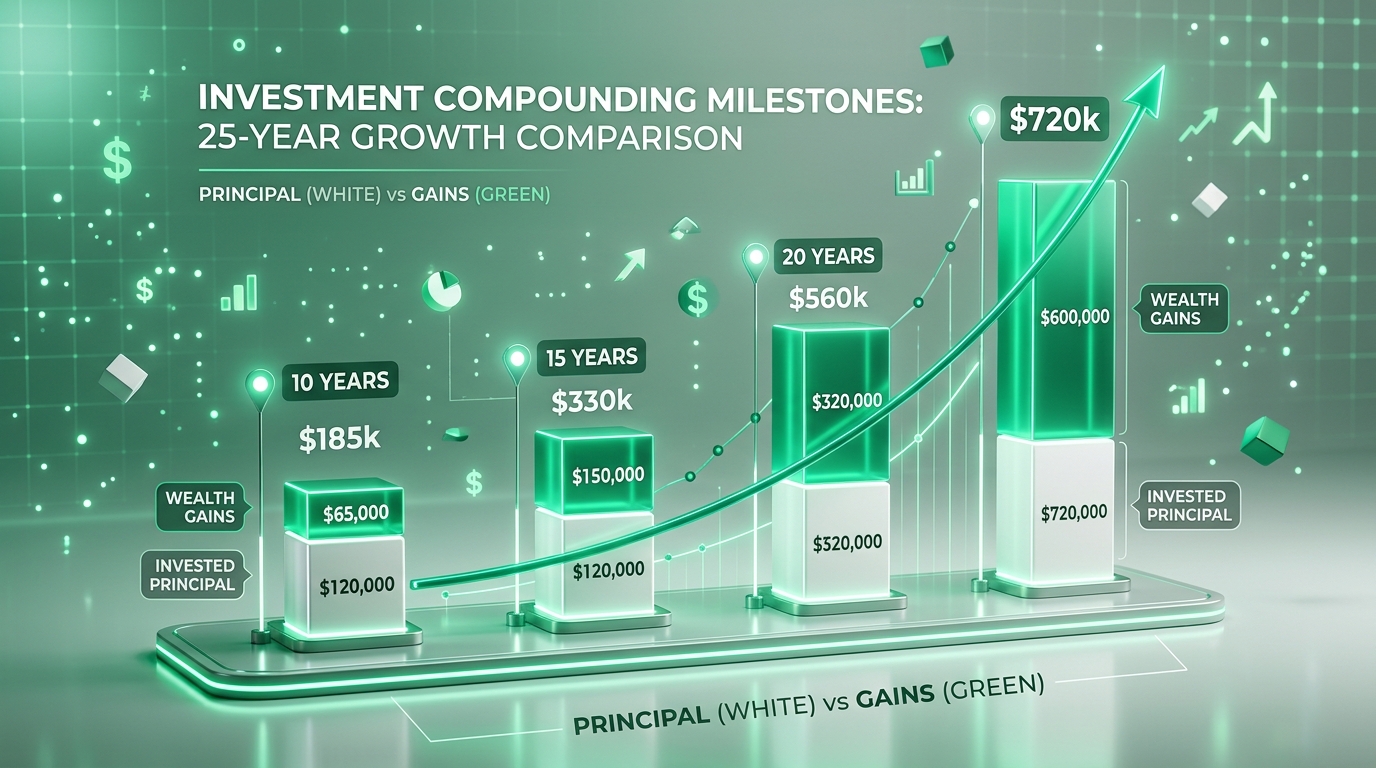
TeenBucks Guide: Notice how gains eclipse deposited principal after year 7 and dominate total corpus
Deep Dive: What Happens to ₹5,000 SIP in 10 Years?
In the first 3 years of an SIP, you might feel disappointed. After investing ₹5,000 for 36 months (₹1,80,000), your portfolio will stand at roughly ₹2,17,000 at 12% returns. A ₹37,000 gain after three years doesn’t feel life-changing.
However, by Year 7, the compounding flywheel begins to take over. Here is the exact milestone breakdown at the 10-year mark:
- Your Pocket Contribution: ₹5,000 × 120 months = ₹6,00,000
- Total Compounded Portfolio: ₹11,61,695
- Pure Wealth Generated: ₹5,61,695 (a 93.6% return on invested capital)
At this stage, your annual mutual fund returns (₹1.3 Lakh+/year) start generating more income than your entire annual investment (₹60,000/year). Your money has officially begun working harder than you do.
The 10% Step-Up Superpower: Turn ₹25 Lakh into ₹37.6 Lakh
Keeping your SIP flat at ₹5,000 for 15 years assumes that your income will remain frozen in time. As you progress from an entry-level salary to mid-senior positions, your savings capacity will naturally expand.
By enabling an automatic 10% Annual Step-Up (Top-Up), your monthly deposit increases by ₹500 in Year 2 (₹5,500/mo), ₹550 in Year 3 (₹6,050/mo), and so forth.

TeenBucks Guide: Stepping up your SIP by just 10% annually creates an additional ₹12.64 Lakh in wealth
Look at the dramatic difference over 15 years at 12% CAGR:
- Flat ₹5,000 SIP: Invested ₹9,00,000 → Corpus = ₹25.05 Lakh
- 10% Step-Up SIP: Invested ₹19,06,340 → Corpus = ₹37.69 Lakh
- The Step-Up Advantage: +₹12.64 Lakh in additional wealth (+50.4%)!
The Inflation Reality: Real Purchasing Power of Your Future Wealth
Nominal wealth figures can create an illusion of future luxury. In India, long-term consumer price inflation (CPI) averages around 6.0% per annum according to historical data from the Reserve Bank of India (RBI).
Here is what your ₹5,000 SIP corpus will realistically buy in today’s purchasing power terms:
| Horizon | Future Corpus @ 12% | Inflation Discount Factor (6%) | Purchasing Power in Today’s Money |
|---|---|---|---|
| 10 Years | ₹11,61,695 | 1.79x | ₹6,48,990 |
| 15 Years | ₹25,04,580 | 2.40x | ₹10,43,575 |
| 20 Years | ₹49,95,740 | 3.21x | ₹15,56,305 |
| 25 Years | ₹94,78,781 | 4.29x | ₹22,09,500 |
This proves why a static ₹5,000/month SIP should be upgraded over time. By stepping up your monthly contribution by 10% annually, your 20-year wealth climbs to over ₹84 Lakh, preserving substantial real-world purchasing power.
The Ideal 3-Fund Student Portfolio for a ₹5,000 Monthly SIP
Do not invest all ₹5,000 in a single mutual fund scheme. Diversifying across large, flexi, and mid-cap categories under SEBI guidelines gives you stability alongside aggressive alpha:
- ₹2,500/mo (50%) in Nifty 50 Index Fund (Direct – Growth): Low-cost bedrock (UTI Nifty 50 or Navi Nifty 50). Expense ratio under 0.10%. Expected return: 12%.
- ₹1,500/mo (30%) in Flexi-Cap Fund (Direct – Growth): e.g., Parag Parikh Flexi Cap Fund. Unrestricted mandate across Indian and international equities. Expected return: 14% to 15%.
- ₹1,000/mo (20%) in Mid-Cap Fund (Direct – Growth): e.g., HDFC Mid-Cap Opportunities or Nippon India Growth Fund. High volatility in short terms, massive outperformance over 10+ years. Expected return: 16%+.

TeenBucks Guide: Starting with ₹5,000 at age 20 sets you decades ahead of peers who wait until their 30s
The Retirement Bridge: Converting ₹50 Lakh into Monthly Cashflow via SWP
When your ₹5,000 SIP reaches ₹50 Lakh (after 20 years) or ₹1 Crore (after 25 years), you transition from wealth accumulation to wealth distribution.
Using a Systematic Withdrawal Plan (SWP):
- From a ₹50,00,000 corpus, a safe 7% annual withdrawal provides ₹29,166 per month in tax-efficient cash flow.
- From a ₹1,00,00,000 corpus, you can withdraw ₹58,333 to ₹65,000 per month without ever touching your base capital if the underlying hybrid fund generates 8% to 10% returns.
Calculate your exact monthly withdrawal roadmap on our free TeenBucks SWP Calculator.
Taxation Breakdown: How Much Tax Will You Pay on ₹5,000 SIP?
Under the latest Budget 2024-25 and 2026 rules (Section 112A of the Income Tax Act), equity mutual fund gains are taxed as follows:
- Long-Term Capital Gains (LTCG): Applies to units held for longer than 12 months. Gains up to ₹1.25 Lakh per financial year are 100% tax-free. Any gains exceeding ₹1.25 Lakh are taxed at 12.5%.
- Short-Term Capital Gains (STCG): Units redeemed before 12 months are taxed at a flat 20%.
- The FIFO Rule: In an SIP, each individual monthly instalment is treated as a separate purchase. When you redeem, the oldest units are sold first (First-In, First-Out).
Tax Example on 10-Year ₹5,000 SIP: Out of your ₹5.61 Lakh total profit, if you withdraw your entire corpus in one go, ₹1.25 Lakh is tax-exempt. You pay 12.5% tax on the remaining ₹4.36 Lakh, which comes to approximately ₹54,500. Your net in-hand wealth is still over ₹11,07,000!
Authoritative Data & Industry Citations
Data published by the Association of Mutual Funds in India (AMFI) indicates that systematic investment plan inflows in India crossed an all-time record of ₹23,500+ Crore per month, reflecting massive retail investor confidence. Furthermore, a 20-year rolling return study by SEBI proved that equity mutual funds held for 10 years or longer had an astonishing 0% probability of delivering negative returns across any historical decade.
To ensure your returns aren’t eroded by hidden account fees, make sure you choose the right brokerage. Read our exhaustive breakdown on the Best Zero-Fee Demat Accounts for College Students in India (Groww vs Zerodha Hidden AMC Exposed).
Frequently Asked Questions About ₹5,000 Monthly SIP
What is the expected maturity amount of ₹5,000 SIP for 10 years?
At a standard 12% expected annual return, a ₹5,000 monthly SIP for 10 years accumulates to approximately ₹11,61,695 against a total invested principal of ₹6,00,000. At a conservative 10% CAGR, the corpus is ₹10,32,760, while an aggressive 15% CAGR yields ₹13,93,286.
Which mutual fund scheme is best for a ₹5,000 monthly SIP?
For most young investors, a split strategy works best: allocate ₹2,500 in a low-cost Nifty 50 Index Fund (such as UTI or HDFC Nifty 50 Index), ₹1,500 in a diversified Flexi-Cap Fund (such as Parag Parikh Flexi Cap), and ₹1,000 in an active Mid-Cap Fund. Always select the Direct – Growth plan to save up to 1.5% in recurring distributor commissions.
Can I stop or pause my ₹5,000 SIP if I face a financial emergency?
Yes. Mutual fund SIPs are completely flexible. You can pause your SIP for 1 to 3 months directly inside your investment app (Groww, Zerodha Coin, etc.) without paying any penalty. Never let an auto-debit bounce through a bank NACH mandate, as banks levy ₹250 to ₹500 in return fees; instead, always set up your SIP via UPI Auto-Pay.

![15-15-15 Rule in SIP Explained: How Students Can Build ₹1 Crore [2026] - TeenBucks](https://teenbucks.in/wp-content/uploads/2026/09/15_15_15_rule_sip_crore_featured-300x167.jpg?v=clean2026)