
Your first salary arrives. For a few minutes, it feels like the hard part is over.
Then you look at the education-loan balance. Someone tells you to close it as quickly as possible. Someone else says you are wasting your twenties if you do not start investing immediately.
I would start with a smaller question: how much money can you actually spare after this month’s commitments? That number matters more than a confident return prediction in a reel.
This guide is for Indian students earning on the side and graduates starting their first job. We will use one transparent loan example, compare the choices fairly, and give you a way to decide without pretending your salary or the stock market will behave perfectly.
What does “repay the loan or start a SIP” really mean?
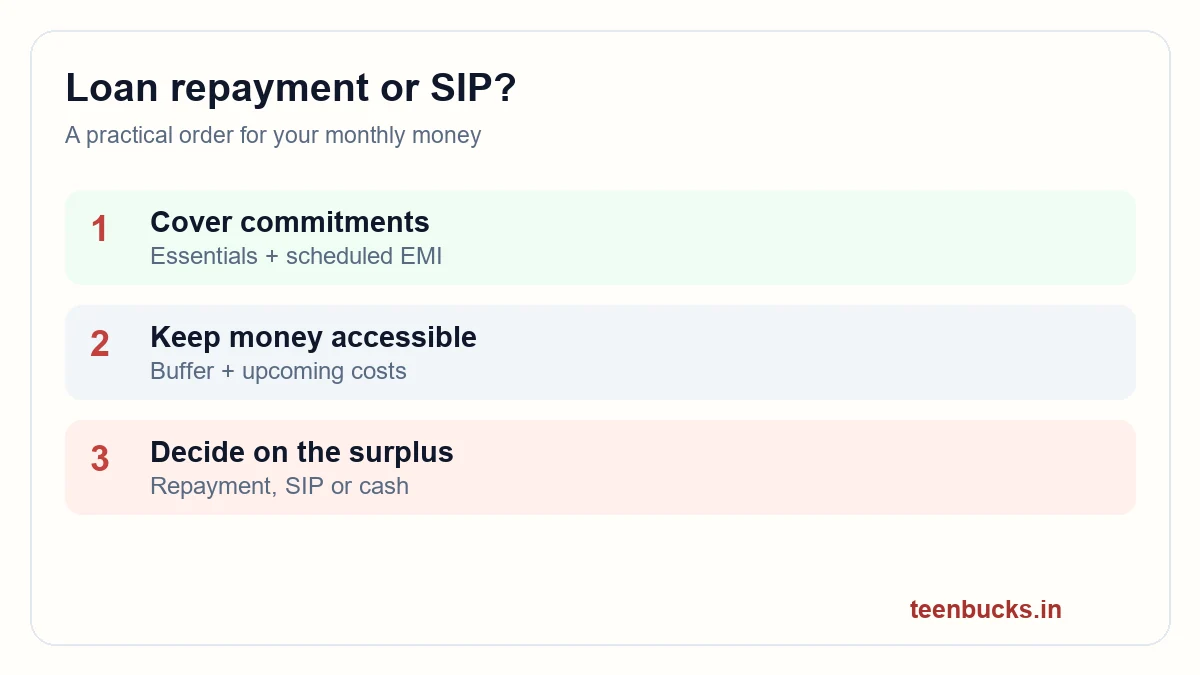
You must still pay the scheduled EMI. The choice is what to do with money left after that payment and your essential costs: make an extra loan payment, invest it regularly, keep it accessible, or divide it between those purposes.
A SIP is a facility for investing at regular intervals in a mutual fund. It is not a separate asset with a fixed interest rate. SBI Mutual Fund’s SIP guide explains the facility and notes that minimum amounts depend on the scheme.
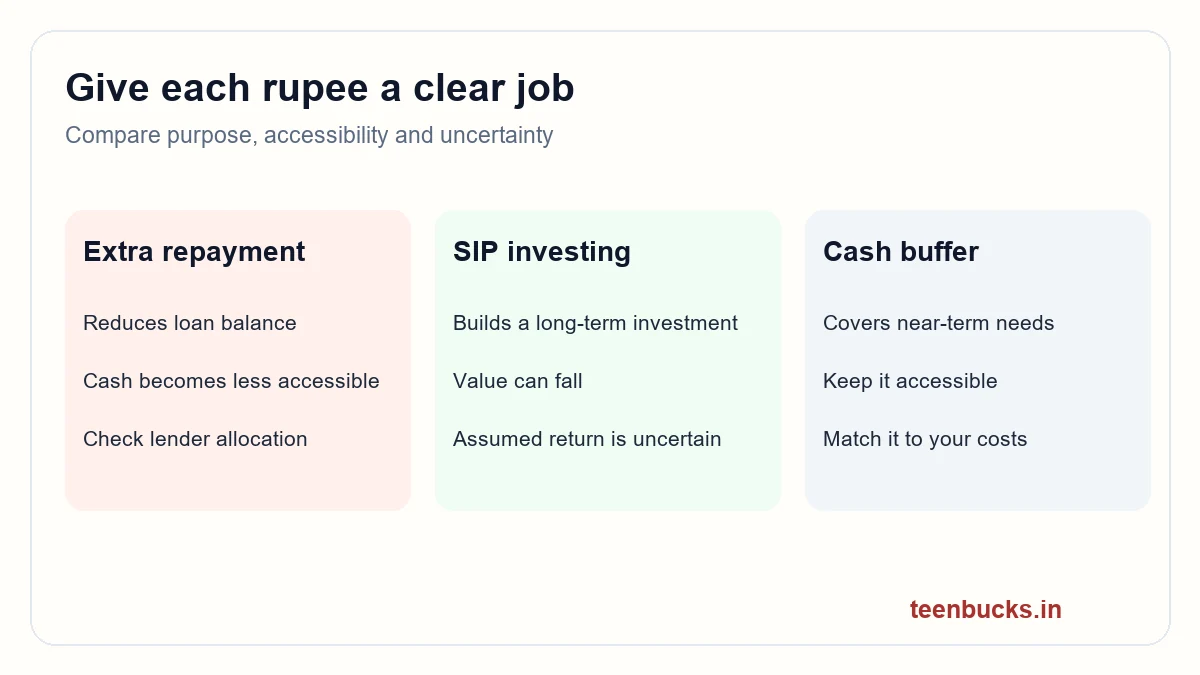
Prepayment reduces the amount you owe when the lender applies it to principal. A SIP builds an investment whose value can rise or fall. Both can be useful. They solve different parts of your financial life.
First check whether the “extra money” is really extra
Suppose your take-home pay is ₹30,000. Rent, food, transport and other essential bills cost ₹15,000. Your EMI is ₹10,624. That leaves roughly ₹4,376 before upcoming costs and unexpected expenses.
If a ₹2,000 SIP makes you reach for pay-later credit when your phone needs repairing, the investment is too large for your present cash flow. You do not need to turn every spare rupee into an investment this month.
Write down the expenses due before your next salary, including annual or occasional costs. Keep a buffer you can access without selling a volatile investment. Its size should reflect your income stability, family support and responsibilities. Start with an achievable amount rather than abandoning the idea because a large target feels impossible.
For irregular freelance income, plan against a conservative month. A good month does not make a larger EMI or SIP affordable every month. Our student budgeting guide can help you separate essentials from genuine surplus.
A ₹5 lakh education loan: what does ₹2,000 extra change?
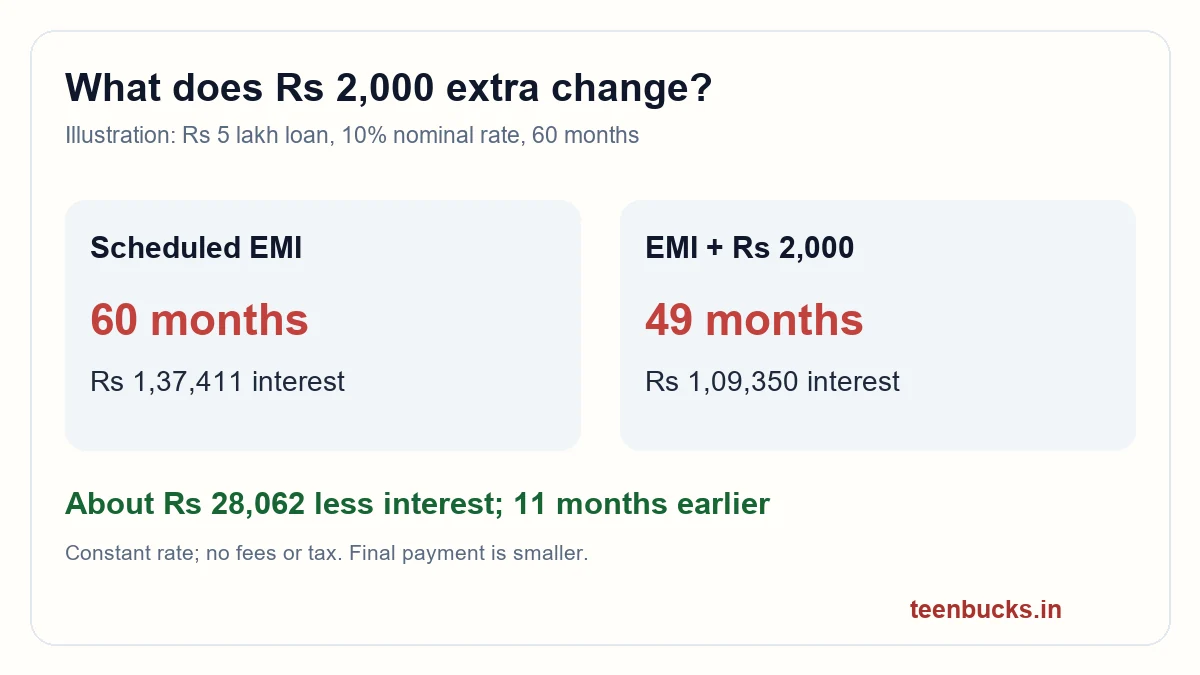
Here is a worked example, not a bank offer. Assume the balance at the start of repayment is ₹5,00,000, the nominal annual reducing-balance rate stays at 10%, and 60 monthly payments remain. No fees, rate changes, arrears or tax benefits are included.
| Option | Monthly payment | Months to repay | Total interest |
|---|---|---|---|
| Scheduled EMI only | ₹10,624 | 60 | ₹1,37,411 |
| EMI plus ₹2,000 | ₹12,624 | 49 | ₹1,09,350 |
In this model, the extra payment saves about ₹28,062 in interest and finishes repayment 11 months earlier. The base EMI is kept unchanged. A lender could instead reduce your EMI, so ask how it will apply the payment.
Try your own outstanding balance, rate and remaining tenure in the loan EMI and prepayment calculator. Use the repayment balance, not an old sanctioned limit.
Still in college? Check the moratorium balance first
A repayment holiday does not automatically mean an interest holiday. SBI’s education-loan FAQ says outstanding moratorium interest is added when repayment begins. The balance can therefore differ from the amount originally borrowed.
Ask your lender about the interest accrued, any interest already paid and any subsidy applicable to your account. Loans disbursed in stages need a different calculation from money fully disbursed on day one. Do not assume another student’s balance tells you what yours will be.
What if the same ₹2,000 goes into a SIP?
Over five years, ₹2,000 a month means contributions of ₹1,20,000. With beginning-of-month payments and the assumed annual rate divided by 12, the model gives roughly ₹1,40,238 at 6%, or ₹1,56,165 at 10%. At zero growth, it gives ₹1,20,000. These figures are before tax and any applicable loads.
Those rates are scenarios, not expectations for a particular fund. AMFI’s risk guidance says mutual funds are not assured-return products and investors can lose principal. A SIP does not remove that risk.
To model custom contribution amounts and inflation-adjusted scenarios, try our step-up SIP calculator. You can simulate monthly investments starting from ₹500 upwards, incorporate annual salary increments, and test your wealth creation timeline.
Why ₹28,062 saved and ₹36,165 gained are not a fair final comparison
It is tempting to subtract those two figures and declare a winner. That leaves out important cash flows.
In the prepayment example, the loan ends in month 49. The scheduled payment is then freed for the remaining months. In the SIP example, the borrower continues making the original EMI until month 60 while keeping the investment. A proper comparison must include what happens to the freed payment, the same total budget, taxes and investment risk.
The examples show how each mechanism works. They do not prove that either choice creates the highest future net worth.
When does extra repayment deserve more attention?
- Your loan cost is uncomfortable. Check the rate on your statement and any charges, rather than a generic rate you saw online.
- Your income may drop. Clearing debt sooner can reduce future commitments, although locking all cash into repayment may leave you short today.
- You have expensive short-term debt too. List all obligations before automatically prioritising the education loan.
- You want less debt pressure. Peace of mind is a legitimate consideration, provided the plan still leaves money for essentials.
Before transferring extra money, ask whether it reduces principal immediately, whether there is a charge, and whether the lender will shorten tenure or reduce EMI. SBI’s cited FAQ says it does not charge a prepayment penalty for the loans described there; confirm your own lender’s current terms.
When can a small SIP alongside the EMI make sense?
A modest SIP may fit if the EMI is manageable, income is reasonably stable, a cash buffer is in place and the goal is far enough away to tolerate losses and delays. That does not mean you must keep debt to “beat the bank.” An investment return is uncertain.
Splitting surplus is an option, not a compulsory ratio. If ₹2,000 is genuinely available, someone might choose ₹1,500 extra repayment and ₹500 investing. Another person might keep the full ₹2,000 accessible until their job situation is clearer. These are examples, not recommended allocations.
If you qualify for a tax benefit on education-loan interest, check what you can actually claim under current law and your tax position. An assumed tax saving is not money already received, and paying interest solely to obtain a deduction still costs money.
Can an SWP pay the EMI for you?
An SWP regularly redeems units from an investment. Its payment can include your own capital, so receiving cash every month does not mean the investment earned that amount.
If you already have a corpus, the SWP calculator can model withdrawals and depletion under different assumptions. It cannot guarantee the money will last. Do not borrow to create a corpus simply because a calculator shows an appealing spread between an assumed return and your loan rate.
Ask your lender these five questions
- What is my current outstanding repayment balance and interest rate?
- Has all applicable moratorium interest or subsidy been reflected?
- What charges or restrictions apply to a partial prepayment on my loan?
- Will this payment reduce tenure, EMI, or future instalments in another way?
- Can you provide the revised repayment schedule after the payment?
You can say: “I can afford an extra ₹2,000 this month. Please confirm how it will be allocated, any charges, and the effect on my remaining tenure before I make the payment.” Save the response and check the next statement.
A decision you can make this weekend
Write down your actual loan figures, essential costs and upcoming bills. Find a realistic surplus. Run the loan calculator once without extra payments and once with an amount you can sustain. Then try our step-up SIP calculator with inflation for beginners across multiple return assumptions.
Choose a plan you can follow for the next three months, and review it when your income or loan rate changes. You do not need a perfect prediction to make a sensible next move. You need a budget that still works when the month is ordinary.
Frequently asked questions
Should I close my education loan before starting any SIP?
Not necessarily. The decision depends on loan cost, cash reserves, income stability, goals and risk. Pay the EMI and protect essential costs first. A small SIP alongside repayment is one option, not a universal requirement.
Is prepaying a 10% loan the same as earning a guaranteed 10%?
It reduces future interest under the loan’s terms, but it is not a liquid investment paying you 10%. The exact benefit depends on payment timing, changing rates, charges and tax eligibility. Compare actual cash flows.
Can I use an equity SIP for next year’s college fees?
Be careful with money needed on a fixed near-term date. Equity values can fall when you need to withdraw. Match the risk and accessibility of the product to the deadline.
Will making an extra payment automatically improve my credit score?
No score increase is guaranteed. Keep repayments on time, check the lender’s reporting and avoid taking unnecessary debt merely to pursue a score.
Sources and calculation notes
- SBI education-loan FAQ: repayment, moratorium balance and its stated prepayment policy.
- SBI Mutual Fund SIP guide: recurring investment facility and scheme-specific minimums.
- AMFI risk factors: investment uncertainty and possible loss of principal.
Sources reviewed 3 October 2026. The loan example uses monthly reducing-balance interest and fixed rates. The SIP example uses beginning-of-month contributions and the assumed annual rate divided by 12. Figures are independently calculated illustrations, not lender quotes or fund forecasts. This article provides general financial education.