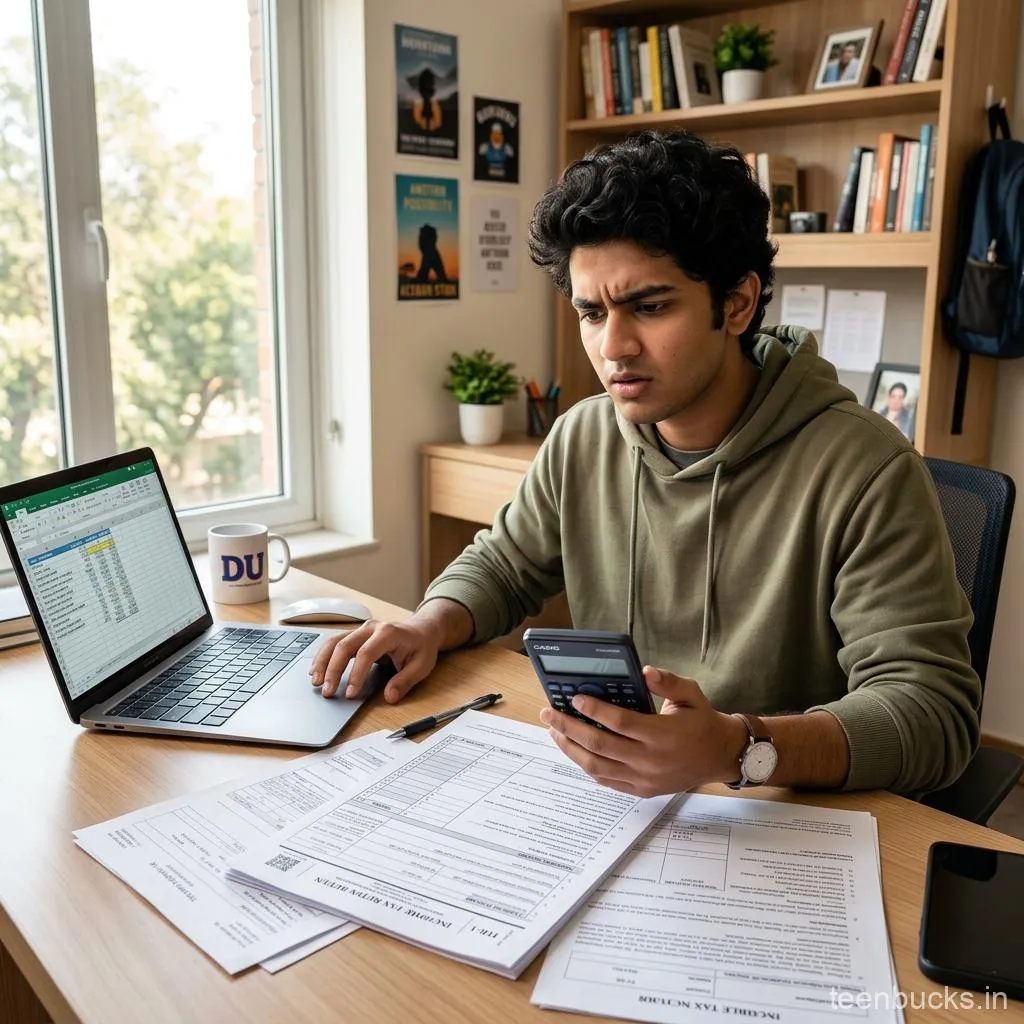
Written by someone who still remembers the exact panic of seeing “Profits and Gains of Business or Profession” for the first time and thinking I needed an MBA to understand it.

Opening Story
Like most students in India, I used to check my father’s expression when the ITR deadline approached. That was my entire tax literacy education.
I am not exaggerating. Every July, my father would sit at the dining table with a stack of papers, a calculator, and a face that said he would rather be anywhere else. He would mutter about “Section 80C” and “Form 16” and “TDS mismatch.” I would nod and go back to my phone. Taxes were an adult problem. I was a student. Students do not file ITR. Right?
Then I earned ₹18,000 from content writing in my third year. A client in the US paid me via Wise. Another Indian client deducted 10% TDS under Section 194J. I had no Form 16. No salary slip. No HR department to handle it. And I realised — with the cold clarity of a UPI notification at 2 AM — that I was now the adult. The tax problem was mine.
Here is what actually changed. I spent three days panicking. I called a CA. He quoted ₹3,500 for filing. That was 19% of my annual freelance income. I hung up. I opened the Income Tax e-filing portal. I read the instructions. I filed ITR-4 under Section 44ADA in 28 minutes. My tax payable: zero. My TDS refund: ₹1,800. The CA fee I saved: ₹3,500.
That is the entire story. The system looks intimidating. It is not. Not for a student earning ₹15,000–₹50,000 from freelancing. Not when you know which buttons to press.
📌 Key Takeaways
- Students with freelance income file ITR using ITR-4, not ITR-1. Freelance income is “Profits and Gains of Business or Profession,” not salary.
- Section 44ADA lets you declare 50% of gross receipts as taxable income — no bookkeeping, no audit, no CA required.
- Income up to ₹4 lakh is tax-free. Under the new regime, the Section 87A rebate makes tax zero up to ₹12 lakh taxable income.
- The deadline for students filing ITR-4 (non-audit) is 31 August 2026 for AY 2026-27 — one month later than salaried filers.
- Filing ITR builds your financial record for loans, visas, and future proof of income — even if your tax is zero.

Quick Summary
- File ITR using ITR-4 if your freelance receipts are under ₹50 lakh (₹75 lakh if 95% digital).
- Section 44ADA presumptive taxation: 50% of receipts = taxable income. The rest is “presumed expenses.”
- New regime tax slabs: zero tax up to ₹4 lakh; 5% on ₹4–8 lakh; 10% on ₹8–12 lakh. Section 87A rebate = zero tax up to ₹12 lakh taxable income.
- TDS deducted by clients (10% under Section 194J) is claimable as credit. Most students get a refund.
- The e-filing portal pre-fills your PAN, bank details, and TDS data. You just verify and submit.
Why Most Students with Freelance Income Never File ITR — And Why That Is a Mistake
Why this happens
You earned ₹12,000 from Fiverr. ₹8,000 from tutoring. ₹5,000 from Meesho. Total: ₹25,000. You think: “That is pocket money. I do not need to file taxes.”
You are wrong. Not because the taxman is coming for your ₹25,000. But because not filing creates three invisible problems that only show up later.
Problem 1 — You lose your TDS refund
Indian clients who paid you more than ₹50,000 in a year deducted 10% TDS under Section 194J. That is ₹2,500 on ₹25,000. If you do not file ITR, that money stays with the government. Forever.
Problem 2 — No income proof for loans or visas
Banks want 2–3 years of ITR for education loans, personal loans, even credit cards. Visa officers want income proof. “I earned ₹25,000 but did not file” is not a sentence that opens doors.
Problem 3 — The Income Tax Department knows anyway
Your PAN is linked to every TDS deduction, every bank deposit above ₹10,000, every UPI transaction. The AIS (Annual Information Statement) tracks it all. Not filing does not hide you. It just marks you as non-compliant.
What it looks like in real life
Sakshi is a second-year student in Nagpur. She earned ₹22,000 from content writing in FY 2025-26. Two Indian clients deducted ₹2,200 as TDS. She did not file ITR. She thought: “It is too small. The government does not care.”
In 2028, she applies for an education loan for her Master’s. The bank asks for 3 years of ITR. She has none. Her father has to become the primary applicant. The interest rate is 0.5% higher because her income history is invisible. That 0.5% on ₹10 lakh over 7 years = ₹35,000 extra.
The system was broken, not her. But she paid for it anyway.
- Not filing ITR does not hide your income — the AIS tracks every TDS and bank deposit.
- You lose TDS refunds, loan eligibility, and visa credibility by not filing.
- Filing takes 30 minutes. Not filing costs you for years.
What the Income Tax Act 2025 Actually Changed (And What Did Not)
The April 2026 overhaul
On April 1, 2026, the Income Tax Act, 2025 replaced the Income Tax Act, 1961. This was the biggest tax law overhaul in six decades. But here is the thing that matters for students: almost nothing changed for you.
The tax rates are the same. The slabs are the same. Section 44ADA still exists — it is just renumbered as Section 58. The e-filing portal looks the same. The ITR forms are the same. The only real change is the section numbering, which you do not need to memorise.
What actually changed for AY 2026-27
Two Budget 2025 changes directly affect student filers:
Change 1 — Zero tax up to ₹12 lakh under new regime
The Section 87A rebate was enhanced. Resident individuals with taxable income up to ₹12 lakh pay zero tax under the new regime. This is confirmed by the Ministry of Finance via official PIB release.
What this means: If you earn ₹24,000 from freelancing and use Section 44ADA (50% taxable), your taxable income is ₹12,000. Tax = zero. If you earn ₹2.4 lakh and use 44ADA, taxable income = ₹1.2 lakh. Tax = zero. If you earn ₹4 lakh and use 44ADA, taxable income = ₹2 lakh. Tax = zero. The rebate covers almost every student freelancer in India.
Change 2 — Extended deadline for freelancers
The ITR filing deadline for non-audit ITR-3 and ITR-4 filers was extended from July 31 to August 31, 2026 for AY 2026-27. Salaried individuals on ITR-1 still have July 31. You get an extra month.
- The Income Tax Act 2025 renumbered sections but did not change student tax rules.
- Zero tax up to ₹12 lakh taxable income under new regime — covers almost all student freelancers.
- Your deadline is 31 August 2026, not 31 July. One extra month.
ITR-1 vs ITR-4 — The Form That Changes Everything
Why you cannot use ITR-1
ITR-1 (Sahaj) is for salaried individuals with income from salary, one house property, and other sources (interest, dividends). It has no section for “Profits and Gains of Business or Profession.” If you earned even ₹1 from freelancing, you cannot use ITR-1. The portal will reject it.
Why ITR-4 (Sugam) is your form
ITR-4 is built for presumptive taxation. It has a dedicated section for business/professional income. It auto-calculates your 50% presumptive income under Section 44ADA. It pre-fills your TDS from Form 26AS. It is designed for people like you — freelancers without accountants.
The eligibility check
You can use ITR-4 if:
- Your gross receipts are under ₹50 lakh (₹75 lakh if 95% received digitally)
- You opt for presumptive taxation (Section 44ADA for professionals, Section 44AD for businesses)
- You have no capital gains, no foreign assets, no more than one house property
- Your total income is under ₹50 lakh
Every student freelancer in India meets these conditions. Every single one.
What it looks like in real life
Poulomi is a final-year student in Guwahati. She earned ₹18,000 from Canva design and ₹12,000 from tutoring. Total: ₹30,000. She tried to file ITR-1 because “that is what my father uses.” The portal rejected her return. She called the helpline. The operator told her: “Madam, you have business income. Use ITR-4.”
She switched to ITR-4. Under Section 44ADA, her taxable income = ₹15,000 (50% of ₹30,000). Tax = zero. TDS refund = ₹3,000. Filing time: 24 minutes. The form was not the problem. Picking the wrong form was.
- ITR-1 is for salary only. Freelance income = ITR-4. No exceptions.
- ITR-4 auto-calculates presumptive income and pre-fills TDS. Built for non-CA filers.
- Every student freelancer in India qualifies for ITR-4.
How Section 44ADA Works With Real Student Numbers
The magic of presumptive taxation
Section 44ADA says: instead of tracking every expense, just declare 50% of your gross receipts as taxable income. The government “presumes” the other 50% covered your expenses — laptop, internet, chai, whatever. No receipts needed. No bookkeeping. No audit.
The exact math for students
Example 1 — The small earner
- Freelance income: ₹18,000
- Section 44ADA (50%): ₹9,000 taxable
- Tax under new regime: zero (below ₹4 lakh threshold)
- TDS deducted by client: ₹1,800 (10% of ₹18,000)
- Refund: ₹1,800
- Time to file: 25 minutes
Example 2 — The mid earner
- Freelance income: ₹45,000
- Section 44ADA (50%): ₹22,500 taxable
- Tax under new regime: zero (below ₹4 lakh threshold)
- TDS deducted: ₹4,500
- Refund: ₹4,500
- Time to file: 28 minutes
Example 3 — The higher earner
- Freelance income: ₹2,40,000
- Section 44ADA (50%): ₹1,20,000 taxable
- Tax under new regime: zero (Section 87A rebate covers up to ₹12 lakh taxable income)
- TDS deducted: ₹24,000
- Refund: ₹24,000
- Time to file: 32 minutes
That is the entire math. Three examples. Three zero-tax outcomes. One form.
- Section 44ADA = 50% of receipts is taxable income. No expense tracking needed.
- For almost every student freelancer, the taxable income falls below the zero-tax threshold.
- TDS refunds are claimable only through ITR filing. Do not leave money on the table.
The Exact Step-by-Step Process on incometax.gov.in
Before you start: gather these
- PAN card (linked to Aadhaar)
- Bank account details (for refund)
- Form 26AS (download from TRACES portal or e-filing site)
- AIS (Annual Information Statement — download from e-filing site)
- Total freelance receipts for FY 2025-26 (April 2025 to March 2026)
- TDS certificates (if any client gave you Form 16A)
The exact 10-step process
Step 1 — Log in to incometax.gov.in
Use your PAN as user ID. Password + captcha. If you have not registered, do it now — takes 5 minutes with PAN and mobile OTP.
Step 2 — Go to e-File > Income Tax Returns > File Income Tax Return
Select Assessment Year 2026-27. Select ITR-4. Select online mode.
Step 3 — Pre-fill personal details
Click “Pre-fill.” The portal auto-populates your name, PAN, address, bank accounts, and Aadhaar status. Verify everything. Update your mobile number if changed.
Step 4 — Select tax regime
The new regime is default. For student freelancers, the new regime is almost always better — the Section 87A rebate gives zero tax up to ₹12 lakh taxable income. Do not switch to old regime unless you have significant 80C deductions (which students rarely do).
Step 5 — Enter income details
Go to Schedule BP (Business or Profession). Enter your gross receipts. The portal auto-calculates 50% as taxable income under Section 44ADA. If you have multiple income sources (tutoring + writing + design), enter the total gross receipts.
Step 6 — Verify TDS and advance tax
Go to Schedule TDS. The portal pre-fills TDS from Form 26AS. Cross-check with your TDS certificates. If any TDS is missing, enter it manually with the challan details.
Step 7 — Check tax computation
The portal auto-computes tax payable or refund. For most students, this shows “Tax Payable: ₹0” and “Refund: ₹X,XXX.”
Step 8 — Validate and submit
Click “Validate.” Fix any errors. Click “Submit.” Choose e-Verification option.
Step 9 — e-Verify immediately
Use Aadhaar OTP (fastest) or net banking. e-Verification is mandatory. Without it, your return is treated as “not filed.”
Step 10 — Download ITR-V
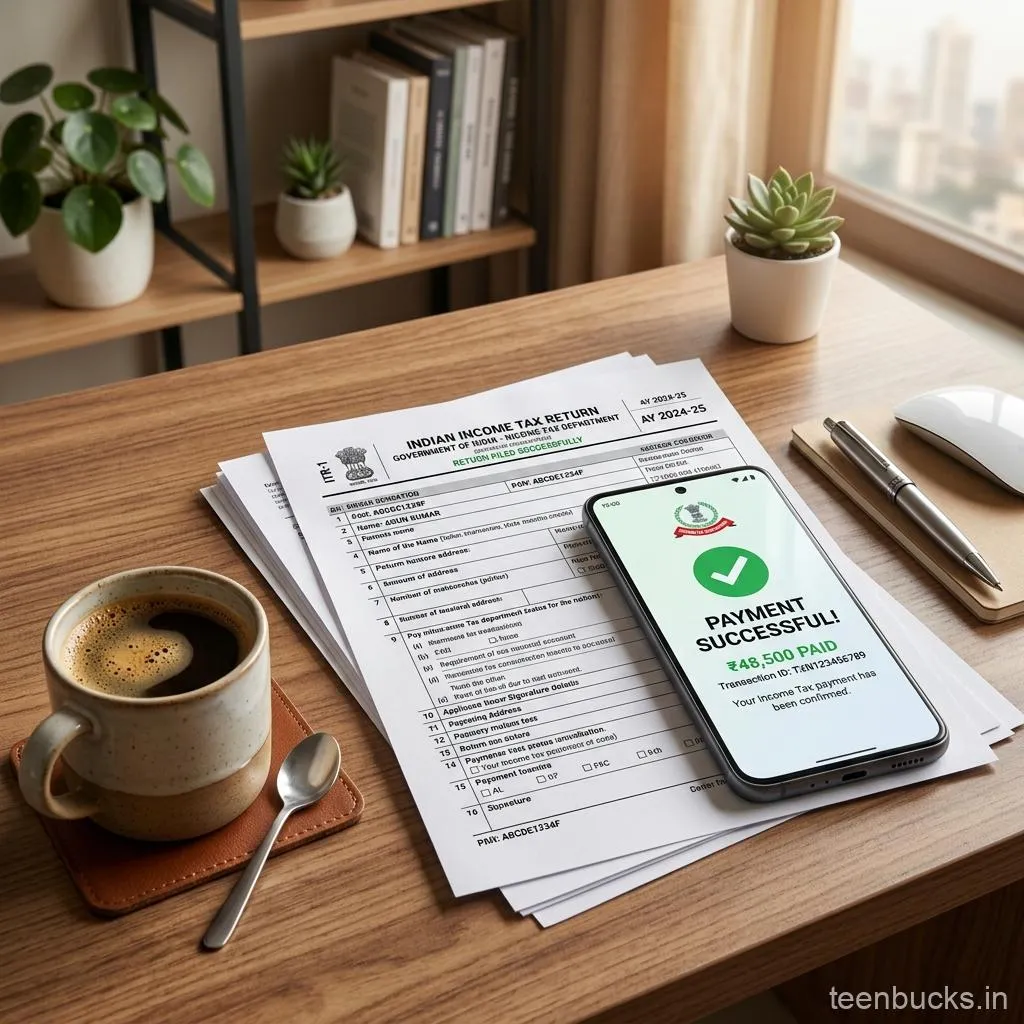
Download the acknowledgement (ITR-V). Save it. Screenshot the “Return Filed Successfully” page. Done.
That is the entire system. Ten steps. One form. Zero CA.
- The e-filing portal pre-fills most data. You are verifying, not creating from scratch.
- e-Verification via Aadhaar OTP is mandatory and takes 30 seconds.
- Download ITR-V as proof of filing. Banks and visa officers ask for it.
How to Claim Your TDS Refund (And Why Most Students Miss It)
The TDS trap
When an Indian client pays you more than ₹50,000 in a year, they deduct 10% TDS under Section 194J. Platform payments (like Fiverr India or Upwork India) may deduct TDS under Section 194C at 1–2%. This TDS is not your final tax. It is an advance deposit. You claim it back when you file ITR.
The refund math
If your tax payable is zero (which it is for almost every student), the entire TDS becomes a refund. The government sends it to your bank account within 30–60 days of filing.
How to verify TDS
Form 26AS: Download from the e-filing portal or TRACES (tdscpc.gov.in). It shows all TDS deducted against your PAN. Cross-check every entry with your payment records.
AIS (Annual Information Statement): Download from the e-filing portal. It is more comprehensive than Form 26AS — includes bank interest, dividends, crypto transactions, and foreign remittances.
Mismatch fix: If Form 26AS shows TDS that you do not recognise, or misses TDS you know was deducted, contact the deductor (your client) and ask them to correct their TDS return. This takes 2–3 weeks. Do it before filing.
What it looks like in real life
Karthik is a third-year student in Kochi. He earned ₹32,000 from tutoring via UrbanPro. The platform deducted ₹3,200 as TDS. He filed ITR-4 under Section 44ADA. Taxable income: ₹16,000. Tax: zero. Refund: ₹3,200. The refund hit his SBI account on day 42. He used it to pay his semester exam fee.
That is the entire point. Filing is not about paying tax. It is about getting your own money back.
- TDS is an advance deposit, not final tax. Claim it back via ITR.
- Form 26AS and AIS are your verification tools. Cross-check every entry.
- Refunds arrive in 30–60 days. File early to get early.
The Penalties for Not Filing (And Why July Is the Wrong Time to Panic)
The late filing fee
If you miss the 31 August 2026 deadline:
- Income above ₹5 lakh: late fee of ₹5,000 under Section 234F
- Income up to ₹5 lakh: late fee of ₹1,000
- Interest at 1% per month on unpaid tax under Section 234A
For a student with zero tax, the late fee is ₹1,000. Not catastrophic. But unnecessary. And it marks you as a late filer in the system.
The bigger cost
You cannot carry forward business losses. You cannot claim TDS refunds after the deadline. You lose financial credibility. And if the Income Tax Department sends you a notice for non-filing — which they increasingly do based on AIS data — you will spend more than ₹1,000 in stress and follow-up.
The belated return option
If you miss 31 August, you can still file a belated return by 31 December 2026. But you lose the right to carry forward losses, and the late fee applies. After 31 December, you can file an updated return (ITR-U) until 31 March 2031, but with additional tax and no new deductions.
- Late filing fee: ₹1,000 (income under ₹5 lakh) or ₹5,000 (above). Plus interest.
- Belated return allowed until 31 December 2026. Updated return until 31 March 2031.
- File by 31 August. The fee is zero. The stress is zero. The refund is yours.
5 Mistakes Students Make When Filing ITR
Mistake 1 — Using ITR-1 Because “That Is What My Father Uses”
❌ The trap: Your father files ITR-1 for his salary. You assume you should too. You enter your freelance income under “Other Sources.” The portal rejects your return.
❌ Why it fails: Freelance income is business income, not salary or other sources. ITR-1 has no section for PGBP (Profits and Gains of Business or Profession). The rejection wastes a day and triggers panic.
❌ The fix: Use ITR-4. Always. If you have freelance income of any amount, ITR-4 is your only option among the simple forms.
Mistake 2 — Not Linking PAN and Aadhaar Before Filing
❌ The trap: You try to e-Verify with Aadhaar OTP. The portal says “PAN not linked to Aadhaar.” You cannot complete filing.
❌ Why it fails: PAN-Aadhaar linking is mandatory for e-filing. If not linked, you must use DSC (digital signature) or send a physical ITR-V to Bengaluru — both are hassles students do not need.
❌ The fix: Link PAN and Aadhaar on the e-filing portal before 31 July. It takes 2 minutes. Do it now, even if you are not filing yet.
Mistake 3 — Ignoring Form 26AS and AIS Mismatches
❌ The trap: You file without checking Form 26AS. The portal auto-fills TDS that does not match your records. Or misses TDS you know was deducted. Your refund is delayed by 4 months.
❌ Why it fails: The Income Tax Department matches your ITR data with Form 26AS. Mismatches trigger automated notices and manual processing delays.
❌ The fix: Download Form 26AS and AIS before filing. Cross-check every TDS entry. Fix discrepancies with your client before submitting.
Mistake 4 — Choosing Old Regime Without Checking
❌ The trap: You select “Old Regime” because your father said it has more deductions. You claim ₹0 under 80C because you have no investments. Your tax is higher than it would be under the new regime.
❌ Why it fails: The old regime only makes sense if you have substantial 80C, 80D, or HRA deductions. Most students do not. The new regime’s zero tax up to ₹12 lakh is unbeatable for low earners.
❌ The fix: Run the tax computation under both regimes on the portal. Pick the one with lower tax. For 95% of student freelancers, the new regime wins.
Mistake 5 — Waiting for a CA Instead of Doing It Yourself
❌ The trap: You think ITR filing is “too complex” for a student. You wait for a CA. The CA charges ₹2,500–₹5,000. You delay. You miss the deadline.
❌ Why it fails: For student-level income (₹25,000–₹2 lakh), ITR-4 with Section 44ADA is genuinely simple. The portal guides you. The math is basic. The CA fee is 10–20% of your annual income — money better spent on your next SIP.
❌ The fix: File yourself. If you get stuck, the e-filing portal has live chat. The Income Tax Department helpline is 1800 180 1961. Both are free. Both are faster than waiting for a CA.
What This Looks Like in Real Life
Scenario 1: Kabir, First-Year Hosteler, Jaipur
Kabir earned ₹15,000 from Meesho reselling in FY 2025-26. His total income (pocket money + reselling): ₹57,000. He filed ITR-4 under Section 44ADA. Gross receipts: ₹15,000. Presumptive income (50%): ₹7,500. Total taxable income: ₹7,500. Tax: zero. No TDS was deducted (Meesho does not deduct TDS on reselling margins). Refund: zero. But he now has an ITR record. His bank sees him as a legitimate earner. When he applies for a credit card next year, his ITR is his income proof.
Scenario 2: Divya, Final-Year Student, Kochi
Divya earned ₹48,000 from content writing and Canva design. Three Indian clients deducted ₹4,800 as TDS under Section 194J. She filed ITR-4. Section 44ADA: ₹24,000 taxable. Tax: zero. TDS refund: ₹4,800. The refund arrived in 38 days. She used it to buy a new phone — not with her father’s money, but with her own tax refund. The feeling was different. Better.
Scenario 3: Faizan, Tier-2 City Freelancer, Surat
Faizan earned ₹1,80,000 from video editing for foreign clients via Fiverr. No Indian TDS (foreign clients do not deduct TDS under Section 194J). He converted his Payoneer receipts to INR using RBI reference rates. Filed ITR-4. Section 44ADA: ₹90,000 taxable. Tax: zero (below ₹12 lakh rebate threshold). No refund, but no tax either. He now has documented foreign income. When he applies for a US student visa in 2027, his ITR shows earnings, not just a bank statement funded by his father.
How This Looks Across India
Mumbai
In Mumbai, a student named Aditya in a shared flat in Andheri earned ₹36,000 from social media management for a Bandra café. The café owner deducted ₹3,600 TDS. Aditya filed ITR-4. Section 44ADA: ₹18,000 taxable. Tax: zero. Refund: ₹3,600. He used the refund to pay his PG rent for one month. The ITR took 26 minutes. The CA he almost hired would have charged ₹4,000 — more than his refund.
Delhi
In Delhi, a student named Simran in a North Campus hostel earned ₹28,000 from tutoring Class 10 students. She received cash payments — no TDS. She filed ITR-4 anyway. Section 44ADA: ₹14,000 taxable. Tax: zero. No refund, but a clean record. When she applied for an education loan for her Master’s in 2028, the bank approved her application in 3 days because she had 2 years of ITR. Her friend who did not file waited 3 weeks.
Bangalore
In Bangalore, a student named Vishnu in a Koramangala PG earned ₹52,000 from podcast editing for US clients via Fiverr. He received dollars in Wise. Converted to INR at RBI rates. Filed ITR-4. Section 44ADA: ₹26,000 taxable. Tax: zero. He also reported ₹1,200 in bank interest. Total taxable income: ₹27,200. Tax: zero. The ITR-4 form has a section for “Income from Other Sources” — bank interest goes there. One form. All income covered.
Hyderabad
In Hyderabad, a student named Meera at an engineering college earned ₹22,000 from Canva design for a Hyderabad startup. The startup deducted ₹2,200 TDS. She filed ITR-4. Section 44ADA: ₹11,000 taxable. Tax: zero. Refund: ₹2,200. She e-Verified with Aadhaar OTP in 30 seconds. The entire process — from login to download — took 22 minutes. She timed it.
Pune
In Pune, a student named Kunal in a Viman Nagar flat earned ₹19,000 from transcription on Rev. Rev paid via Payoneer. No Indian TDS. He filed ITR-4. Section 44ADA: ₹9,500 taxable. Tax: zero. He also claimed ₹0 in expenses — because 44ADA presumes them. No receipts. No Excel. No stress. Just one number: ₹19,000 gross receipts. The portal did the rest.
Chennai
In Chennai, a student named Ananya at Anna University earned ₹41,000 from selling notes on TestKart and tutoring. TestKart deducted ₹4,100 TDS. She filed ITR-4. Section 44ADA: ₹20,500 taxable. Tax: zero. Refund: ₹4,100. She used the refund to buy a Zerodha account and started her first ₹500 SIP. Her ITR became her investing trigger. You can read how to earn your first ₹12,000/month as a student here.
Kolkata
In Kolkata, a student named Om in a Salt Lake hostel earned ₹16,000 from Meesho reselling and ₹8,000 from content writing. Total: ₹24,000. The writing client deducted ₹800 TDS. He filed ITR-4. Section 44ADA: ₹12,000 taxable. Tax: zero. Refund: ₹800. Small amount. But the filing habit was the real win. He now files every year, automatically. His financial record is 3 years deep by graduation.
Your 7-Step Action Plan: Try This Today
☐ Step 1 (5 minutes): Check if PAN and Aadhaar are linked. Go to incometax.gov.in → Profile → Link Aadhaar. If not linked, do it now.
☐ Step 2 (10 minutes): Download Form 26AS and AIS from the e-filing portal. Check for TDS entries. Note any mismatches.
☐ Step 3 (10 minutes): Calculate your total freelance receipts for FY 2025-26 (April 2025 to March 2026). Include Fiverr, Upwork, direct clients, tutoring, reselling — everything.
☐ Step 4 (15 minutes): Log in to incometax.gov.in. Select ITR-4. Pre-fill personal details. Enter gross receipts in Schedule BP. Let the portal auto-calculate 50% under Section 44ADA.
☐ Step 5 (5 minutes): Verify TDS in Schedule TDS. Check tax computation. Confirm “Tax Payable: ₹0” and note your refund amount.
☐ Step 6 (5 minutes): Submit. e-Verify with Aadhaar OTP. Download ITR-V. Screenshot the success page.
☐ Step 7 (Habit loop): Set a calendar reminder for 1 April every year. “File ITR for last FY.” By the time you graduate, you will have 3–4 years of ITR. That is your financial passport.
Final Thought
The habits I started in my early 20s as a student in India did not make me rich overnight.
They did something quieter. They made me visible to the financial system. Banks saw me. Visa officers saw me. Loan officers saw me. I was not just a student with a PAN card. I was a taxpayer with a record. That distinction — invisible, boring, repeated every July — is what opens doors years later.
You do not need to become a different person. You just need to notice that the tax system is not designed to punish you. It is designed to track you. And being tracked is better than being invisible. Invisible people do not get loans. Invisible people do not get visas. Invisible people do not get the benefit of the doubt.
Your future self is built one small decision at a time. The decision to spend 30 minutes on incometax.gov.in instead of scrolling Instagram. The decision to claim your TDS refund instead of letting the government keep it. The decision to file ITR-4 instead of pretending your freelance income does not exist.
That decision — small, boring, repeated every year — is the entire difference between a student who graduates with a financial record and one who graduates with a blank slate.
💾 Save this post and share it with the friend who earned ₹20,000 from freelancing last year and still thinks “ITR is for adults.”
📖 Read These Next
→ How to Earn ₹15,000/Month as a College Student in India (Without Coding)
→ The Fake Credit UPI Scam: How Indian Students are Getting Tricked on GPay
→ How Indian Students Are Earning ₹12,000/Month Cutting YouTube Shorts With AI
📚 Related Articles You Will Love
- Section 44ADA vs Section 44AD: Which Presumptive Scheme Fits Your Freelance Income?
- Form 26AS vs AIS: How to Read Your Tax Statement Before Filing ITR
- TDS Refund for Students: How to Claim Money Deducted by Clients
- New Tax Regime vs Old Tax Regime: A Student’s Simple Guide for 2026
Frequently Asked Questions
What is ITR and why do students need to file it?
ITR (Income Tax Return) is a form you submit to the Income Tax Department declaring your income for the financial year. Students with freelance income must file ITR because their earnings are classified as “Profits and Gains of Business or Profession,” not salary. Filing is mandatory if gross total income exceeds ₹3 lakh, and advisable even below that to claim TDS refunds and build financial records.
Which ITR form should a student with freelance income use?
Use ITR-4 (Sugam) under Section 44ADA presumptive taxation. ITR-1 is for salaried individuals only and cannot handle business income. ITR-4 is designed for freelancers with receipts under ₹50 lakh (₹75 lakh if 95% digital). It auto-calculates your taxable income and pre-fills TDS data.
What is Section 44ADA and how does it help students?
Section 44ADA is a presumptive taxation scheme that lets you declare 50% of your gross receipts as taxable income. The government presumes the other 50% covers your expenses. No bookkeeping, no receipts, no audit required. For a student earning ₹24,000, taxable income becomes ₹12,000. Tax = zero.
Do I need to pay tax if I earned only ₹15,000 from freelancing?
No. Under the new tax regime, income up to ₹4 lakh is tax-free. Under Section 44ADA, your taxable income on ₹15,000 is ₹7,500. Tax = zero. Plus, the Section 87A rebate makes tax zero up to ₹12 lakh taxable income. Almost no student freelancer pays actual income tax.
How do I claim TDS refund as a student freelancer?
When Indian clients pay you more than ₹50,000/year, they deduct 10% TDS under Section 194J. If your tax payable is zero, this entire TDS becomes a refund. File ITR-4, verify TDS in Schedule TDS against Form 26AS, and the refund is auto-calculated. It arrives in your bank account within 30–60 days.
What is the deadline for filing ITR as a student freelancer?
For AY 2026-27 (FY 2025-26), the deadline for non-audit ITR-4 filers is 31 August 2026 — extended from July 31 for freelancers and gig workers. If you miss this, you can file a belated return by 31 December 2026 with a late fee of ₹1,000 (income under ₹5 lakh) or ₹5,000 (above).
What documents do I need to file ITR as a student?
You need: PAN (linked to Aadhaar), bank account details, Form 26AS (download from e-filing portal), AIS (Annual Information Statement), total freelance receipts for FY 2025-26, and TDS certificates (Form 16A) if any. No expense receipts needed under Section 44ADA.
Can I file ITR if I earned from foreign clients via Payoneer or Fiverr?
Yes. Foreign income is taxable for Indian residents. Convert your earnings to INR using the RBI reference rate on the date of receipt. Report under “Business or Profession” in ITR-4. Foreign clients do not deduct Indian TDS, so there is no refund — but filing builds your foreign income record for visas and loans.
What happens if I do not file ITR as a student?
You lose TDS refunds, cannot carry forward business losses, and have no income proof for loans or visas. The Income Tax Department tracks income via AIS and TDS returns. Non-filing can trigger notices and a late fee of ₹1,000–₹5,000. Filing takes 30 minutes. Not filing costs you for years.
How is filing ITR different for students compared to salaried employees?
Salaried employees get Form 16 from their employer and use ITR-1. Students with freelance income have no Form 16, use ITR-4, and must calculate their own taxable income under Section 44ADA. The process is slightly more involved — but the portal guides you, and for student-level income, the math is simple and the tax is almost always zero.
Sources
Investopedia: Income Tax Return
Income Tax Department e-Filing Portal: Official Help
Tax Garden: Freelancer Income Tax Filing Guide India AY 2026-27
1Finance: ITR Filing for Freelancers & Self-Employed
PickMyWork: ITR Filing for Freelancers and Gig Workers 2026
Ebizfiling: ITR-4 Form Filing AY 2026-27
Kissht: ITR Filing Last Date AY 2026-27
Last updated: 17 July 2026
Written by TeenBucks
Key Takeaways (End of Post)
- Students with freelance income file ITR using ITR-4, not ITR-1. Freelance earnings are business income, not salary.
- Section 44ADA presumptive taxation: 50% of gross receipts = taxable income. No bookkeeping, no audit, no CA needed.
- Under the new tax regime, zero tax up to ₹4 lakh income. Section 87A rebate makes tax zero up to ₹12 lakh taxable income.
- The deadline for student freelancers is 31 August 2026 for AY 2026-27 — one month later than salaried filers.
- TDS deducted by clients (10% under Section 194J) is claimable as refund. Most students get their full TDS back.
- The e-filing portal pre-fills PAN, bank, and TDS data. You verify and submit. Total time: 25–35 minutes.
- Filing ITR builds your financial record for education loans, personal loans, credit cards, and visas.
- Download Form 26AS and AIS before filing. Cross-check TDS entries. Fix mismatches with clients.
- Link PAN and Aadhaar before filing. e-Verify with Aadhaar OTP is mandatory and takes 30 seconds.
- An imperfect ITR filed today is worth ten perfect ITRs planned for next year that never happen.

AI Overview Summary
Students with freelance income in India should file ITR using ITR-4 under Section 44ADA presumptive taxation, declaring 50% of gross receipts as taxable income. For AY 2026-27, the deadline is 31 August 2026, and under the new tax regime’s enhanced Section 87A rebate, taxable income up to ₹12 lakh attracts zero tax — covering almost all student freelancers. TDS deducted by clients under Section 194J is fully claimable as refund through the e-filing portal at incometax.gov.in.