
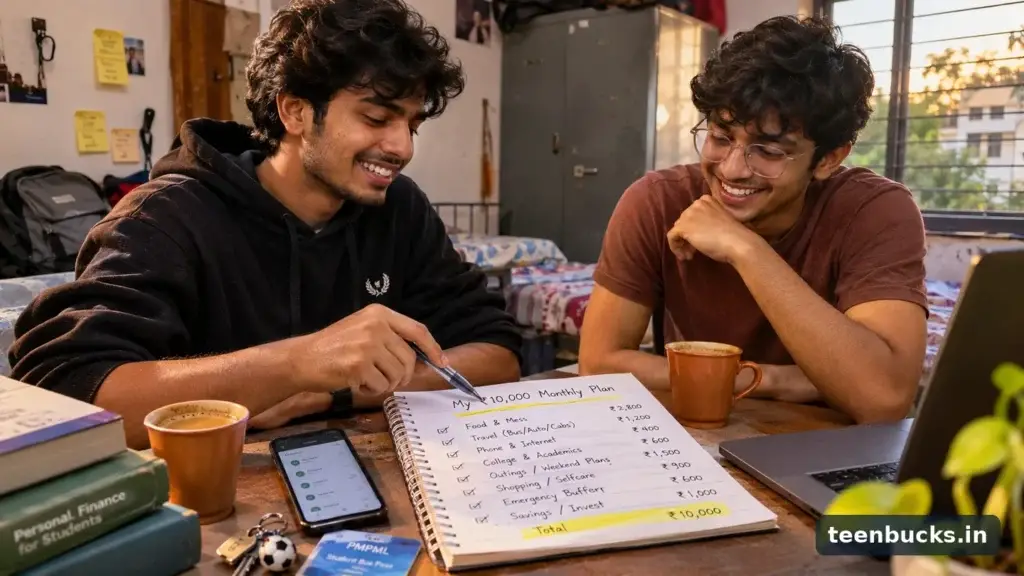
It’s the 23rd of the month. A friend drops the usual message in the group chat: “Saturday movie, then dinner?”
You want to go. Of course you do. College isn’t just classes, attendance and a canteen samosa between lectures.
But you open your UPI app and see ₹840. You remember having ₹10,000 at the start of the month. You haven’t bought anything huge. No new phone. No expensive shoes. Then where did the money go?
A few auto rides because it was raining. Coffee after practicals. One birthday treat. A delivery order when the mess food wasn’t great. A ₹199 app subscription you forgot to cancel. And the weekend plan that somehow costs double what everyone agreed in the group.
This is the kind of budget problem nobody solves by shouting, “Save 20% and stop spending on coffee.” You still have friends, college projects, travel and a life to live.
So here’s the way I’d approach ₹10,000: cover the unavoidable stuff, protect a little future money, and give fun a real budget instead of pretending you’ll never go out. All amounts below are examples you should adjust to your city and college, not nationwide price averages.
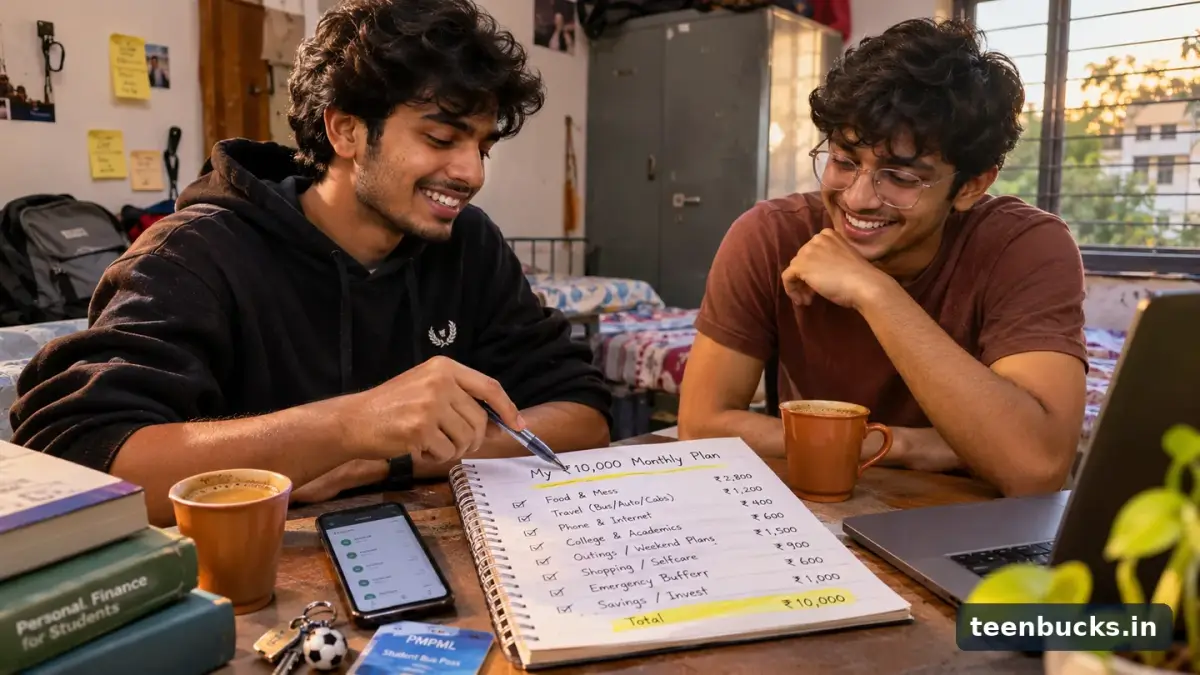
First question: what does your ₹10,000 actually cover?
Two students can receive the same ₹10,000 and have completely different lives.
One student’s parents pay hostel fees, mess charges and tuition directly. The ₹10,000 is mainly for canteen food, transport, outings, laundry, phone recharge and personal purchases. Another student pays for their rented room and food from the same ₹10,000. Those are not remotely the same budgets.
This isn’t just theory. If you look at published fee schedules—like IIIT Hyderabad’s published 2026–27 information—it lists approximately ₹6,000/month for hostel and ₹5,000/month for mess, paid semester-wise. That’s around ₹11,000/month before personal spending, at that institution. It doesn’t represent every college, but it shows why “₹10,000 is plenty for everyone” is bad advice. IIIT Hyderabad official fee schedule.
Student discussions online show the other end: some hostel students whose rent and mess are prepaid report needing only a few thousand rupees for additional monthly spending. Those are individual experiences, not a statistical average. Example student discussion, July 2026.
Before you use any percentage rule, answer three things:
- Already paid by home or college: Tuition? Hostel? Mess? Electricity? Everyday commute?
- Must be paid from your ₹10,000: Bus pass, lunch, stationery, recharge, toiletries, medicines?
- Can move around: Weekend plans, extra café food, shopping, cabs taken for convenience, subscriptions?
If you cannot cover your food, housing or essential travel on ₹10,000, the solution is not to cut meals to make room for an SIP. You may need a cheaper arrangement, financial assistance, a realistic talk at home or additional income. That’s not a budgeting failure.
The real-life ₹10,000 budget: hostel and mess already paid
Let’s take a student whose hostel, basic mess meals and fees are paid separately. They still need pocket money for the rest of campus life.
| Where the money goes | Monthly limit | What’s actually inside |
|---|---|---|
| Extra food, chai and canteen | ₹1,800 | Occasional snacks, not every meal |
| Local travel, autos and cabs | ₹1,000 | Campus-city trips and planned rides |
| Mobile/data | ₹350 | Recharge or contribution to a family plan |
| College projects and printing | ₹650 | Sheets, printouts, lab material |
| Laundry, grooming and toiletries | ₹700 | Shampoo, laundry, haircut, basics |
| Weekend plans and outings | ₹2,000 | Four weekends at about ₹500 each |
| Shopping, gifts and odd expenses | ₹1,000 | A birthday, a college fest, replacements |
| Emergency buffer | ₹1,000 | Leave it accessible for real surprises |
| Goal savings | ₹1,500 | Future travel, laptop repair or another goal |
| Total | ₹10,000 | Exactly ₹10,000 |
This isn’t the only correct split. It’s a realistic planning example when rent and mess are prepaid. If you spend ₹2,600 on travel because your college is far away, that extra ₹1,600 has to come from other categories. Maths doesn’t care how motivated you are.
Notice something else: this budget still has ₹2,000 for outings. That is not a mistake. If you make a plan that removes every café visit, every movie and every birthday, you’ll probably abandon it within a week.
What matters is that the ₹2,000 is a ceiling, not an excuse to spend it all.
The weekend rule I’d actually follow
₹2,000 for four weekends is roughly ₹500 per weekend. That’s the average, not a command to spend precisely ₹500 every Saturday.
If this Saturday’s birthday plan costs ₹900, there is only ₹1,100 left for the other weekends combined. Maybe the next one is chai and a walk, not a ₹700 café bill. That’s a trade-off, not a punishment.
And don’t forget the cab home. A ₹250 outing can become a ₹600 outing when the plan runs late and everyone leaves separately. To keep transport and student entertainment within budget, check out our curated guide to the 15 best student discounts in India for deals on transit passes and dining apps.
Same ₹10,000, different student: compare three practical budgets
Here are three hypothetical plans. These are not estimates of average student spending in India. Their purpose is to help you choose the right starting point.
| Category | Day scholar (commute) | Hostel + mess prepaid | Very low-cost shared room + mess self-funded |
|---|---|---|---|
| Housing and base meals | Paid separately | Paid separately | ₹6,300 |
| Transport | ₹2,200 | ₹1,000 | ₹600 |
| Extra food/canteen | ₹1,700 | ₹1,800 | ₹500 |
| Mobile/data | ₹350 | ₹350 | ₹300 |
| Academics | ₹650 | ₹650 | ₹400 |
| Personal/laundry | ₹650 | ₹700 | ₹300 |
| Outings | ₹1,300 | ₹2,000 | ₹300 |
| Flexible purchases / irregular costs | ₹1,000 | ₹1,000 | ₹250 |
| Emergency buffer | ₹1,000 | ₹1,000 | ₹500 |
| Goal savings | ₹1,150 | ₹1,500 | ₹550 |
| Total | ₹10,000 | ₹10,000 | ₹10,000 |
Read the assumptions, not just the totals. The third column works only if you genuinely have verified accommodation and basic food for ₹6,300. It will not work at every college or in every city. At institutions with costs like the IIIT Hyderabad example, ₹10,000 doesn’t cover housing and mess alone.
A day scholar may spend more commuting and less on local hostel errands. A hostel student whose mess is prepaid may have more room for outings. Someone paying rent out of the allowance needs to prioritise food and housing and may be unable to save every month.
If your real figures don’t fit these columns, make your own. That’s the whole point.
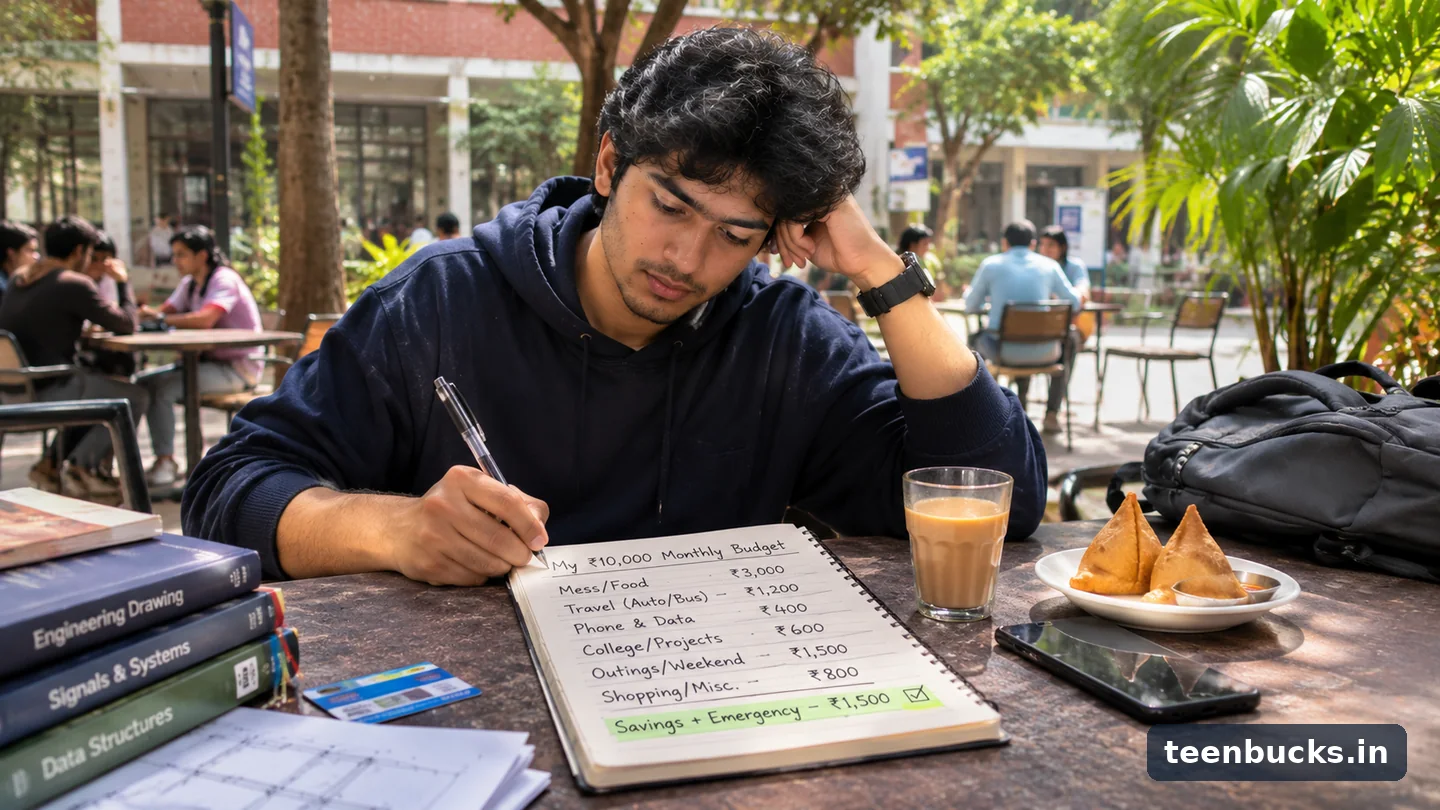
Why the famous 50/30/20 rule can go wrong in college
You’ve probably seen the neat graphic: 50% needs, 30% wants, 20% savings. On ₹10,000, that’s ₹5,000 / ₹3,000 / ₹2,000. It is a useful starting framework—and we break down the fundamentals in our complete student budgeting 50/30/20 guide—but applying it blindly to student life can backfire.
Suppose rent and food alone cost ₹7,000. Your needs are already 70% of the allowance. Forcing your expenses into 50% doesn’t magically reduce the rent.
Or suppose tuition, hostel and mess are fully prepaid. The ₹10,000 is a discretionary allowance with some everyday essentials. In that case, a bigger savings goal may be possible.
India’s securities regulator SEBI advises people to list real income and expenses, prioritise essentials, plan savings and build an emergency fund. It doesn’t say every college student must save exactly 20% regardless of circumstances. SEBI Investor: Managing income and expenses.
My preference: use the real bills first, the percentages second. A student who puts aside ₹500 consistently while eating properly is doing better than someone who “saves” ₹2,000 and has to borrow for meals in week four.
The UPI leak: four kinds of small spending that add up
Let’s look at the kind of numbers you can verify directly in your own UPI transaction history. These aren’t wild splurges—they’re the tiny taps you barely think twice about during a busy week:
| Small expense | Example frequency | Monthly total |
|---|---|---|
| ₹35 chai/coffee or snack | 18 times | ₹630 |
| ₹120 canteen extras | 10 times | ₹1,200 |
| ₹150 convenience cab/auto share | 6 times | ₹900 |
| ₹199 subscriptions | 2 | ₹398 |
| Total | ₹3,128 |
₹3,128 is 31.28% of ₹10,000. Not because any one of these purchases is outrageous, but because small payments are easy to forget when each takes about three seconds on UPI.
I’m not saying stop buying chai. I’m saying count it as food spending, not invisible spending.
And if you have a subscription you stopped using after semester exams, check whether it’s still renewing. We have a separate TeenBucks guide to cancelling Google Pay AutoPay; cancellation steps depend on the app and the mandate.
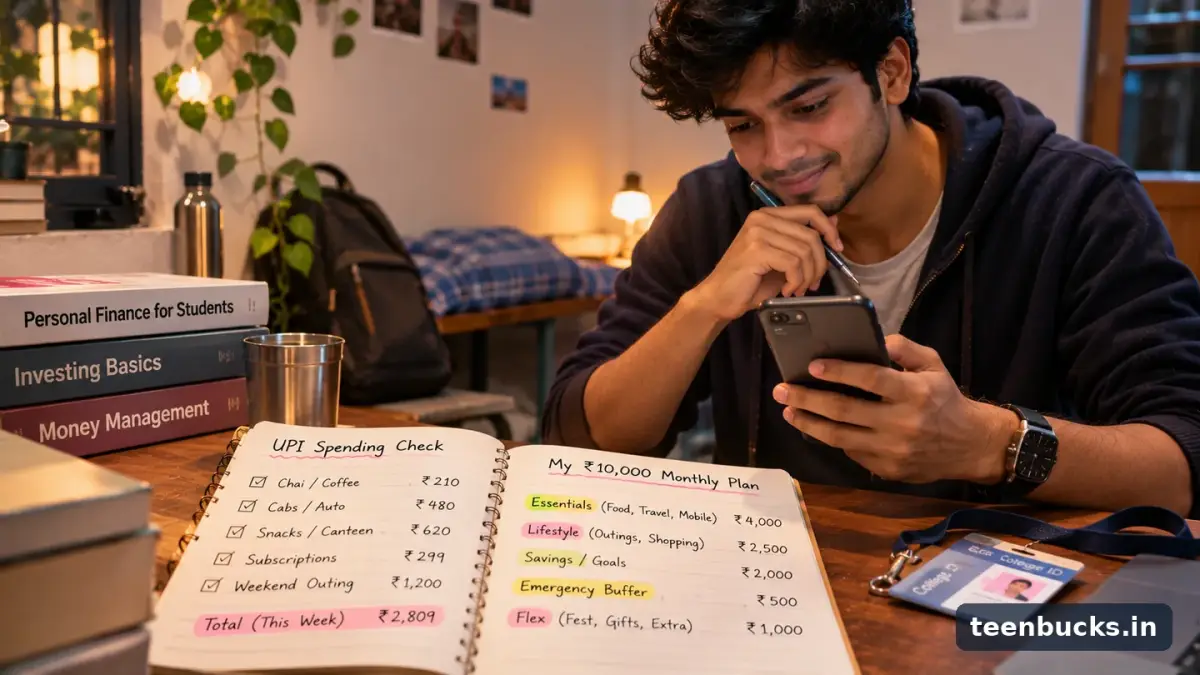
Do a seven-day UPI check before you set next month’s limits
Open your bank/UPI transactions for the past seven days, record them and label each transaction as:
- Must-pay: College bus, mess top-up, required printing, phone recharge.
- Enjoyment: Canteen extras, cafés, movies, optional cabs.
- Unplanned: A forgotten subscription, impulse purchase or surprise expense.
For example, if you spent ₹1,510 over the last seven days, don’t automatically declare that every month costs ₹6,040. Some weeks have birthdays; others have exams and no outings. Use that week to spot patterns and then check a full month if possible.
I would put every cash purchase in the same tracker. Otherwise the tracker tells you a pleasant lie: “UPI spending under control” while cash disappears at the canteen.
Don’t divide ₹10,000 by 30 and call it your daily budget
₹10,000 ÷ 30 = ₹333.33 a day. It sounds generous. It’s also misleading if your travel pass, upcoming college project and savings haven’t been taken out.
Use this instead:
Spendable money = pocket money − essentials − planned irregular expenses − emergency buffer − savings you can realistically afford.
Then divide what’s left by the number of days, or split it into separate weekly food and outing envelopes.
In the hostel example, you already assigned ₹1,800 to canteen extras and ₹2,000 to outings. That’s ₹3,800 of discretionary food and fun for the month, not an extra ₹3,800 hiding in another account.
You could see it as about ₹60/day for extra food (₹1,800 ÷ 30) and about ₹500/weekend for plans (₹2,000 ÷ 4). If it’s a five-weekend month, adjust the weekend limit rather than pretend the calendar doesn’t exist.
Half the month gone and ₹2,200 left? Do this maths
Suppose today is the 16th. Fifteen days remain. You have ₹2,200, and still need:
- ₹700 for unavoidable travel and a printout.
- ₹500 that you want to preserve for a real emergency.
That leaves ₹2,200 − ₹700 − ₹500 = ₹1,000, or about ₹67 per day for fifteen days for everything else.
A spontaneous ₹800 weekend could wreck that plan. This is where you tell your friends, “This week I’m doing the budget version. Chai is fine; dinner can wait.” You don’t need a dramatic explanation.
If you’re already short on food or safe transport, the emergency amount may need to be used for those essentials. Food and safety come before an arbitrary savings streak.
A three-bucket setup that doesn’t require three bank accounts
Some people make budgeting sound like you need six apps, three bank accounts and a spreadsheet dashboard. You don’t.
One bank account plus a note on your phone is enough for a start. Divide your allowance conceptually into these buckets:
Bucket 1: Money that is already spoken for. Recharge, commuting, required college work, laundry, basic meals. Treat these like bills even if the actual UPI payment happens later.
Bucket 2: Life money. Weekend plans, extra canteen food, gifts, shopping. You decide what matters most; the total has a cap. Unused money rolls into the next week or your buffer.
Bucket 3: Money for later. An accessible emergency buffer plus a specific goal—maybe an interview trip, books, a replacement phone or home travel. Do not lock near-term emergency money into a risky investment just because the internet says to start an SIP at 18.
If your bank offers a separate savings space or standing instruction at no extra cost, that can be helpful. But a notebook or reminder works too. Make sure money needed soon remains accessible.
For a student living on an allowance, a ₹500–₹1,000 emergency buffer can be a sensible first target. The right amount depends on what expenses your family already covers. After that, build it gradually; you don’t have to invest every spare rupee.
How to enjoy weekend plans without blowing the month
I wouldn’t tell a college junior to stop going out. Sometimes the ₹250 café visit is the one time that week everyone actually sits together after lab submissions. It has value.
I would suggest three ground rules:
Agree on the total before leaving. “Let’s meet” is not a budget. Ask whether it’s coffee or coffee + food + movie + cab. ₹300 and ₹1,000 are two very different evenings.
Count your own share, not the bill’s headline. If four friends split a ₹1,600 bill equally, it’s ₹400 each. Add ₹120 for your ride and you’ve spent ₹520. The meal wasn’t “just ₹400.”
Keep a cheap-plan fallback. A campus walk, canteen tea, badminton, a movie in someone’s hostel common room. If every weekend needs ₹800–₹1,200, even ₹10,000 disappears quickly.
And don’t borrow from a roommate or use BNPL just to keep up with the group. Borrowing today to fund a Saturday plan makes next Saturday harder.
What about shopping, college fests and birthdays?
These costs feel random, but they’re often predictable.
You know your friend’s birthday is next month. You know your college fest usually has a registration fee and somebody will want matching T-shirts. You know workshop printouts can arrive with almost zero warning. They don’t need to be emergencies every time.
In the hostel example, the ₹1,000 shopping/gifts/odd-expenses bucket is there for this reason. If you don’t use it, let it build. A ₹1,000 cushion carried over for two months becomes ₹2,000 you can use for a bigger planned purchase without taking money from essentials.
Don’t confuse this with the separate ₹1,000 emergency buffer for urgent needs.
Should you put ₹500 or ₹1,000 into an SIP from pocket money?
Not automatically.
If you’re depending on your family for basics, paying for next week’s travel and saving for a laptop repair, accessible cash comes first. Mutual funds fluctuate. They are not replacements for cash you may need in ten days.
If your essentials are covered, your short-term buffer is healthy and you have money for a longer-term goal, learning about investing can make sense. You could run hypothetical returns through the TeenBucks SIP calculator. Those projections depend on the assumed rate and aren’t guaranteed.
The bigger win isn’t a ₹500 SIP badge on your Instagram story. It’s reaching the end of the month without borrowing ₹500 to pay for bus fare. If spending still makes you anxious even when it fits your budget, take a look at our guide on overcoming scarcity mindset and money guilt for students.
The 30-day college-money challenge I’d actually use
On allowance day: Note how much arrived, what is already paid and what must be paid this month. Set aside essentials and a modest buffer first. Write a realistic savings goal.
Every Friday: Check what’s left for weekend plans. Do the maths before the group chat makes plans for you.
Each Sunday night: Spend five minutes looking at UPI + cash spends. No guilt journal. Just note what surprised you and move next week’s plan accordingly.
On day 15: Recalculate using the money left, the bills still due and the days remaining. Don’t use what you thought you would have; use the balance you have.
On day 30: Move genuine leftover money into your emergency or goal savings. Then adjust the categories next month. Maybe you underestimated transport or overestimated shopping. Good. Now you know.
Copy this mini tracker into Notes
| This month’s number | Enter your amount |
|---|---|
| Pocket money received | ₹10,000 |
| Rent/mess/tuition paid outside allowance? | Yes / No / Partly |
| Essentials still to pay | ₹_____ |
| Weekend/outing limit | ₹_____ |
| Flexible purchases | ₹_____ |
| Emergency buffer | ₹_____ |
| Realistic savings goal | ₹_____ |
| Money left after commitments | ₹_____ |
| Days until next allowance | _____ |
| Safe daily discretionary limit | ₹_____ |
The formula isn’t magic. The habit is: don’t confuse your current bank balance with money you can freely spend.
One thing I’d tell someone with just ₹10,000
Don’t compare your month with the guy who gets ₹25,000 and has his hostel paid for, or with someone who gets ₹2,000 and goes home every weekend. The numbers are different because the arrangements are different.
If you can pay your essentials, go out with friends sometimes and save even ₹500 without borrowing it back, you’re making progress.
And if the money genuinely doesn’t cover food or safe travel, be honest about that. Don’t let a beautifully formatted budget make you feel like the problem is your willpower.
The TeenBucks takeaway
Budget for the life you’re actually living, not an imaginary college student on a finance poster.
On ₹10,000, the goal isn’t to become the most boring person in the group. It’s to enjoy the month and still be able to answer “Where did my money go?” before the 29th.
Sources and methodology: SEBI Investor: Management of Income and Expenses · SEBI: Financial Goals and Budgeting · IIIT Hyderabad 2026–27 fee schedule · Student pocket-money discussion (individual experiences, not a survey). All scenario budgets and purchase examples are illustrative; city and personal circumstances change actual spending.
Frequently Asked Questions
How should I split ₹10,000 pocket money if my hostel and mess are already paid?
Start with your true campus expenses. A proven planning split is ₹4,500 for everyday essentials (canteen snacks, bus/metro transit, phone recharge, lab printing, grooming), ₹3,000 for social life and irregular purchases (₹2,000 for weekend outings plus ₹1,000 for fests or shopping), ₹1,000 for an accessible emergency buffer, and ₹1,500 for goal savings or a mutual fund SIP. If your daily commute costs more, adjust the outing bucket accordingly—the total always balances to exactly ₹10,000.
Can I save ₹2,000 every month from my pocket money and still go out with friends?
Yes, provided your room rent and primary meals are prepaid by your family, leaving the ₹10,000 purely for personal expenses. Out of the remaining ₹8,000, reserving ₹2,000 gives you ₹500 per weekend for cafe visits, movies, or street food. However, saving 20% is not mandatory if you are struggling to afford academic supplies or safe travel. Start with ₹500 or ₹1,000 until your cash buffer is stable, and always cap your weekend spending before Friday night.
What should I do if ₹10,000 must also cover my hostel rent and mess food?
List housing and food first. As institutional data (such as IIIT Hyderabad’s ~₹11,000/month baseline) shows, hostel and mess fees in tier-1/tier-2 cities often consume ₹6,000 to ₹10,000+ alone. If you must self-fund these, do not force an arbitrary 20% savings rule that compromises nutrition or basic health. Prioritize rent and food, keep a modest ₹500 cash buffer for medical emergencies, and speak openly with your family or explore campus financial aid and safe student freelancing.
Editorial note: This guide is general financial education for students. No bank product, investment return or spending level is guaranteed. All personal scenes and budget breakdowns are illustrative planning examples.