For generations of Indian families, the default answer to generating regular monthly cash flow has been simple: walk into a bank branch, lock your life savings into a Fixed Deposit (FD), and sign up for monthly interest payouts.
While this approach feels emotionally secure, the financial reality in 2026 is sobering: high income tax rates and persistent consumer inflation are quietly eroding fixed-deposit wealth. Today, informed young earners, retirees, and wealth planners are turning to Mutual Fund Systematic Withdrawal Plans (SWP) as a market-linked alternative with different risks.
Side-by-Side Comparison: SWP vs Bank FD
To understand how SWP and fixed deposits differ, examine how both instruments handle taxes, returns, liquidity, and principal capital preservation:
| Feature | Mutual Fund SWP (Hybrid/Equity) | Bank Fixed Deposit (FD) Monthly |
|---|---|---|
| Tax Treatment | Only capital gain portion is taxed. Return of principal is 100% tax-exempt. | 100% of interest earned is fully taxable at your peak income slab rate. |
| TDS Deductions | Zero TDS for resident Indian individual investors. | 10% TDS may apply after annual interest crosses ₹50,000 (₹1 lakh for senior citizens) from 1 April 2025, subject to rules and declarations. |
| Annual Exemption | ₹1.25 lakh equity LTCG threshold under Section 112A only for qualifying equity-oriented funds and eligible holding periods. | Zero exemption for non-senior citizens under new tax regime. |
| Expected Returns | 8.5% to 11.5% CAGR (Conservative Hybrid / Balanced Advantage). | 6.5% to 7.2% fixed interest p.a. |
| Capital Growth | Yes. Principal may grow or fall; outcomes depend on actual returns and withdrawal timing. | Nominal principal is stated by the deposit contract, subject to bank terms; purchasing power can fall with inflation. |
| Premature Exit Penalty | Zero exit load after 12 months. Modify or stop anytime. | 0.5% to 1.0% interest rate penalty on early deposit breakage. |
The Concrete Math: ₹10 Lakh Investment Case Study
To see the staggering real-world difference, let us compare two investors in the 20% or 30% income tax slab who deposit ₹10,00,000 to withdraw ₹6,000 per month (₹72,000 per year):
Case A: Investor in Bank Fixed Deposit (7.0% Interest)
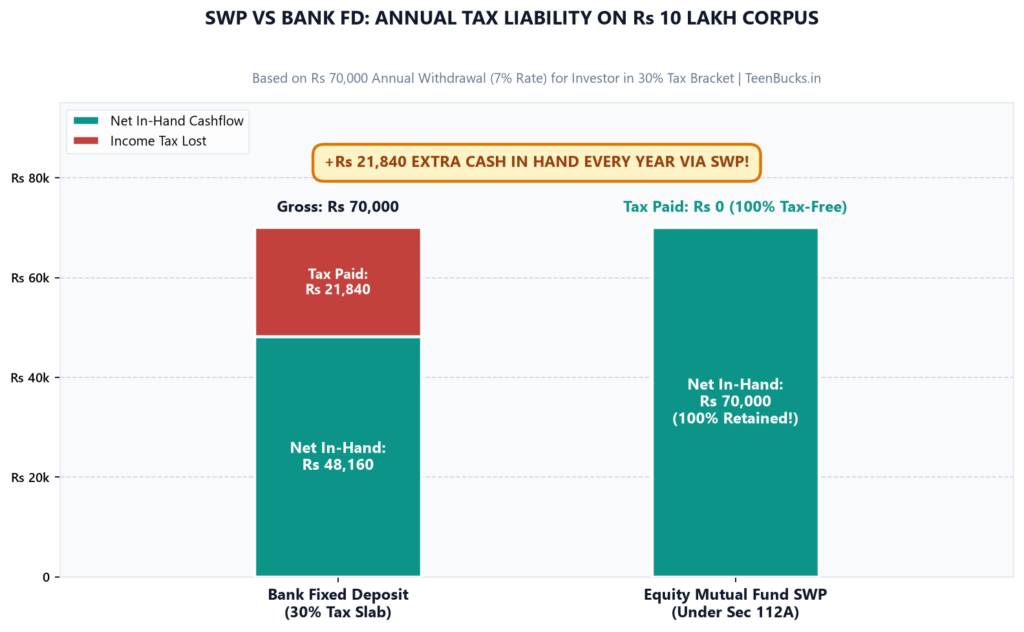
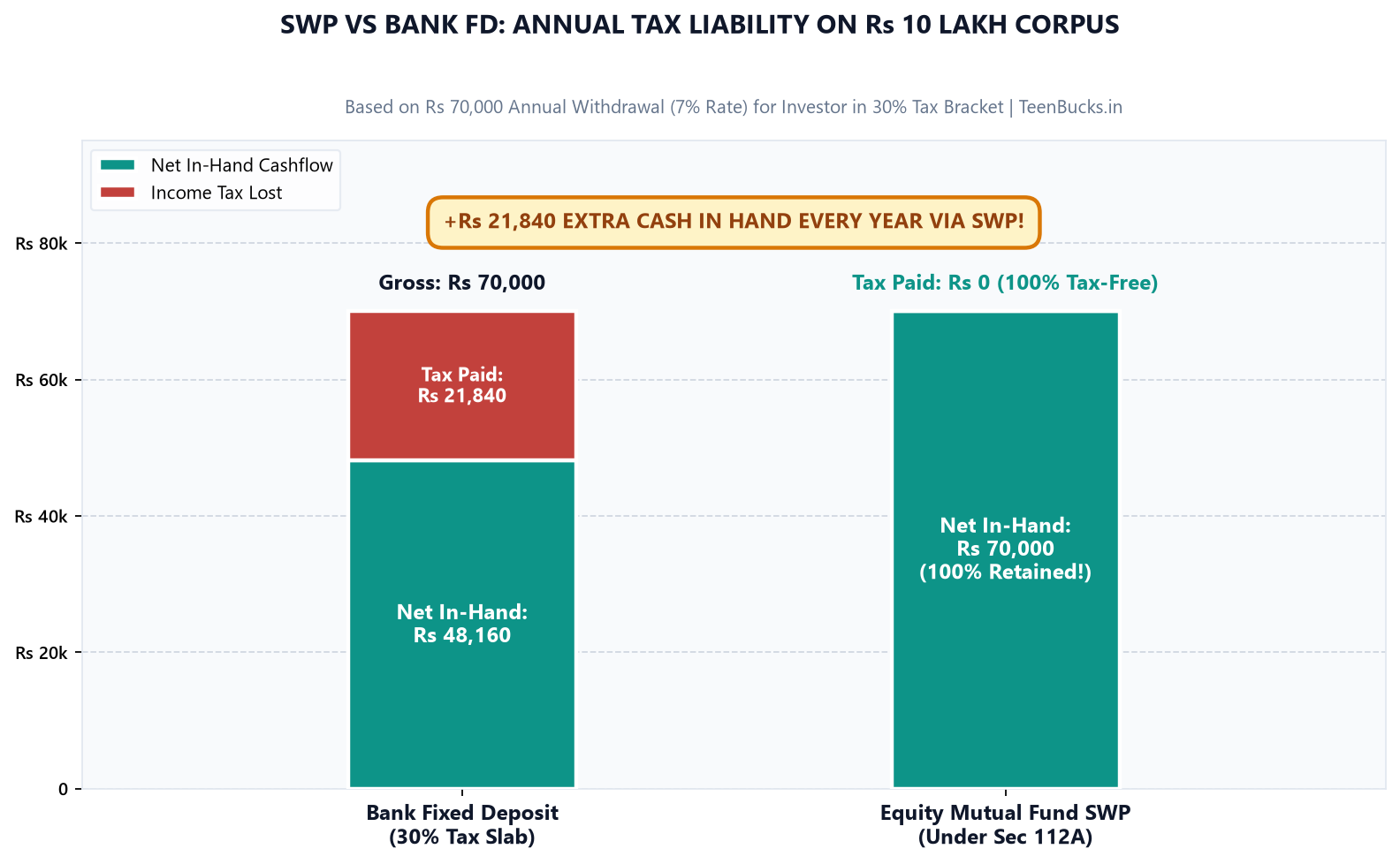
- Annual Interest Credited: ₹70,000
- Income Tax (30% slab + 4% cess): ₹21,840 directly deducted or paid via advance tax.
- Net In-Hand Payout: ₹48,160/year (Just ₹4,013/month instead of the desired ₹6,000!).
- Principal Balance after 10 Years: Exactly ₹10,00,000. But with India’s average retail CPI inflation running at 5.5%, that ₹10 Lakh has the purchasing power of barely ₹5.8 Lakh in today’s terms.
Case B: Investor in Mutual Fund SWP (9.0% Return in Balanced Advantage Fund)
- Annual Cash Withdrawn: ₹72,000 (₹6,000 credited every month without fail).
- Tax Calculation (Year 1): Out of ₹72,000, approximately ₹63,000 is return of the investor’s original capital. Only ₹9,000 represents capital gains.
- Section 112A Benefit: Because total equity LTCG is well below the statutory ₹1.25 Lakh exemption, Total Tax Paid = ₹0!
- Principal Balance after 10 Years: Thanks to surplus compounding (9% return minus 7.2% withdrawal rate), the closing portfolio balance actually expands to over ₹12,32,000!
You can verify this exact calculation right now using our free Mutual Fund SWP Calculator, which includes built-in capital longevity indicators.
The Inflation Reality: Why Fixed Deposits Silently Destroy Wealth
The Reserve Bank of India aims to keep retail consumer price inflation within a 4% to 6% band. When you hold a Bank FD earning 7% and pay 30% tax, your effective post-tax yield is:
Post-Tax FD Return = 7.0% × (1 – 0.312) = 4.81%
When inflation runs at 5.5% and your post-tax FD return is 4.81%, your real rate of return is negative (-0.69%)! Every single year you leave money in a bank fixed deposit, your real purchasing power shrinks. In sharp contrast, a well-managed hybrid fund yielding 9% to 11% easily delivers positive real returns after funding your monthly cash withdrawals.
When Does a Bank FD Still Make Sense?
While SWP clearly wins for long-term recurring income (3+ years), Bank Fixed Deposits still maintain a valuable role for specific short-term scenarios:
- Emergency Cash Needed in Under 6 Months: If you need money within a few months, avoiding even minor mutual fund market fluctuations is wise.
- Individuals with Zero Taxable Income: For senior citizens whose total annual income remains below the basic exemption threshold (₹3 Lakh under the applicable regime; AY 2026-27 Section 87A may rebate eligible new-regime tax up to the ₹12 lakh total-income condition), bank FD interest incurs minimal or zero income tax via Form 15G / 15H.
If you’re balancing education expenses or evaluating loan options alongside savings, read our comprehensive guide on the PM-Vidyalaxmi Education Loan Scheme 2026, calculate debt instalments with our Loan EMI Calculator, and learn how to maintain strong credit standing with our tutorial on How Students Can Build a 750+ CIBIL Score.
![15-15-15 Rule in SIP Explained: How Students Can Build ₹1 Crore [2026] - TeenBucks](https://teenbucks.in/wp-content/uploads/2026/09/15_15_15_rule_sip_crore_featured-300x167.jpg?v=clean2026)