
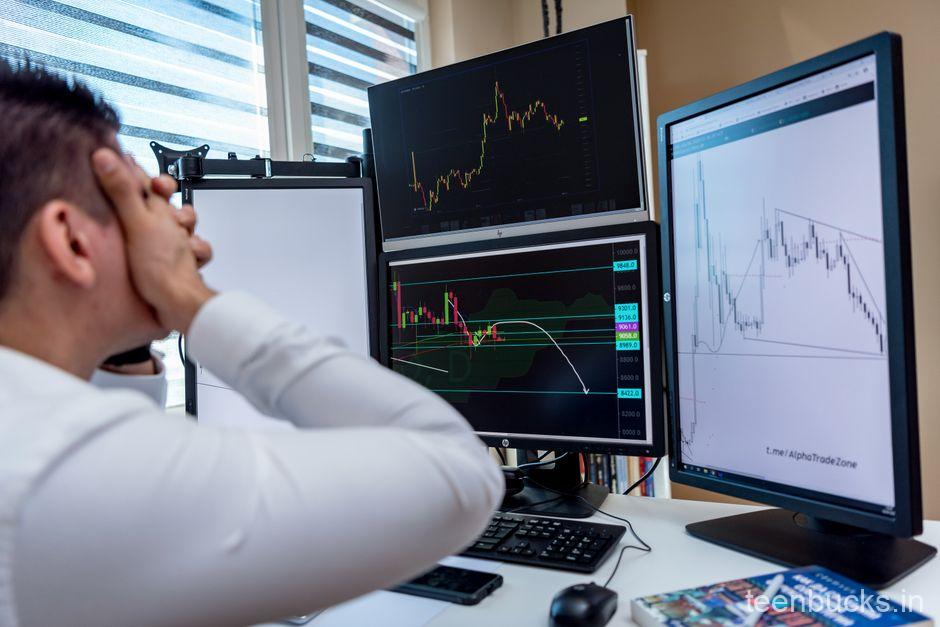
Thursday, 1:45 PM: The ₹2,800 College Hostel Nightmare
It is Thursday afternoon in a college hostel room in Pune.
You have an internal lab exam at 3:00 PM. But your laptop isn’t open to your engineering notes or your MBA case study. Your screen is split between a 1-minute candlestick chart on your discount broker app and a buzzing Telegram group titled “NIFTY BANKNIFTY SURE-SHOT VIP TRADERS”.
Your bank balance is down to ₹2,840 — the remnants of your monthly allowance that was supposed to cover your mess bill, water jar refills, and weekend chai for the next twelve days.
Then, a notification pings on your phone with three fire emojis:
“🚨 EXPIRY DAY HERO-ZERO CALL!! BUY BANKNIFTY 49200 CE @ ₹18! TARGET 65! FAST MOMENTUM COMING! SL NONE, JACKPOT TRADE! 🚀🚀”
Your heart races. You do the instant mental arithmetic that has ruined more student bank accounts in India than all credit cards combined:
“At ₹18 a premium, a lot costs less than ₹300! If I buy 8 lots for ₹2,400, and it spikes to ₹65 like last week… my ₹2,400 becomes ₹8,500 in 40 minutes. I can pay my mess dues, buy that sneaker on sale, and still have money left over.”
You swipe right to execute the order. The trade fills at ₹18.40.
For two minutes, the green number flashes: +₹180. A dopamine hit floods your brain. You feel like a Wall Street prodigy sitting in a hostel room.
Then, Bank Nifty consolidates. It doesn’t crash; it just stops moving for fifteen minutes. The premium drops from ₹18 to ₹12. Then to ₹7.50. Then to ₹3.20. You freeze. Panic sets in. You refuse to cut the loss because “it might bounce back.” By 3:18 PM, the market closes. The contract expires worthless at ₹0.05.
Your ₹2,400 is gone. And on top of that, your broker debits ₹47.20 in turnover charges, STT, and GST from your remaining bank balance.
If this story sounds uncomfortably familiar, you are not alone. Across engineering hostels in Bangalore, commerce colleges in Delhi, and universities in Tier-2 and Tier-3 cities, this exact scene plays out every single week. What feels like bad personal luck is actually an engineered, multi-billion-rupee statistical meat grinder.
The SEBI Reality Check: Cold, Hard Numbers from FY26
For years, financial influencers on YouTube and Instagram claimed that trading losses were just a matter of “bad mindset” or “poor risk management.” But in late 2024 and throughout 2025–2026, the Securities and Exchange Board of India (SEBI) released exhaustive, empirical studies analyzing real trading data across millions of Indian demat accounts.
The regulatory findings completely dismantled the influencer fantasy:
What Official SEBI Data Reveals About F&O Traders in India:
- The 88.5% Loss Rate: In FY26, 87.7% to 88.5% of all individual F&O traders incurred net financial losses. Over a 3-year cumulative period (FY22–FY24), the loss percentage among active retail traders touched an astonishing 93%.
- Youth Domination: Traders aged under 30 years old now make up 43% of the total individual F&O trading base in India — up from just 11% five years ago. This cohort suffered an even higher loss rate of 88.5%.
- ₹91,685 Crore Lost: Individual retail traders lost a net total of ₹91,685 crore in FY26 alone (following over ₹1.8 lakh crore lost in the preceding three-year cycle).
- The Average Wipeout: The average net loss per loss-making trader was ₹1,17,000. For a college student or fresher earning zero or minimal income, ₹1.17 lakh represents several years of pocket money or an entire semester’s tuition.
- The Low-Income Trap: Over 75% of active individual traders reported an annual income of less than ₹5 lakh. Yet, their trading turnover was 75 times their total net worth.
So, where did that ₹91,685 crore go? SEBI’s data answers this clearly: Proprietary algorithmic trading desks and Foreign Portfolio Investors (FPIs) made gross trading profits exceeding ₹60,000+ crore. The money did not disappear; it was systematically transferred from the bank accounts of college students and retail dreamers into the servers of multi-million-dollar quantitative hedge funds.
The 4 Traps That Guarantee Students Lose Money
Why is it that intelligent students who can solve complex calculus, write clean Python code, or master company law consistently fail at options trading? The answer lies in four structural traps that retail traders can never overcome with willpower alone.
1. Theta Decay: The Silent Guillotine of Options Buying
Most students trade as Options Buyers because buying requires very little capital (you only pay the premium, whereas options selling requires ₹1.5 lakh to ₹2 lakh in margin). What beginners don’t realize is that options are wasting assets governed by a Greek variable called Theta (Time Decay).
An option contract does not just track the underlying index; it has an expiration countdown clock. Every second that passes without a massive directional movement in your favor, the option premium bleeds value. On expiry day (e.g., Thursday for Nifty), Theta decay accelerates exponentially.
Even if you correctly predict that Nifty will go up, if it goes up too slowly, your call option will still lose 60% of its value before you can sell it. You can be 100% right on the market direction and still lose 100% of your money. That is the mathematical trap of options buying.
2. The “Hero-or-Zero” Fallacy (Negative Expected Value)
Buying out-of-the-money (OTM) options trading at ₹5, ₹10, or ₹20 on expiry afternoon feels like a smart, low-risk bet. You tell yourself: “The most I can lose is ₹1,000, but I could make ₹5,000.”
In probability theory, this is known as a Negative Mathematical Expectation game. Quantitative studies on the National Stock Exchange (NSE) show that deep OTM contracts on expiry day have a probability of expiring in-the-money of less than 4% to 6%.
If you play a game where you lose ₹1,000 nine times out of ten, and double your money once, your expected long-term outcome is mathematical bankruptcy. You are buying lottery tickets from algorithmic market-makers who have priced the odds with microsecond precision.
3. You vs. The Machine: An Asymmetric War
When you place an order on your smartphone through a 5G connection in your hostel room, your order travels through cell towers, public internet nodes, your broker’s gateway, and finally hits the exchange matching engine. Total latency: 200 to 500 milliseconds.
On the other side of your trade is a High-Frequency Trading (HFT) server physically co-located inside the National Stock Exchange data center in Bandra-Kurla Complex, Mumbai. Their execution latency is measured in microseconds (0.000001 seconds). Their algorithms read order book imbalances, cancel fake liquidity, and adjust option pricing before your smartphone screen has even refreshed the candlestick chart.
Competing against institutional quantitative firms with a phone and a Telegram channel is like challenging an Olympic sprinter to a 100-meter race while wearing lead boots.
4. The Friction Tax: Brokerage and Taxes Will Bleed You Dry
Even if you manage to break even on your trades, the transaction friction of derivatives trading in India is brutal. SEBI’s research revealed that on top of gross trading losses, retail traders paid an additional 26.4% in non-market friction costs:
If a student with a ₹10,000 capital executes just 4 round-trip option trades a day for 20 trading days in a month, they pay approximately ₹3,500 to ₹4,200 in pure friction charges. That means their portfolio must generate a 42% monthly return just to break even! No hedge fund on earth produces 42% monthly returns consistently.
The Telegram Grift: How “Finfluencers” Fake Their Profits
Every student caught in the F&O vortex points to the same justification: “But Bhai, the Telegram channel admin posted a screenshot showing ₹4,50,000 profit today! People are making money!”
Understanding how these screenshots are manufactured will immediately cure your FOMO (Fear Of Missing Out):
- HTML Inspection / Fake Demo Apps: On web browsers, editing an HTML element to change a ₹45 loss into a ₹4,50,000 profit takes 10 seconds via “Inspect Element”. Furthermore, the grey market is flooded with clone trading apps that simulate fake Zerodha or Groww dashboards for Instagram reels.
- The Straddle Hedging Scam: Fraudulent tipsters operate two separate sub-channels. In Channel A, they tell 1,000 people to buy the 49000 Call. In Channel B, they tell 1,000 people to buy the 49000 Put. Whichever side the market moves, one channel wins a 300% profit. The scammer deletes the losing post from the failed channel, screenshots the winning channel, and uses it to charge new students ₹5,000 for “VIP Lifetime Access”.
- SEBI Registration Reality: Over 95% of Telegram and WhatsApp tipsters are unregistered and operating completely illegally. Under SEBI regulations, offering paid stock advice or guaranteed returns without a SEBI Research Analyst (RA) or Investment Adviser (IA) license is a punishable offense.
Why SEBI Just Shut Down the Expiry Day Circus (2024–2026 Reforms)
Recognizing that retail derivatives speculation was threatening the financial stability of Indian households, SEBI implemented sweeping regulatory interventions between late 2024 and 2026:
- Increased Minimum Contract Value: SEBI raised the minimum index derivative contract size from ₹5–10 lakh to ₹15–20 lakh. This substantially increases the margin required, deliberately pricing small retail gamblers out of high-risk contracts.
- Restriction to One Weekly Expiry: Previously, stock exchanges competed by offering expiries every single day of the week (Nifty on Thursday, Bank Nifty on Wednesday, FinNifty on Tuesday, Midcap Nifty on Monday, Sensex on Friday). SEBI banned this practice, restricting each exchange to only one weekly index derivative product to curb daily gambling addiction.
- Mandatory Upfront Premium Collection: Brokers can no longer offer intraday leverage or deferred credit for option buying. Every rupee of option premium must be pre-funded in cash.
- 50:50 Cash-Collateral Margin Rule: Enforcing strict cash requirements prevents traders from pledging illiquid holdings to borrow reckless derivatives leverage.

The Real Path: How to Actually Build Wealth in College
If options trading is a statistical dead end, what should an ambitious college student with an appetite for wealth creation actually do? The formula is boring, unglamorous, and mathematically bulletproof.
1. Automate a ₹500 or ₹1,000 Index Fund SIP
Instead of burning ₹2,000 every Thursday on expiring lottery tickets, route that exact money into a ₹500 to ₹1,000 monthly Systematic Investment Plan (SIP) in a low-cost Nifty 50 Index Fund or a broad-market Flexi-Cap Fund.
Consider the math of compounding over time:
- If you invest ₹1,500 every month starting at age 19, assuming a historical 12.5% CAGR from the Indian equity market, your investment will grow to over ₹9.8 Lakh by age 30, and over ₹1.1 Crore by age 45.
- You spend zero hours staring at 1-minute candlestick charts. You suffer zero mental anxiety during lectures. You have zero risk of your capital expiring to ₹0.00 on Thursday afternoon.
2. Invest in Asymmetric Skills, Not Asymmetric Trades
The best investment you can make between the ages of 18 and 23 is in your personal earning power. A student who spends three months mastering freelancing skills (video editing, high-ticket copywriting, full-stack coding, or digital performance marketing) can realistically scale their monthly income to ₹25,000–₹50,000/month.
That extra income can then be poured into real equity assets, real businesses, or your own education without ever touching toxic derivatives.
🟢 The TeenBucks Takeaway
The Indian stock market is one of the greatest wealth-creation machines in modern economic history. Over the past twenty years, long-term equity investors in India have created life-changing, generational fortunes by backing world-class businesses.
But Futures and Options trading is not investing. It is a highly leveraged, zero-sum financial instrument originally designed for institutional hedgers and corporate treasuries to manage massive portfolio risks — not for college students trying to flip their mess money into quick weekend cash.
Delete the shady Telegram channels. Stop looking for “Hero-or-Zero” lottery tickets. Close your intraday trading terminal, set up an automated index SIP, focus on building high-value career skills, and let the unstoppable mathematics of Indian economic growth compound your wealth over decades.
Frequently Asked Questions (FAQs)
Can college students legally trade F&O in India?
Why do options buyers lose money even when the market moves in their direction?
What is a “Hero-or-Zero” trade on expiry day?
Are Telegram and WhatsApp stock tip channels genuine?
How much money did retail traders lose in F&O according to SEBI?
What changes did SEBI make to F&O rules in 2024–2026?
What is the best alternative to options trading for college students?
Can I offset options trading losses against my salary or freelance income in ITR?
Authoritative Sources & Official References:
1. Securities and Exchange Board of India (SEBI) — Study on Analysis of Profit and Loss of Individual Traders in Equity F&O Segment
2. National Stock Exchange of India (NSE) — Equity Derivatives Risk Disclosures & Contract Specifications
3. BSE India — Investor Protection Guidelines & Derivatives Settlement Rules
4. Press Information Bureau (PIB) — Ministry of Finance Regulatory Updates on Securities Transaction Tax (STT)
Disclaimer: This article is strictly for financial educational and literacy purposes. TeenBucks does not provide investment advice, trading tips, or stock recommendations. Trading in derivatives (Futures & Options) carries high market risk and can result in total loss of invested capital. Always consult a SEBI-registered financial advisor before making investment decisions.


![₹5,000 SIP for 10, 15, 20, 25 Years: Exact Returns at 10%, 12%, 15% [2026] - TeenBucks](https://teenbucks.in/wp-content/uploads/2026/09/5000_sip_investment_returns_featured-300x167.jpg?v=clean2026)