Your bank balance is ₹84. Your college project needs a ₹1,200 software subscription. And that internship application wants a payment card.
You search for a credit card. Every second form asks for a monthly income, employment details, or salary slips you obviously don’t have.
So your roommate says, “Bro, just open an FD and take a credit card. Guaranteed.”
The FD part is real. The ‘guaranteed’ part isn’t. Here’s what to check before you lock away your semester’s spare cash.

Your first card should solve a payment problem, not create a debt problem. Original TeenBucks editorial image.
What is an FD-backed credit card, exactly?
Think of it like giving the bank a refundable security deposit—not buying a credit card.
You open a fixed deposit (FD) with the issuing bank. The bank places a lien on it, which means you can’t freely withdraw that pledged money while it is securing the card. The bank then sets a limit based on a percentage of the FD. You spend with the card and receive a monthly bill, just like a regular card.
If you miss repayments, the bank can charge interest and fees, report the missed payment, and may use the pledged FD to recover dues under its agreement. An FD doesn’t make the debt harmless.
Two things are easy to mix up:
- The FD earns interest at the rate agreed when you book it, subject to its terms. There’s no universal 7% rate.
- The card balance is a separate bill. You still owe everything you spend; interest on the FD doesn’t automatically pay the bill.
For eligible deposits at insured banks, DICGC insurance generally covers up to ₹5 lakh per depositor per bank, including principal and interest, according to its aggregation rules. That’s protection for an eligible bank deposit—not a promise that credit-card fees or losses will be reimbursed. DICGC’s deposit-insurance guide explains the limits.
The actual maths: ₹2,000, ₹10,000 and ₹20,000 FDs
Forget “easy credit up to ₹1 lakh.” Your useful number is the limit against the amount you can genuinely afford to lock away.
Illustrative limits, using the issuers’ published percentages:
| Example product | FD | Card limit | 30% of limit |
|---|---|---|---|
| SBM ZET (90%) | ₹2,000 | ₹1,800 | ₹540 |
| Kotak 811 DreamDifferent (90%) | ₹10,000 | ₹9,000 | ₹2,700 |
| IDFC FIRST WOW! (100%) | ₹20,000 | ₹20,000 | ₹6,000 |
That last column is 30% of the limit, a useful conservative spending target, not an RBI rule or a guarantee of score improvement. On a ₹1,800 limit, even a ₹600 canteen-and-books bill would use 33.3% of available credit. Small limits fill up fast.
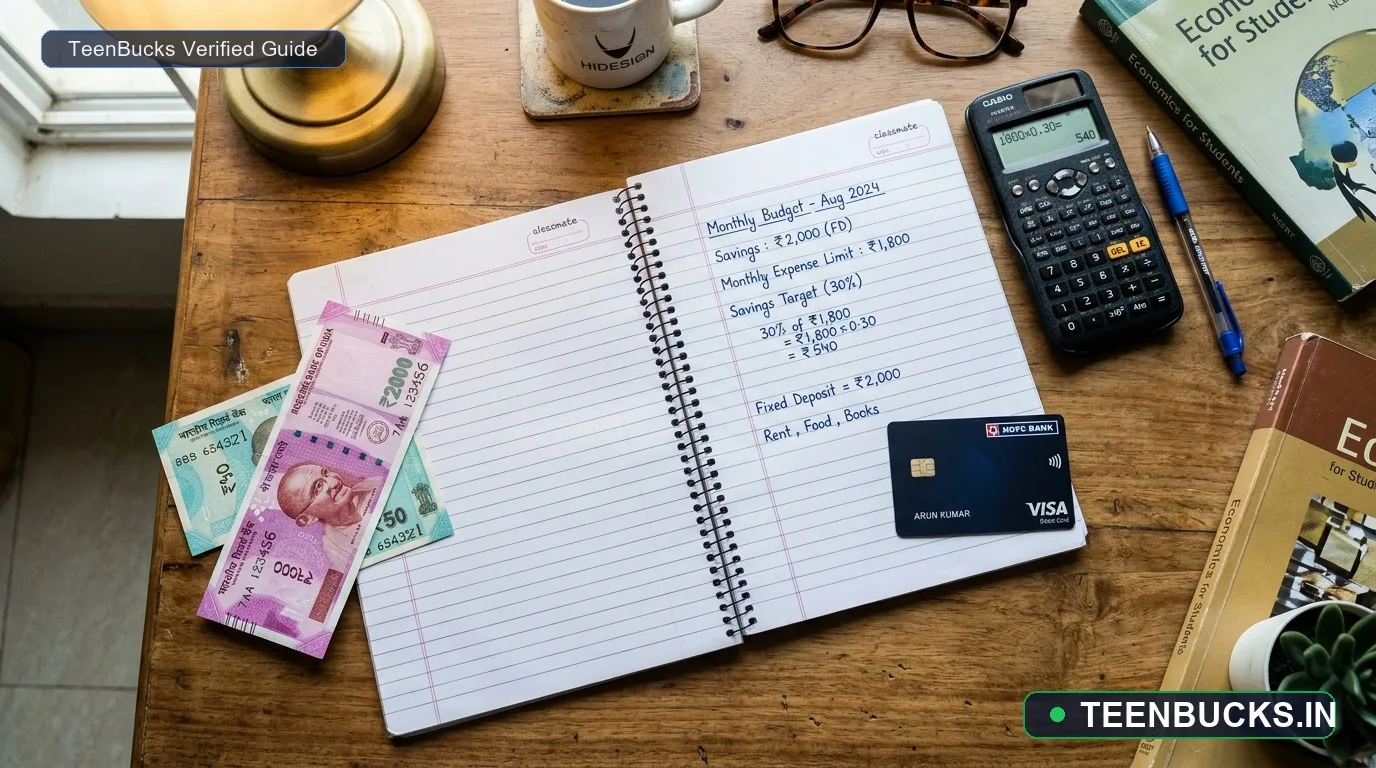
Run the deposit, limit and fee calculation before clicking ‘Apply’. Original TeenBucks editorial image.
Three FD-backed credit cards worth comparing in October 2026
These are options to compare, not bank endorsements or personally tested rankings. Published rates, eligibility and offers can change. Before paying an FD, open the issuer’s live application and Key Fact Statement (KFS) or Most Important Terms and Conditions (MITC).
1. IDFC FIRST WOW! — if you can spare ₹20,000
The official FIRST WOW! page currently lists a ₹20,000 minimum FD for resident Indians, a credit limit equal to 100% of the FD, no joining or annual fee on the core WOW! card, and 0% foreign-currency markup. It says no income proof or prior credit history is required. The bank still reserves the right to decline an application under its policies.
That last sentence matters: “No salary slip required” is not “every student is approved.”
- FD illustration: ₹20,000 → ₹20,000 credit limit, subject to approval.
- Indicative FD interest shown on the issuer page: 6.30% a year at the time checked. ₹20,000 × 6.30% = ₹1,260 for one simple-interest year before tax; actual maturity interest follows FD terms.
- Use case: Someone who has ₹20,000 genuinely available to pledge and values international card payments. It is not sensible if that amount is your rent or emergency money.
- Fee trap: The issuer advertises an optional UPI companion card with separate fees of ₹199 plus GST to join and ₹199 plus GST annually from year two. Don’t confuse that with the lifetime-free core WOW! card.
One extra note: older IDFC pages still appear online with smaller FD amounts. For this article, I’ve followed the bank’s current main WOW! product and eligibility page. Check the amount again inside the actual application.
2. Kotak 811 #DreamDifferent — a ₹10,000 option, but not free to join anymore
This is where the October 2026 fact-check changes the original draft.
Kotak’s current #DreamDifferent product page lists a ₹10,000 minimum FD, up to 90% of the FD as credit limit, and a ₹500 joining fee inclusive of GST from 1 September 2026. It lists no annual fee. Some older Kotak FAQs still say the joining fee is zero; don’t use those older FAQs to override the updated product page.
- FD illustration: ₹10,000 → up to ₹9,000 credit limit.
- Joining cost: ₹500, GST included, as advertised by Kotak. Not ₹500 plus GST.
- Catch with rewards: Its 2% cashback promotion is tied to spending at least ₹15,000 in a billing cycle and has caps. That’s not a natural match for someone trying to spend ₹500–₹1,000 per month.
- Verdict: More plausible than WOW! if ₹20,000 is too much, but compare the joining charge and the value you’ll actually get.
If you’re comparing Kotak products, don’t confuse this with the separately marketed Kotak811 super.money credit card. Those are different offers and must be checked separately.
3. SBM Bank ZET — starts low, but read the new cancellation charges
The ZET product site advertises a starting FD of ₹2,000 and a credit limit of 90% of the FD. The issuing SBM Bank’s site confirms the SBM ZET is an FD-backed RuPay card. This matters if you want to make supported merchant payments on UPI.
- FD illustration: ₹2,000 → ₹1,800 credit limit.
- Joining/annual fees: ₹0 on the current issuer KFS.
- Interest if you carry a purchase balance: 3.5% per month, shown as 42% per annum in that KFS. Avoid revolving debt.
- Forex fee: 2.49% under the KFS, so it is not a zero-forex card.
- New effective 23 October 2026: Late payment fee becomes 5% of total outstanding due (minimum ₹50; maximum ₹1,000). Cancellation within two years of activation attracts ₹499 plus GST, per the current KFS.
The cancellation charge deserves more attention than a flashy cashback banner. ₹499 + 18% GST = ₹588.82.
Let’s say you locked ₹2,000 in an FD that earned a simple 7% for a full year: the illustrative gross interest would be ₹140. The early-cancellation charge alone would be over four times that amount. In practice, FD tenure, tax and premature-closure terms can change the actual interest received. The point is not that ZET is bad; it’s that “no annual fee” doesn’t necessarily mean “no exit cost.”
Quick comparison: which card fits which student?
| Card | Minimum FD advertised | Card/fee point |
|---|---|---|
| SBM ZET | ₹2,000 | 90% limit; no annual fee; early cancellation fee applies |
| Kotak #DreamDifferent | ₹10,000 | Up to 90% limit; ₹500 joining fee incl. GST |
| IDFC FIRST WOW! | ₹20,000 | 100% limit; core card free; 0% forex markup |
My take: If ₹2,000 is all you can spare, don’t lock it in until you’ve read the ZET cancellation clause. If you can comfortably spare ₹10,000, compare Kotak’s ₹500 fee with any fee-free alternatives offered to you. If you have ₹20,000 spare after an emergency buffer, WOW! deserves a look. And if you don’t need a credit card right now, it’s perfectly fine not to get one.
Can you really use a RuPay credit card for chai and canteen UPI payments?
Sometimes, yes. A compatible RuPay credit card can be linked to a supported UPI app and used to pay eligible merchants by scanning their QR code. But you can’t use that route to send money person-to-person, transfer between cards or withdraw cash. Some merchants or categories may not accept card-funded UPI transactions.
So that ₹30 chai at a registered shop might work. Sending ₹300 to a roommate’s personal UPI ID will not work through RuPay credit-on-UPI. The NPCI’s official RuPay-on-UPI guide sets out the eligible payments and restrictions.

RuPay credit on UPI is for eligible merchant payments—not paying your roommate. Original TeenBucks editorial image.
Three ways students accidentally turn a ‘credit-building’ card into a problem
Mistake 1: Treating the credit limit as extra pocket money
On a ₹5,000 card limit, spending ₹4,800 means 96% utilisation. Aiming for a low reported balance, often under 30% as a practical rule of thumb, can help you avoid looking heavily dependent on available credit. But 30% is not a universal statutory threshold, and there’s no specific number of CIBIL points guaranteed.
Don’t manufacture shopping just to build a score. A small planned expense and full repayment are enough to establish a sensible habit.
Mistake 2: Paying ‘minimum due’ and thinking the bill is settled
If you spent ₹2,000 and your minimum due is ₹100, paying ₹100 is not the same as clearing your ₹2,000 bill. You still owe ₹1,900 and may lose the interest-free period on further purchases. Interest, taxes and other charges can make the total higher.
Using ZET’s stated 3.5% monthly rate, 3.5% of ₹1,900 is ₹66.50 for a hypothetical one-month calculation, before GST and any other applicable charges. This is an illustration, not an exact statement calculation; actual finance charges depend on dates, payment allocation and the card terms.
The habit to build: pay the Total Amount Due by the due date, ideally with a reliable reminder or autopay and enough money in the linked account.
Mistake 3: Assuming your FD is instant emergency cash
While it’s under lien, the FD isn’t freely available for hostel fees, urgent travel or a medical expense. Card cancellation, clearing outstanding dues, lien release and any FD pre-closure follow the issuer and deposit terms. Don’t rely on a universal “48-hour release” promise.
If ₹5,000 is your only emergency money, keeping it liquid matters more than getting a credit card.
For the bigger picture of what counts in a credit report, use our student CIBIL score guide. This article is the card-comparison companion, not a shortcut to a guaranteed score.
How to apply without making a mess of it
You usually need to be 18 or older for a primary credit card and satisfy the issuer’s identity, address, residency and KYC checks. PAN and acceptable identity/address documents are commonly requested. Aadhaar-based verification, mobile OTP or video KYC may be offered, but the steps vary by issuer—there is no standard “60-second KYC and delivery in four days” guarantee.
- Decide the FD amount first. Make sure it is spare money, not next month’s food or rent budget.
- Start on the actual issuing bank’s official site or its linked partner journey. For fintech-branded cards, check which regulated bank is issuing the card and holding the FD.
- Read three documents: the FD terms, the card’s current KFS/MITC, and cancellation/lien-release rules. Check joining fees, APR, cash withdrawal charges and taxes.
- Complete the prescribed KYC and FD funding. Don’t send an FD to a personal UPI ID or to a stranger claiming to be an agent.
- After approval, set billing alerts and full-balance payment. Check your first statement and card controls. An optional RuPay companion card may have a separate cost.
- Confirm reporting. The issuer should explain its credit-bureau reporting. RBI requires lenders to update credit information on a fortnightly cycle from January 2025, but that doesn’t mean a new 750 score magically appears after two weeks.
You can read the RBI card-issuance directions and RBI’s credit-reporting frequency circular for the regulatory background. Issuer terms decide the exact product conditions.
Do hard enquiries ruin your CIBIL score?
Submitting a formal credit application can trigger a lender enquiry in your credit file. Multiple applications in a short period may hurt a score or raise questions for a lender—but there’s no reliable rule that three rejections in one semester will deduct a fixed number of points. A rejection and a recorded enquiry are not the same event.
Your own credit-report check is different from a lender’s credit application enquiry. Rather than spraying applications across five apps, shortlist one appropriate card, check eligibility, then decide whether you need it at all.
And remember: a credit score isn’t normally a universal requirement for renting an apartment. Landlords can have their own screening practices, but don’t build an entire credit habit around that scare line.
One final money check before applying
If your family sends ₹3,000 monthly pocket money and ₹2,400 already goes on mess meals, local travel, mobile data and canteen spending, a new credit card doesn’t create an extra ₹1,800. It creates an extra bill that will arrive later.
If you still want one, limit it to an amount you can pay in full from money you already have. That is the boring part that actually works.
If you’re still picking a primary savings account, read our zero-balance account guide for students and compare account charges separately from card fees.
FAQs: Student Credit Cards Without Salary Slips
Can I get an FD-backed credit card at 17?
You generally need to be 18 or older for a primary card. Some banks may offer add-on cards to eligible family members under their own age and consent rules, but an add-on card isn’t the same as building an independent credit history in your name. Check the issuer’s rules rather than assuming every 17-year-old qualifies.
Does the FD still earn interest while it is pledged?
Usually yes, under the booked FD’s applicable rate and terms. But you generally cannot withdraw pledged funds freely. For example, 7% of ₹2,000 is ₹140 for a simple one-year illustration before tax; actual FD interest and closure charges vary.
Will I have a 750+ CIBIL score within six months?
Nobody can honestly promise that. A properly reported card and on-time, full payments can help establish credit history, but scoring depends on your complete file and reporting. RBI’s fortnightly reporting frequency is not a guarantee of a score or approval date.