📊 The 4 Student Deciding Factors (Groww vs Zerodha)
- Account Opening Fee: Groww is 100% free (₹0), whereas Zerodha charges ₹200 for digital onboarding.
- Annual Maintenance (AMC): Groww is ₹0 lifetime free. Zerodha is ₹0 under ₹4 Lakh (BSDA rule), but charges ₹354/yr once combined demat holdings cross ₹4 Lakh.
- Unit Holding Format: Groww holds mutual funds in SOA format directly with AMCs (safer if broker is down). Zerodha holds them in CDSL Demat.
- UPI AutoPay Safety: Both support 1-click UPI AutoPay without bank bounce penalties, avoiding risky ₹500 bank NACH return penalties.
If you are an Indian student or a 20-something first-time investor ready to start your first Systematic Investment Plan (SIP), you have undoubtedly hit the classic dilemma: Groww or Zerodha?
Both platforms are SEBI-registered fintech giants commanding millions of active investors. Both offer 100% Direct Mutual Funds with 0% distributor commission. But under the hood, how they store your mutual fund units, their fee structures, and their ease of auto-pay automation are completely different.
In this exhaustive 2026 comparison, we peel back the marketing to help you choose the exact platform suited to your pocket money and investment goals.
Calculate Your SIP Returns Before Picking an App
Before committing your monthly savings to either app, test your expected returns on our free SIP calculator for college students India. You can try our step-up SIP calculator to see how starting with a ₹500 stipend and adding annual 10% increments accelerates your first ₹10 Lakh milestone.
Feature Comparison: Groww vs Zerodha Coin at a Glance
Before diving into the fine print, here is how the two platforms stack up across critical metrics for student investors:
| Feature | Groww | Zerodha (Coin) |
|---|---|---|
| Account Opening Fee | ₹0 (Free) | ₹200 (Online KYC) |
| Demat Annual Maintenance (AMC) | ₹0 Lifetime Free | ₹300/yr + GST (Free under ₹4L BSDA rule) |
| Mutual Fund Commission | 0% (Direct Plans Only) | 0% (Direct Plans Only) |
| Unit Storage Format | SOA (Statement of Account via AMC) | Demat Format (CDSL Depository) |
| SIP Auto-Pay Mode | UPI Auto-Pay & NetBanking Mandate | UPI Mandate & Trading Balance |
| Step-Up SIP Support | Yes (Native in app) | Yes (Customizable in Coin) |
| Pledge / Loan Against Mutual Funds | Yes (via partner NBFC) | Yes (Instant CDSL Demat Pledge) |
| App User Experience | Super Intuitive, 1-Click Navigation | Minimalist, Pro-Trader Orientated |
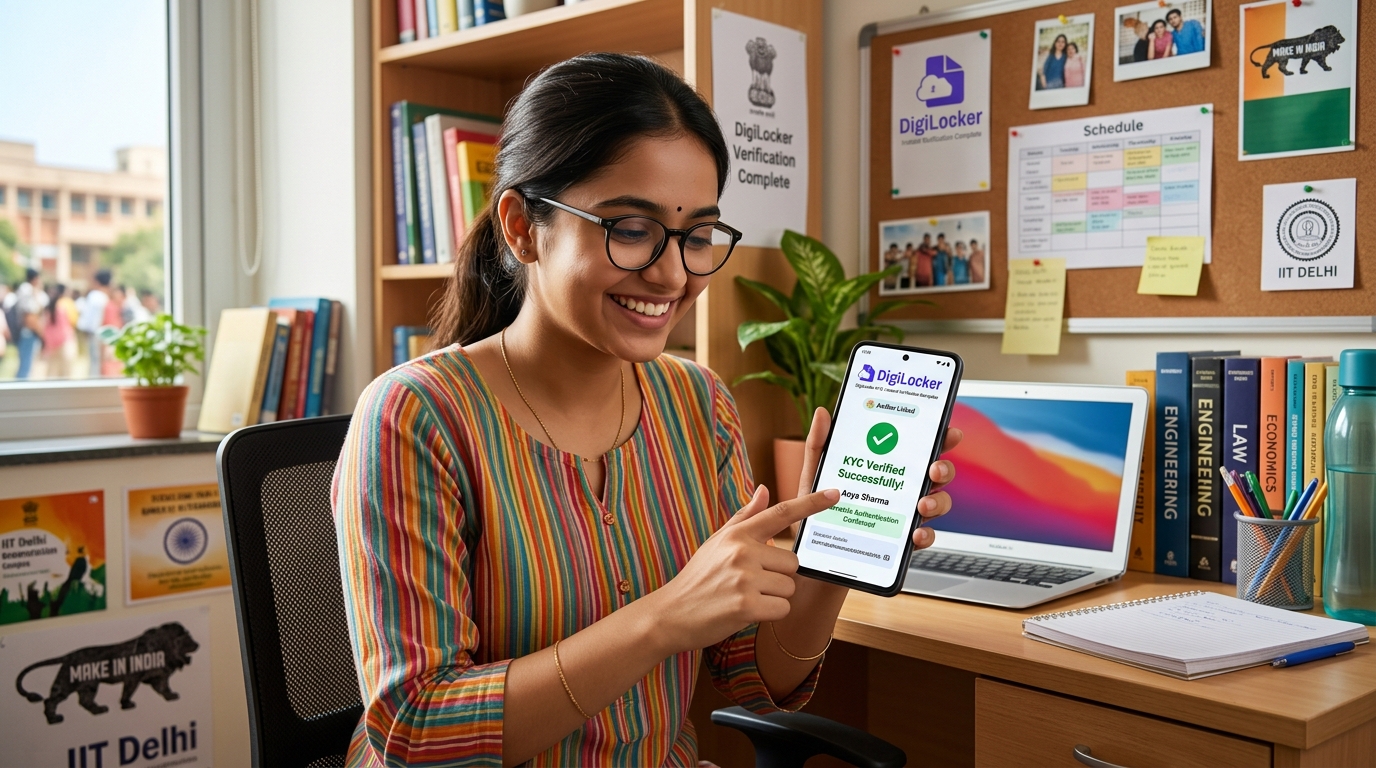
TeenBucks Guide: Both Groww and Zerodha support 100% digital e-KYC using DigiLocker and Aadhaar OTP
Key Difference #1: Demat vs SOA (Statement of Account) Format
This is the fundamental technical architecture nuance that 95% of beginners overlook when opening an account:
- Groww uses SOA Format: When you purchase a mutual fund on Groww, the units are registered directly with the mutual fund house (AMC) through official Registrar and Transfer Agencies (RTAs) like CAMS or KFintech. Groww acts purely as an execution gateway. If Groww ever encounters technical downtime or stops operating, your units remain 100% safe with the AMC. You can log into MFCentral or CAMS directly and redeem your units without opening the Groww app.
- Zerodha Coin uses Demat Format: Zerodha holds your mutual fund units directly in your CDSL Demat account alongside your stocks and ETFs. While having all your equities in one single demat statement is organized, you cannot manage or redeem your units through external RTA portals like CAMS without transferring them out of demat via formal depository slips.
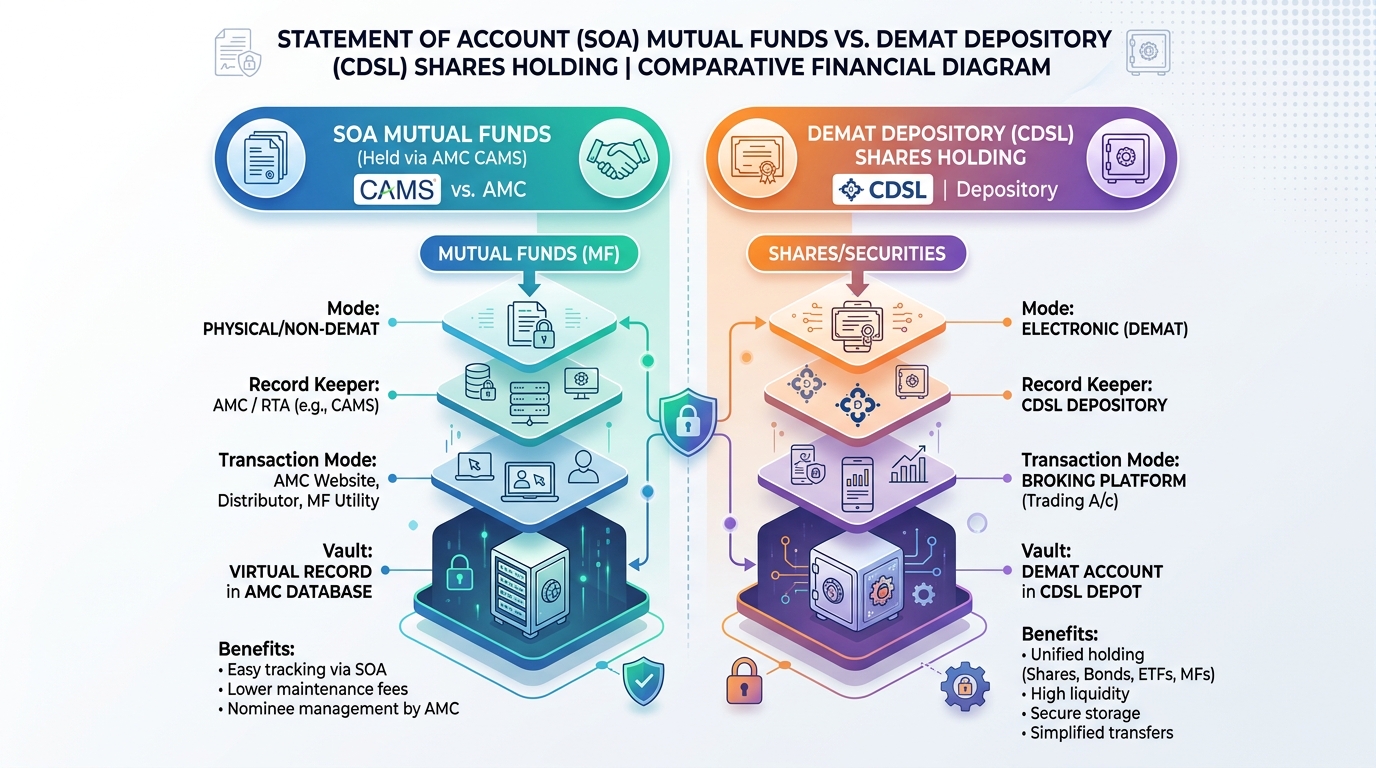
TeenBucks Guide: SOA format holds units directly with the AMC, while Demat format holds them in CDSL depository
Key Difference #2: Hidden Charges & The Revised SEBI BSDA ₹4 Lakh Rule
For a student starting with ₹500 to ₹2,000 per month, annual maintenance charges (AMC) can silently eat away an entire month’s worth of student savings.
Groww’s Pricing: Groww charges ₹0 Account Opening and ₹0 AMC forever. Whether your portfolio is ₹5,000 or ₹50,00,000, you will never receive an annual maintenance debit invoice.
Zerodha’s Pricing & The BSDA Rule: Zerodha charges a one-time ₹200 digital account opening fee. For demat AMC, SEBI (Securities and Exchange Board of India) revised the Basic Services Demat Account (BSDA) regulations:
- Portfolio under ₹4,00,000: Annual AMC is ₹0 (Free).
- Portfolio between ₹4,00,001 and ₹10,00,000: AMC is capped at ₹100/year + GST (₹118).
- Portfolio above ₹10,00,000: Standard AMC of ₹300/year + GST (₹354) applies.
The Critical Catch for Students: Because Zerodha Coin holds mutual funds in Demat form, your mutual funds count toward your ₹4 Lakh BSDA limit! On Groww, because mutual funds are in SOA form, your mutual fund wealth never triggers demat AMC charges.
For complete details on avoiding surprise broker maintenance charges, check our dedicated investigative guide on Best Zero-Fee Demat Accounts for College Students in India (Groww vs Zerodha Hidden AMC Exposed).
Key Difference #3: Mandate Failures & Bank Bounce Penalties
Setting up automated monthly debits is the heartbeat of SIP investing. But what happens if you are a student and your bank account balance runs low on the 5th of the month?
- UPI Auto-Pay on Groww: Groww leverages UPI Auto-Pay via PhonePe, Google Pay, and Paytm. If your bank balance is insufficient on the scheduled debit date, the UPI mandate simply fails for that month. Groww charges ₹0 penalty, and your bank charges ₹0 bounce fee.
- Bank E-NACH Mandates: If you configure your SIP via physical or net banking E-NACH mandates rather than UPI Auto-Pay, and your balance falls short, your bank (such as SBI, HDFC, or ICICI) may slap an institutional ECS/NACH return penalty of ₹250 to ₹500 + GST! Always opt for UPI AutoPay inside both apps.
Key Difference #4: Same-Day NAV Cut-off Times
Under SEBI’s operational circulars on mutual fund NAV allocation:
- The official industry cut-off time for equity funds is 2:30 PM.
- However, same-day NAV is only allocated if the investor’s money is actually realized by the fund house (AMC) before 2:30 PM.
- Groww’s payment gateway clearing directly to ICCL generally ensures same-day NAV if you order before 1:00 PM via UPI. On Zerodha Coin, orders are batched and executed seamlessly through the exchange clearing corporation.

TeenBucks Guide: Pick Groww for zero-fee mutual funds, or Zerodha if you want a pro trading terminal alongside your SIP
Loan Against Mutual Funds (LAMF): What If You Need Emergency Cash?
If you accumulate a sizable portfolio and face an unexpected medical or college semester fee emergency, breaking your SIP triggers taxes and kills compounding. Both platforms allow you to pledge your mutual funds for an instant digital overdraft loan:
- Zerodha Loan Against Securities: Because units are stored in CDSL Demat, lien marking is instant. You can borrow against mutual funds at competitive interest rates (10.5% to 11.5% p.a.).
- Groww Credit: Groww partners with top NBFCs to offer digital loans against SOA mutual funds without visiting a branch.
Before taking any borrowing decision, compare your monthly EMIs and total interest payable using our free TeenBucks Loan & EMI Calculator.
The Final Verdict: Which Platform Should Students Pick?
Here is our clear, no-nonsense recommendation for 2026:
- Choose Groww if: You are a college student, intern, or beginner starting with ₹500 to ₹5,000/month. You want 100% free account opening, lifetime zero AMC, pure SOA unit safety, and a simple app that doesn’t distract you with complicated candlestick charts.
- Choose Zerodha if: You have ₹200 to pay for onboarding, you want an institutional-grade platform with zero marketing push notifications, and you plan to invest in individual equity stocks, ETFs, or Sovereign Gold Bonds (SGBs) alongside your mutual funds in a single consolidated CDSL Demat account.
Frequently Asked Questions: Groww vs Zerodha for SIP
Is Groww or Zerodha safer for mutual fund investments?
Both are equally safe and strictly regulated by SEBI (Securities and Exchange Board of India). Neither app holds your investment capital; they act purely as technological execution platforms. Your money is transferred directly to the Asset Management Company (AMC), and your ownership is recorded independently with RTAs (CAMS/KFintech) or depositories (CDSL). Even if either company shut down, your mutual funds remain 100% safe.
Can I transfer my mutual fund SIP from Groww to Zerodha later?
Yes. Because Groww holds units in SOA (Statement of Account) format and Zerodha holds them in Demat format, you can convert and dematerialize your SOA units into your Zerodha CDSL demat account by submitting a Demat Request Form (DRF). Alternatively, an easier method is to simply pause your SIP on Groww and start a new SIP in the exact same scheme on Zerodha without selling your existing units.
Do Groww or Zerodha charge commission on SIP profits?
No. Both Groww and Zerodha offer 100% Direct Mutual Funds. Neither platform charges any entry load, distributor commission, or profit cut. The only cost is the mutual fund’s own Total Expense Ratio (TER), which goes directly to the fund house.