
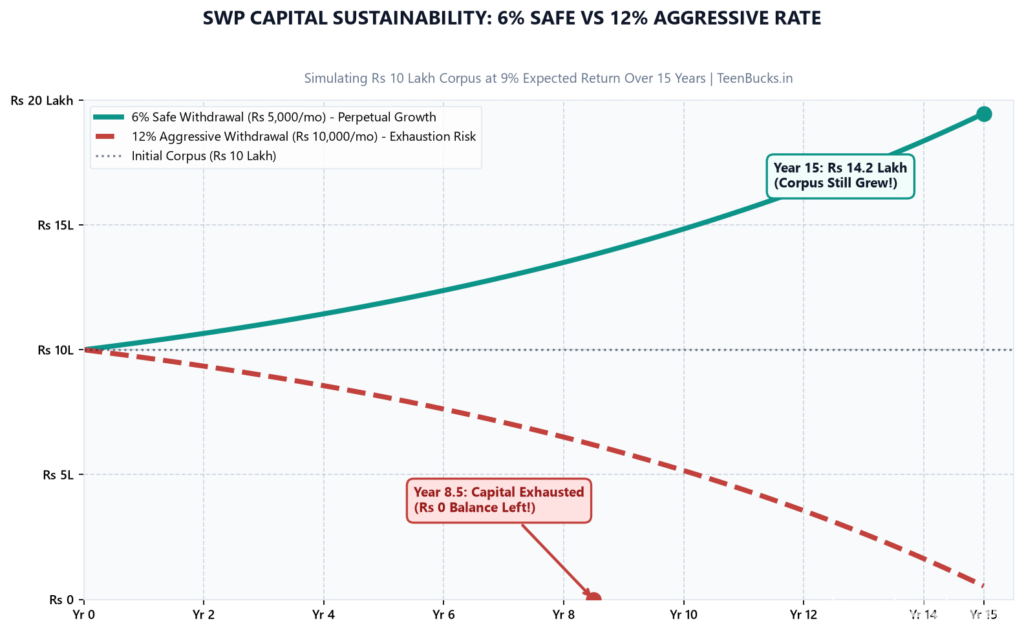
Generating a predictable monthly paycheck without working a traditional 9-to-5 job is the cornerstone of modern financial independence. Whether you are funding your college living costs, supplementing freelance income, or building an early retirement cushion for your family, a Mutual Fund Systematic Withdrawal Plan (SWP) is India’s most tax-efficient cash flow mechanism.
Unlike a traditional Bank Fixed Deposit (FD) where the bank taxes every rupee of your interest, an SWP allows you to withdraw cash while your remaining units continue compounding in the Indian stock and bond markets.
How Much Corpus Do You Need to Get ₹15,000 Every Month?
The exact lump-sum corpus required to generate ₹15,000 monthly (₹1,80,000 annually) depends directly on the expected rate of return and your chosen safe withdrawal rate.
According to long-term market studies by the Association of Mutual Funds in India (AMFI), a safe withdrawal rate for Indian investors is typically between 7% and 9%, given that balanced funds historically deliver 10% to 12% annualized returns.
| Starting Corpus | Annual Return (CAGR) | Withdrawal Rate | 10-Year Total Payout | 10-Year Remaining Corpus | Sustainability |
|---|---|---|---|---|---|
| ₹15,00,000 | 9.0% | 12.0% | ₹18,00,000 | ₹6,53,000 | Exhausts in ~14 Yrs |
| ₹20,00,000 | 9.5% | 9.0% | ₹18,00,000 | ₹22,14,000 | Scenario result only — not guaranteed |
| ₹22,50,000 | 10.0% | 8.0% | ₹18,00,000 | ₹31,45,000 | Generational Wealth |
You can simulate your custom starting balance and expected returns immediately on our interactive SWP Calculator (Target Income Mode), which maps out year-by-year cashflow schedules.
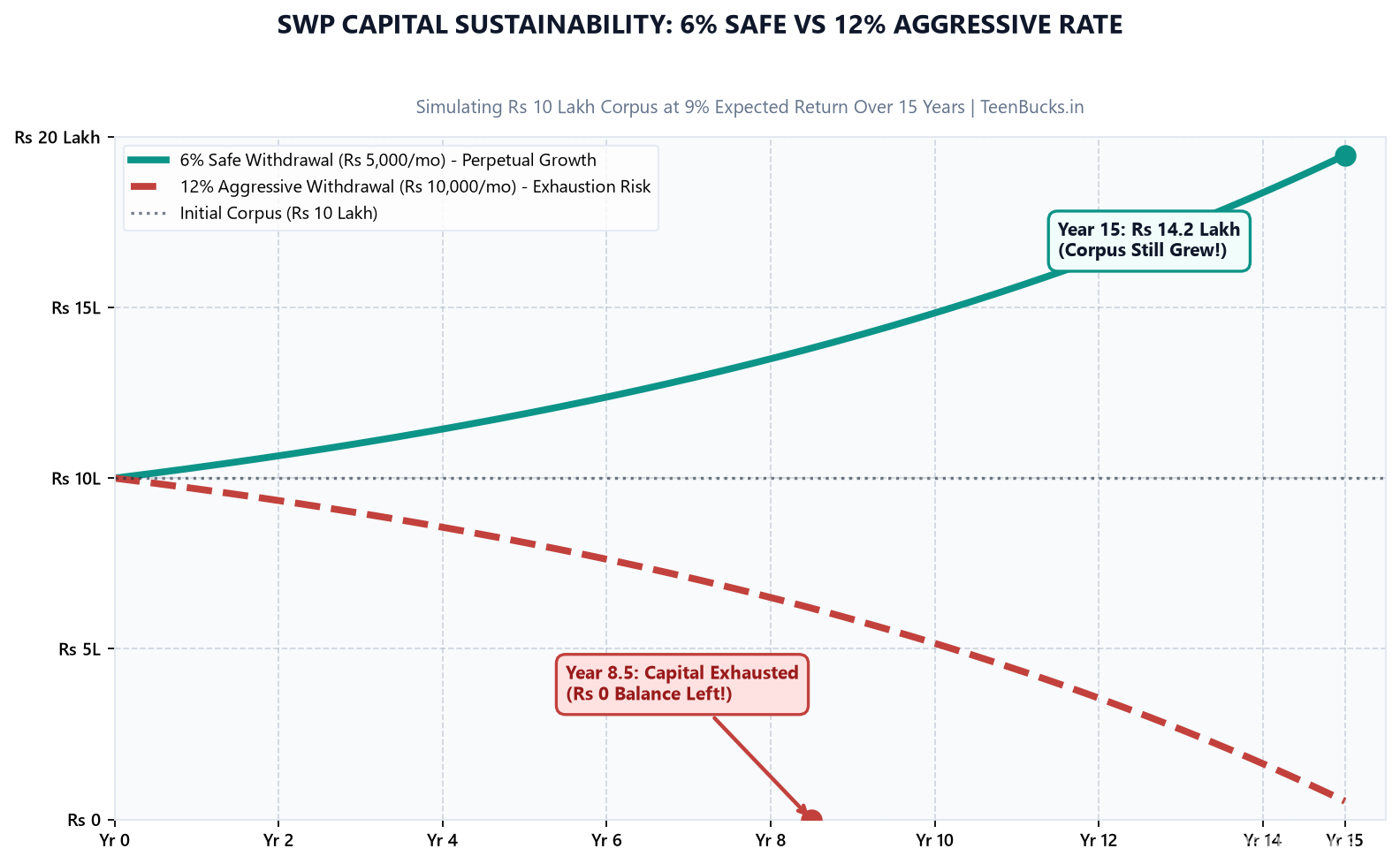
Which Mutual Funds Are Best for Generating ₹15,000 Monthly SWP?
A fatal mistake made by beginner investors is triggering an SWP from high-volatility small-cap or sectoral equity funds. When markets drop 20%, high-beta funds suffer sharp NAV declines, triggering “Reverse Rupee Cost Averaging”—where the fund sells a massive chunk of units at bargain-basement prices to fund your ₹15,000 payout.
To build a bulletproof SWP engine, financial advisors recommend three fund categories:
1. Balanced Advantage Funds (BAFs)
Also known as Dynamic Asset Allocation funds, BAFs dynamically shift between equity (30% to 80%) and debt/arbitrage based on stock market valuations. In a raging bull run, they book profits into fixed income; during severe market crashes, they buy cheap equities. They offer 9% to 11% historical CAGR with roughly half the volatility of pure equity.
2. Conservative Hybrid Funds
These schemes invest 75% to 90% in secure sovereign bonds and top-rated corporate debt, with only 10% to 25% allocated to blue-chip equities. While long-term returns hover around 8% to 9%, they provide supreme stability, making them ideal for individuals who cannot tolerate sharp portfolio fluctuations.
3. Equity Savings & Arbitrage Funds
For investors needing short-term cash flow (1 to 3 years), Arbitrage funds capture mispricings between cash and futures markets with lower directional equity risk but not zero credit, liquidity or market risk, delivering 7% to 7.5% returns with equity taxation treatment.
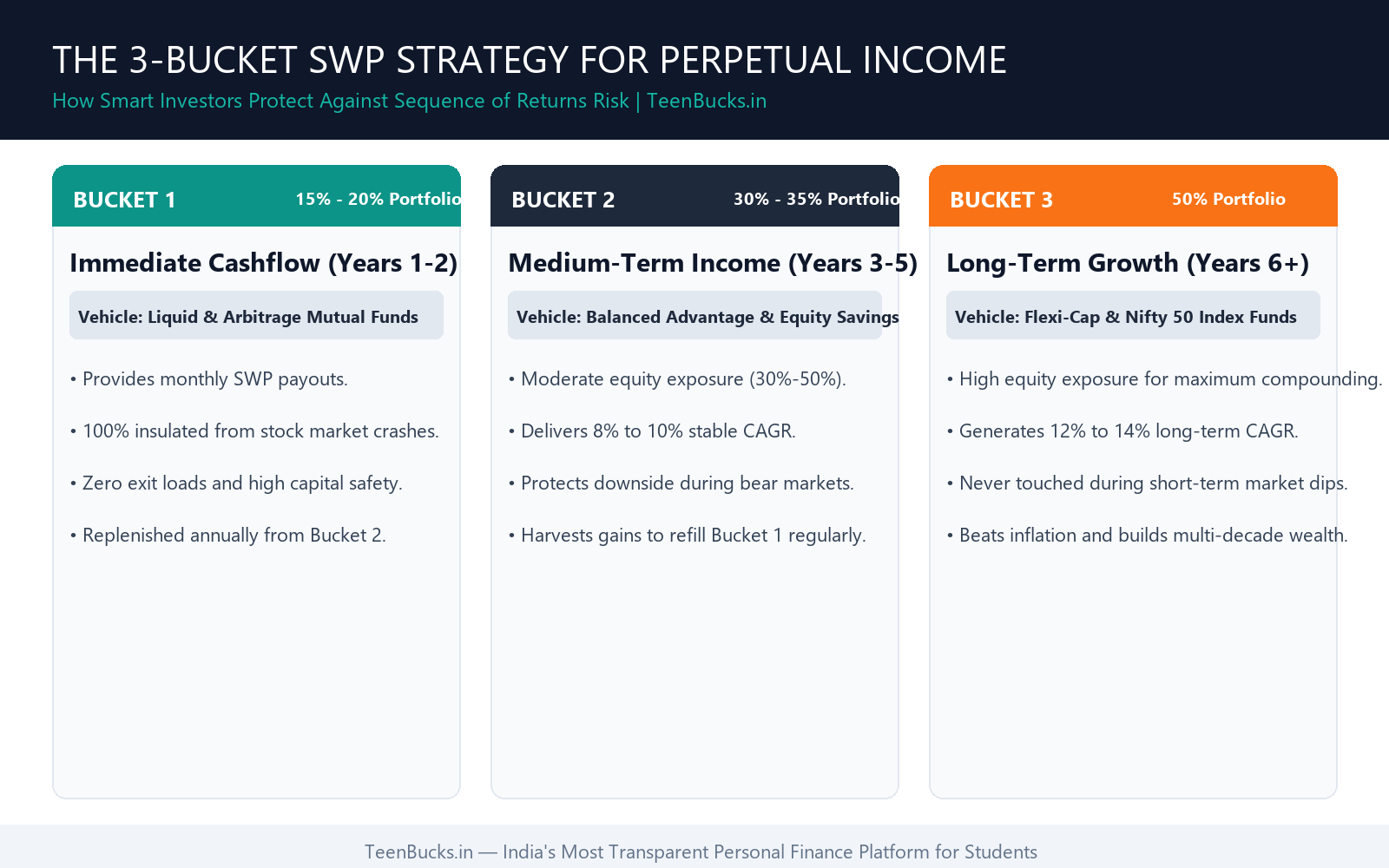
The 3-Bucket Strategy: How to Protect Your ₹15,000 Income Against Market Crashes
To ensure your monthly ₹15,000 income never stops—even if the Sensex or Nifty crashes 30%—institutional wealth managers deploy the 3-Bucket Strategy:
- Bucket 1 (Cash & Emergency – ₹3,60,000): Equal to exactly 24 months of living expenses (24 × ₹15,000). Keep this money in an Arbitrage Fund or Liquid Fund. Your monthly SWP draws exclusively from this lower-volatility bucket (not risk-free).
- Bucket 2 (Conservative Growth – ₹6,00,000): Invested in a Balanced Advantage Fund to yield 8% to 10% returns over medium-term horizons.
- Bucket 3 (Long-Term Compounding – ₹10,40,000+): Allocated to Large & Mid Cap Index Funds or Flexi-Cap Funds delivering 12% to 14% long-term compounding.
Every year, you review your portfolio. During profitable bull markets, you harvest excess profits from Bucket 3 to refill Bucket 1. During steep bear markets, you leave Bucket 3 untouched to recover, while Bucket 1 continues paying your ₹15,000 every month without stress.
Tax Treatment: SWP and FD Are Different, Not Universally Better
FD interest is taxable at the investor’s applicable slab rate. A bank generally deducts TDS under Section 194A only after annual interest crosses the applicable threshold—₹50,000 for most depositors and ₹1,00,000 for senior citizens from 1 April 2025. TDS is not the final tax liability.
An SWP redeems mutual-fund units, so only the capital-gain component is taxed. Section 112A treatment and the ₹1.25 lakh equity LTCG threshold apply only when the scheme qualifies as equity-oriented and the holding-period rules are met. Conservative Hybrid and some Balanced Advantage funds may be taxed differently depending on portfolio classification. Verify the scheme tax status and your own other capital gains.
If you’re also planning for future loan payments or credit building, understand how your bank account operates with our guide on Can Bank Balance Go Negative? The RBI Rule Every Student Must Know and explore PM-Vidyalaxmi Education Loan 2026: Eligibility & Subsidies.
Step-by-Step: How to Set Up Your ₹15,000 SWP Today
- Complete Your Mutual Fund e-KYC: Use any leading discount broker or AMC portal (Groww, Zerodha Coin, CAMS, or MF Central) with your PAN and Aadhaar.
- Deploy Your Corpus: Invest your lump sum into your chosen Balanced Advantage or Hybrid Fund under the Direct – Growth option (never Regular or IDCW).
- Select Your Withdrawal Date: Most AMCs allow you to select any date between the 1st and 28th of the month. Choose a date right after your rent or bill due dates (e.g. 5th of every month).
- Specify the Rupee Amount: Enter ₹15,000 and confirm the auto-credit mandate to your verified primary savings account.
If you haven’t accumulated your ₹20 Lakh corpus yet, start building it systematically using our free SIP Calculator to see how a ₹5,000 to ₹10,000 monthly investment gets you there in under 10 years.
![₹5,000 SIP for 10, 15, 20, 25 Years: Exact Returns at 10%, 12%, 15% [2026] - TeenBucks](https://teenbucks.in/wp-content/uploads/2026/09/5000_sip_investment_returns_featured-300x167.jpg?v=clean2026)

![15-15-15 Rule in SIP Explained: How Students Can Build ₹1 Crore [2026] - TeenBucks](https://teenbucks.in/wp-content/uploads/2026/09/15_15_15_rule_sip_crore_featured-300x167.jpg?v=clean2026)