In the high-stakes AI race of 2026, the real frontier for developers, indie hackers, and student builders isn’t just frontier parameter scale—it is unit economics per token. Building production agents, automated SaaS micro-tools, or customer service pipelines has historically created hefty monthly API invoices that crushed student budgets before products even reached profitability.
Anthropic’s release of Claude Haiku 5.5 fundamentally shifts that equation. Positioned as an ultra-compact powerhouse, Haiku 5.5 is designed from the ground up for high-volume, cost-sensitive production workloads, high-speed customer operations, and multi-agent coordination.
Here is everything you need to know about Haiku 5.5’s pricing economics, benchmark breakthroughs, and how it impacts anyone building with AI in 2026.
The Pricing Revolution: 75% Cheaper AI Compute
Haiku 5.5 slashes operating costs by roughly 75% compared to Claude Haiku 4.5. It delivers exceptional economic value on tasks under 100,000 tokens, which Anthropic notes make up approximately 90% of all user requests to their previous Haiku model.
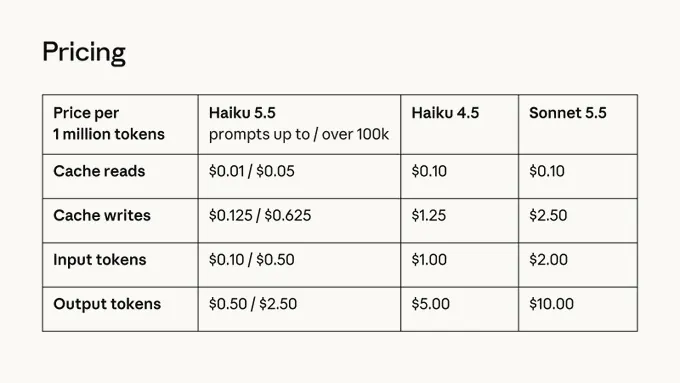
Official Anthropic pricing structure per 1 million tokens for Claude Haiku 5.5 vs Haiku 4.5 and Sonnet 5.5.
To understand why this is a massive win for student developers and startups, examine the token cost breakdown below:
💸 Token Price Comparison (Per 1 Million Tokens)
| Token Metric | Haiku 5.5 (≤100k tokens) | Haiku 5.5 (>100k tokens) | Haiku 4.5 | Sonnet 5.5 |
|---|---|---|---|---|
| Input Tokens | $0.10 | $0.50 | $1.00 | $2.00 |
| Output Tokens | $0.50 | $2.50 | $5.00 | $10.00 |
| Cache Reads | $0.01 | $0.05 | $0.10 | $0.10 (halved!) |
| Cache Writes | $0.125 | $0.625 | $1.25 | $2.50 |
For standard queries (under 100k tokens), input pricing has plummeted by 90% from $1.00 down to $0.10 per million tokens, and output pricing dropped from $5.00 down to $0.50 per million tokens. That means running 1,000 document classifications or short customer support conversations costs mere pennies.
Additionally, Anthropic announced an immediate 50% price cut on Claude Sonnet 5.5 cache reads, lowering it to $0.10 per million tokens. This makes Sonnet 5.5 roughly 20% cheaper to run on long-running code generation and continuous agent loops.
Benchmark Leap: Small Model, Tier-1 Execution
Historically, lightweight models sacrificed reasoning and code execution capabilities to hit low latency. Claude Haiku 5.5 breaks that trade-off, displaying a massive generational jump across coding, autonomous computer use, and analytical knowledge work.
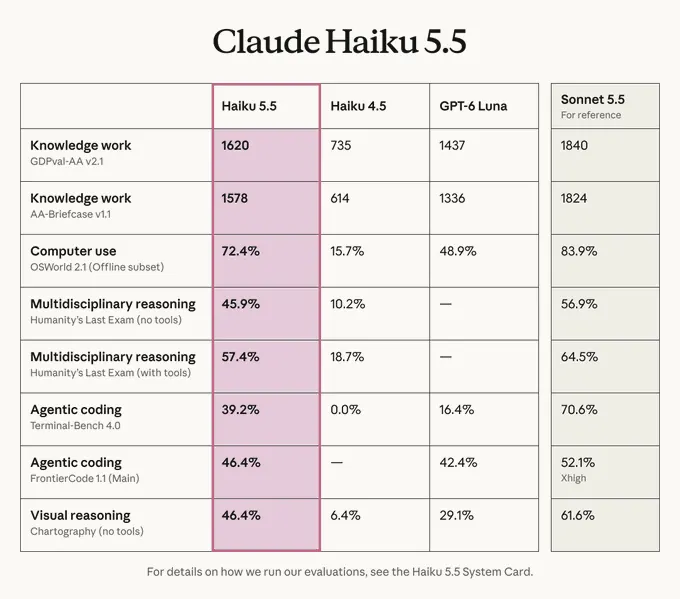
Claude Haiku 5.5 benchmark performance compared to Haiku 4.5, GPT-6 Luna, and Sonnet 5.5.
Key Benchmark Highlights:
- Computer Use (OSWorld 2.1 Offline Subset): Haiku 5.5 achieves an extraordinary 72.4%, crushing Haiku 4.5 (15.7%) and outperforming GPT-6 Luna (48.9%). It approaches Sonnet 5.5 (83.9%) at a fraction of the operating cost.
- Knowledge Work (GDPval-AA v2.1): Scores 1620—more than doubling Haiku 4.5’s score of 735 and comfortably beating GPT-6 Luna’s 1437.
- Agentic Coding (Terminal-Bench 4.0): Scores 39.2%, compared to Haiku 4.5’s 0.0% and GPT-6 Luna’s 16.4%.
- Multidisciplinary Reasoning (Humanity’s Last Exam): Reaches 57.4% with tools (up from 18.7% on Haiku 4.5).
- Visual Reasoning (Chartography no tools): Climbs from 6.4% on Haiku 4.5 to 46.4% on Haiku 5.5.
The Secret Weapon: Adjustable Effort Settings
Haiku 5.5 is Anthropic’s very first model featuring a dynamic adjustable effort setting. Instead of treating every API call with static compute, developers can now toggle effort levels between Low, Med, High, Xhigh, and Max depending on the specific user request.
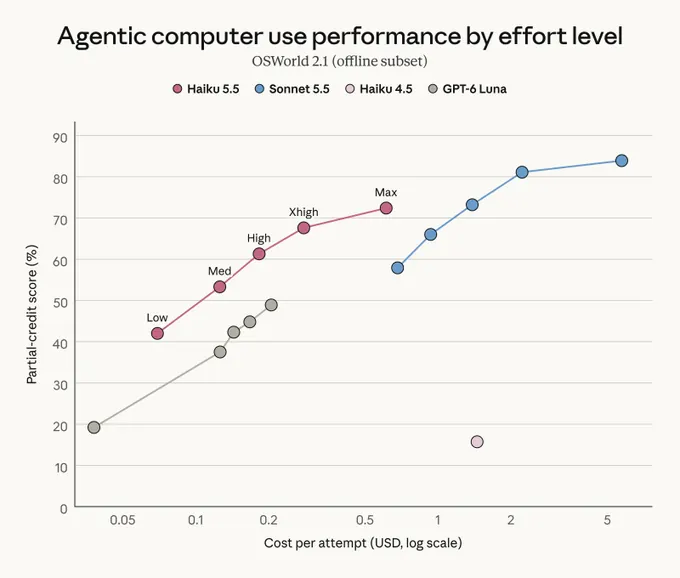
Haiku 5.5 effort-level scaling curve: dial in Low for instant micro-tasks or Max for complex agentic actions.
This allows you to make deliberate cost-versus-intelligence decisions in real time:
- Low / Med Effort: Ultra-fast response times for real-time customer support, quick categorizations, and automated browser form fills.
- Xhigh / Max Effort: Deeper step-by-step thinking for debugging edge cases, complex visual parsing, and intricate agentic tool sequences.
The Multi-Agent Subagent Architecture
One of the most powerful workflows enabled by Haiku 5.5 is its integration as a high-efficiency subagent. In advanced AI engineering, running every sub-task on a flagship model like Opus 5.5 or Sonnet 5.5 is both slow and prohibitively expensive.
With Haiku 5.5, a primary orchestrator (such as Claude Sonnet 5.5) can delegate high-volume tasks—such as file research, documentation parsing, code formatting, test generation, and browser navigation—to concurrent Haiku 5.5 subagents. This maintains top-tier intelligence at the orchestrator level while cutting overall compute expenditure by 60% to 80%.
Furthermore, Haiku 5.5 demonstrates major strides in safety, exhibiting substantial reductions in misaligned outputs across Anthropic’s alignment evaluations.
Availability & Where to Access
Claude Haiku 5.5 is available immediately across all major enterprise and developer distribution channels:
- Anthropic API & Claude Console: Accessible directly via the standard Anthropic API.
- Hyperscaler Cloud Providers: Live on Amazon Web Services (AWS Bedrock), Google Cloud (Vertex AI), and Microsoft Azure AI Foundry.
- Official Documentation: Review full implementation specs and API references on the Anthropic Claude Haiku 5.5 Announcement.
- Cheaper Micro-SaaS & Automations: If you are building automated lead-generation scrapers, customer support bots, or n8n workflow tools, your monthly API costs just collapsed by 75%.
- Higher Profit Margins on Client Gigs: Delivering automated AI client solutions (as outlined in our guide on how to earn ₹20,000/month as a college student) now leaves virtually 100% of your retainer as pure profit.
- Free Up Cash Flow: Check out our complete roadmap on how young builders earn ₹10,000/month with free and low-cost AI tools to start capitalizing on Haiku 5.5 today.
📌 Frequently Asked Questions (FAQ)
How much cheaper is Claude Haiku 5.5 compared to Claude Haiku 4.5?
On average, Claude Haiku 5.5 is 75% cheaper to run than Claude Haiku 4.5. For prompts under 100,000 tokens (which represent ~90% of requests), input token pricing has dropped by 90% from $1.00 to $0.10 per million tokens, and output token pricing has decreased from $5.00 to $0.50 per million tokens. Cache read pricing is also reduced tenfold to just $0.01 per million tokens.
What is the adjustable effort setting in Claude Haiku 5.5?
Claude Haiku 5.5 is the first small model in the Claude family to feature an adjustable effort setting. It allows developers to specify the amount of thinking effort (from Low, Med, High, Xhigh, to Max) on a per-task basis. This lets users optimize strictly for ultra-low cost and sub-second latency on routine tasks like classification, or dial up reasoning depth for difficult computer use and code refactoring.
How can developers use Claude Haiku 5.5 alongside Sonnet 5.5 and Opus 5.5?
Haiku 5.5 is explicitly architected to excel as a high-speed, cost-effective subagent. A flagship model like Claude Sonnet 5.5 or Opus 5.5 can act as the lead system architect, while delegating high-volume repetitive tasks—such as code summarization, automated browser testing, API classification, and data transformations—to multiple concurrent Haiku 5.5 instances, reducing total project inference costs by up to 80%.