
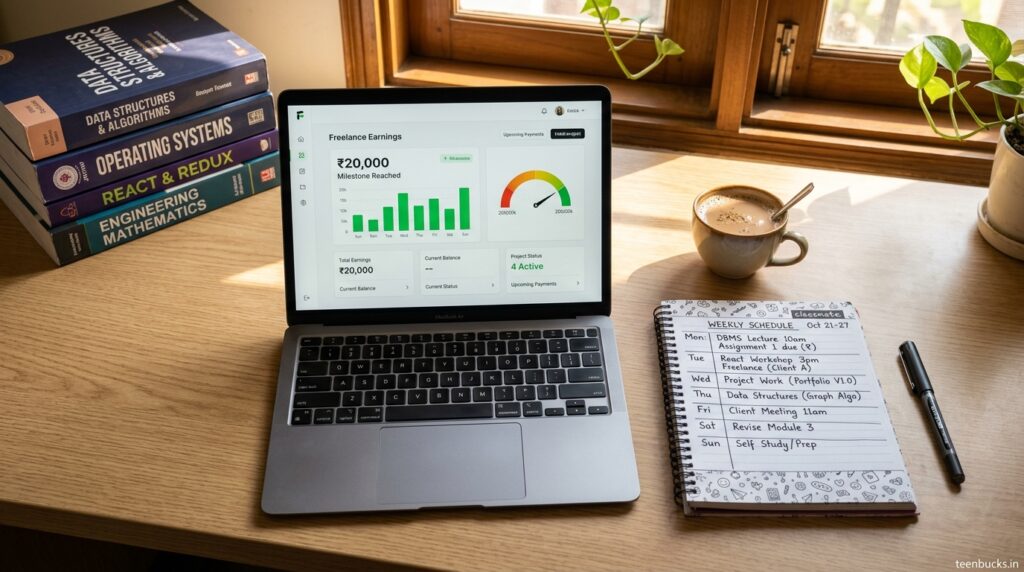
Every Indian college semester starts with the exact same financial friction: exam fees, semester hostel dues, coding subscriptions, weekend outings, and the quiet realization that asking your parents for an extra ₹5,000 every fortnight feels uncomfortable.
When students search online for “how to earn money as a student,” the internet serves up garbage: captcha-solving portals paying ₹12 for three hours of work, data entry scams demanding upfront “security deposits,” or Telegram crypto bots that end up locking bank accounts with police liens. In 2026, that entire ecosystem is obsolete.
Reaching ₹20,000 a month (approximately $240 USD) is a proven, mathematically predictable milestone. It is not about working 40 hours a week or sacrificing your degree. It is about understanding unit economics, packaging a real business skill, and setting up clean banking rails. If you have already explored our foundational guide on proven side hustles for Indian students, this roadmap is your step-by-step master plan for hitting the ₹20k milestone.
The ₹20,000/Month Reality Check: Why Most Students Fail
Before looking at skills, we need to dismantle the three fundamental myths that cause 90% of college freelancers to quit before making their first rupee:
In 2026, Upwork “Connects” cost upwards of ₹120–₹150 just to submit a single proposal into an ocean of AI bots and agency bids. Fiverr’s algorithm takes a 20% platform cut and buries new profiles with zero reviews. Cold bidding without an existing track record drains your student pocket money before you land a single client.
Founders, creator agencies, and local SMBs do not want to hire generalists who claim they can do “SEO, web design, video editing, and content writing.” They want a specialist who solves one distinct bottleneck immediately.
If you trade your college attendance for freelance deliverables, you risk debarment and academic backlogs. A sustainable student income requires an asynchronous model that runs on 14 to 16 focused hours per week.
The solution is the 2-Retainer Stability Model: rather than chasing 10 different one-off clients every month, your entire goal is to sign 2 clients who pay you ₹10,000 per month (or 1 global client paying $250/month) for ongoing, predictable deliverables. Once signed, your sales prospecting drops to zero, and you spend 100% of your available freelance hours executing high-quality work.
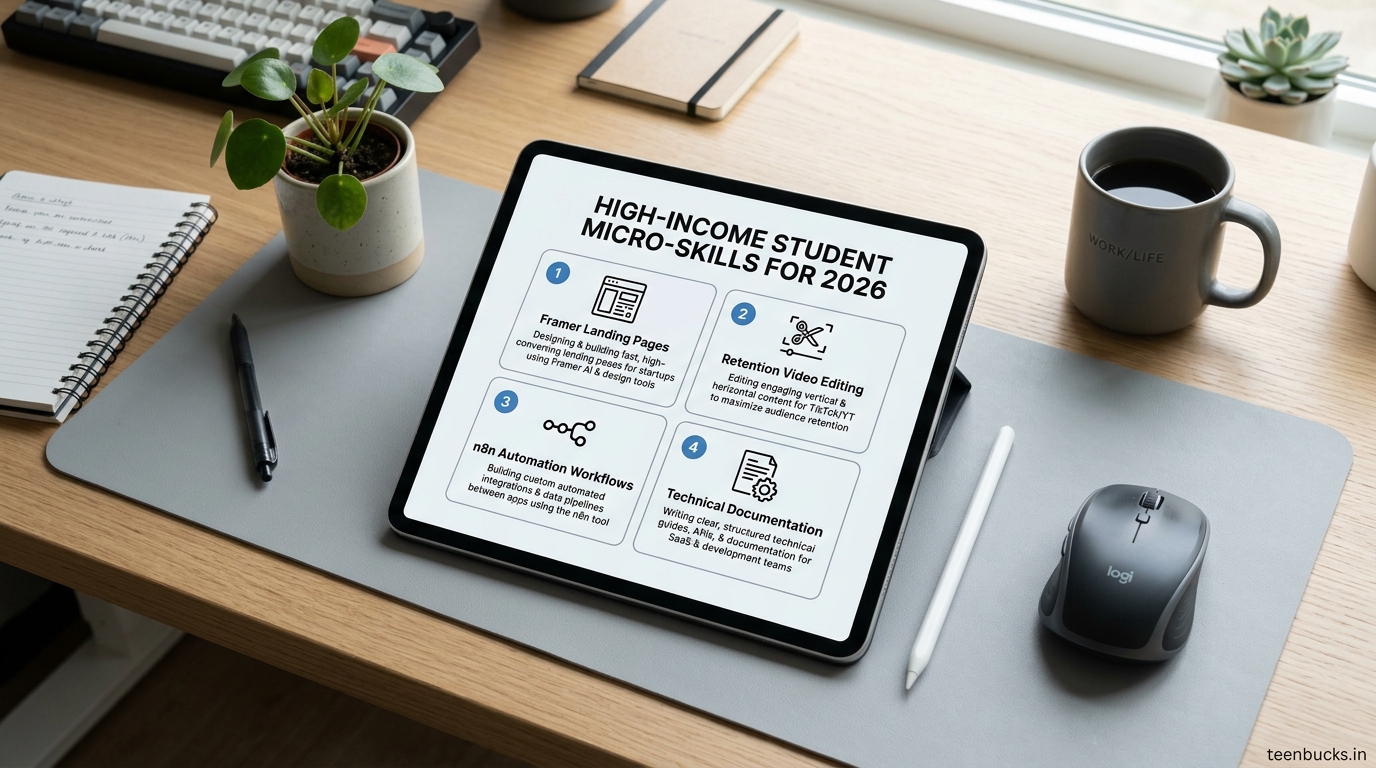
The four validated student micro-skills that bypass AI commoditization in 2026.
The 4 High-Demand Micro-Skills for 2026 (With Real Market Rates)
In 2026, AI tools handle generic copywriting, basic stock graphics, and elementary code. The skills that command premium compensation are specialized execution workflows that integrate AI speed with human taste, domain context, and conversion design. You only need to pick one of these four skills:
1. Framer Landing Page Design & Rapid Development
Modern D2C brands, venture-backed startups, and solo founders build and iterate on marketing campaigns weekly. They no longer wait three weeks for a developer to code raw HTML/CSS. Framer has become the gold standard for responsive, animated, conversion-focused landing pages.
- What you deliver: One complete 5-section landing page (Hero, Features, Social Proof, Interactive Pricing, and FAQ) configured with mobile responsiveness and basic SEO tags.
- Time required: 8–10 hours per project once your component library is built.
- Domestic Market Rate (India): ₹6,000 to ₹10,000 per page for beginners (1–3 portfolio concepts); ₹15,000 to ₹25,000 for intermediate designers with micro-animations.
- International Market Rate (Contra / Twitter): $150 to $300 (~₹12,500 to ₹25,000) per page.
2. Retention-Focused Short-Form Video Editing
Every founder, educator, and B2B SaaS executive is trying to build organic reach on YouTube Shorts, Instagram Reels, and LinkedIn Video. Raw talking-head video dies on algorithms; creators need editors who understand narrative pacing, B-roll selection, sound design, and kinetic typography in CapCut Pro or Premiere Pro.
- What you deliver: 10 to 12 edited short-form videos per month (approx. 3 videos per week).
- Time required: 60 to 90 minutes per 45-second reel.
- Domestic Market Rate (India): ₹800 to ₹1,200 per reel. A monthly package of 10 reels translates directly to an ₹8,000 to ₹12,000 monthly retainer per creator.
- International Market Rate: $25 to $45 per reel ($250 to $450/month per creator retainer).
3. No-Code Workflow Automation (n8n & Make.com)
Small business owners and e-commerce brands waste 15+ hours every week manually entering Shopify orders into Google Sheets, updating CRM leads, and sending WhatsApp status updates. Building automated pipelines using open-source n8n or Make.com solves a direct business pain point that founders happily pay to eliminate.
- What you deliver: Custom automated webhooks connecting Shopify / Razorpay to Google Sheets, Slack alerts, and automated email or WhatsApp confirmations.
- Time required: 4–6 hours per workflow build.
- Domestic Market Rate (India): ₹5,000 to ₹8,000 per automation build, plus a ₹2,500/month maintenance retainer.
- International Market Rate: $150 to $300 per workflow setup.
4. Technical Writing & API Documentation for B2B SaaS
If you are pursuing an engineering, BCA, or computer science degree, your domain knowledge is your greatest unfair advantage. Developer tooling companies and Web3 startups struggle to find writers who can run a repository, test an API endpoint in Postman, and write clear, human setup tutorials.
- What you deliver: Comprehensive 1,500-word step-by-step developer guides with working code snippets, architecture diagrams, and error-handling tips.
- Time required: 6–8 hours per technical article.
- Domestic Market Rate (India): ₹3,000 to ₹6,000 per article. Four tutorials per month easily clear your ₹20,000 goal.
- International Market Rate: $150 to $350 per technical guide.
📊 Market Rate & Deliverable Comparison (2026)
| Micro-Skill | Beginner Pay (India) | Target Retainer Model | Weekly Time |
|---|---|---|---|
| Framer Landing Pages | ₹6,000 – ₹10,000 / page | 2 pages/month = ₹16,000 – ₹20,000 | 7–9 hours |
| Short-Form Video Editing | ₹800 – ₹1,200 / video | 2 clients @ 10 reels = ₹20,000 | 10–12 hours |
| Workflow Automation (n8n) | ₹5,000 – ₹8,000 / setup | 3 builds + maintenance = ₹21,000 | 8–10 hours |
| Technical Writing | ₹3,000 – ₹5,000 / guide | 4 guides/month = ₹16,000 – ₹20,000 | 8–10 hours |
For students interested in how AI workflows can amplify your delivery speed without sacrificing output quality, read our deep-dive on how to earn ₹10,000/month with free AI productivity tools in India.
Client Acquisition in 2026: The “Value-in-Advance” Playbook
If you aren’t bidding on Upwork or paying for Fiverr impressions, how do you actually find clients willing to wire ₹10,000 to your bank account? You use inbound portfolio rails and targeted, value-first direct outreach.
1. Publish on Contra (0% Commission Platform)
Unlike legacy freelance portals, Contra charges freelancers 0% platform commission on contracts. It acts as a sleek, professional digital portfolio where founders actively search for verified independent contractors by deliverables. Create an account, list 2 to 3 spec deliverables with transparent pricing, and link your custom portfolio URL in your bios.
2. The LinkedIn “Audit-in-Advance” Pitch
Generic cold messages like “Hey sir, I am a college student looking for freelance work” go straight into spam. Instead, deliver value before you ask for a single rupee:
- Identify 15 early-stage D2C brands, seed-stage founders, or content creators whose current landing page or video pacing has clear flaws.
- Record a 90-second, high-resolution Loom or screen recording walking through 3 actionable improvements. (For example: “Hey Rahul, I noticed your product landing page takes 4.2 seconds to load on mobile and your CTA button is hidden below the fold. Here is a redesigned hero section mockup in Framer that fixes your conversion drop-off.”)
- Send the Loom video with a polite 3-sentence note. Out of 15 targeted audits, you can reliably expect 3–4 replies and 1–2 closed retainers.
3. Strict Warning: The 3 Blacklisted Student Scams
Protect your hard-earned money and your legal identity by immediately recognizing these fraudulent traps:
- Telegram “Task” & Google Maps Review Scams: Fraudsters pay you ₹150 for liking 3 YouTube videos, add you to a VIP Telegram group, and then ask for a ₹5,000 “prepaid task deposit.” These operations are run by cross-border cyber syndicates. If you participate, your UPI account will be frozen by state police cyber cells under CrPC Section 102.
- Data Entry “Registration Fee” Scams: Any company requiring you to pay an “exam fee,” “security deposit,” or “agreement stamping charge” of ₹500–₹2,000 before sending work is 100% fraudulent. Legitimate clients pay you; they never ask you to pay them.
- Paid “Placement-Guaranteed” Certifications: Avoid spending ₹15,000 on generic cohort courses that promise guaranteed internships. Everything required to master Framer, n8n, CapCut, or Markdown documentation is available for free on YouTube and official documentation.
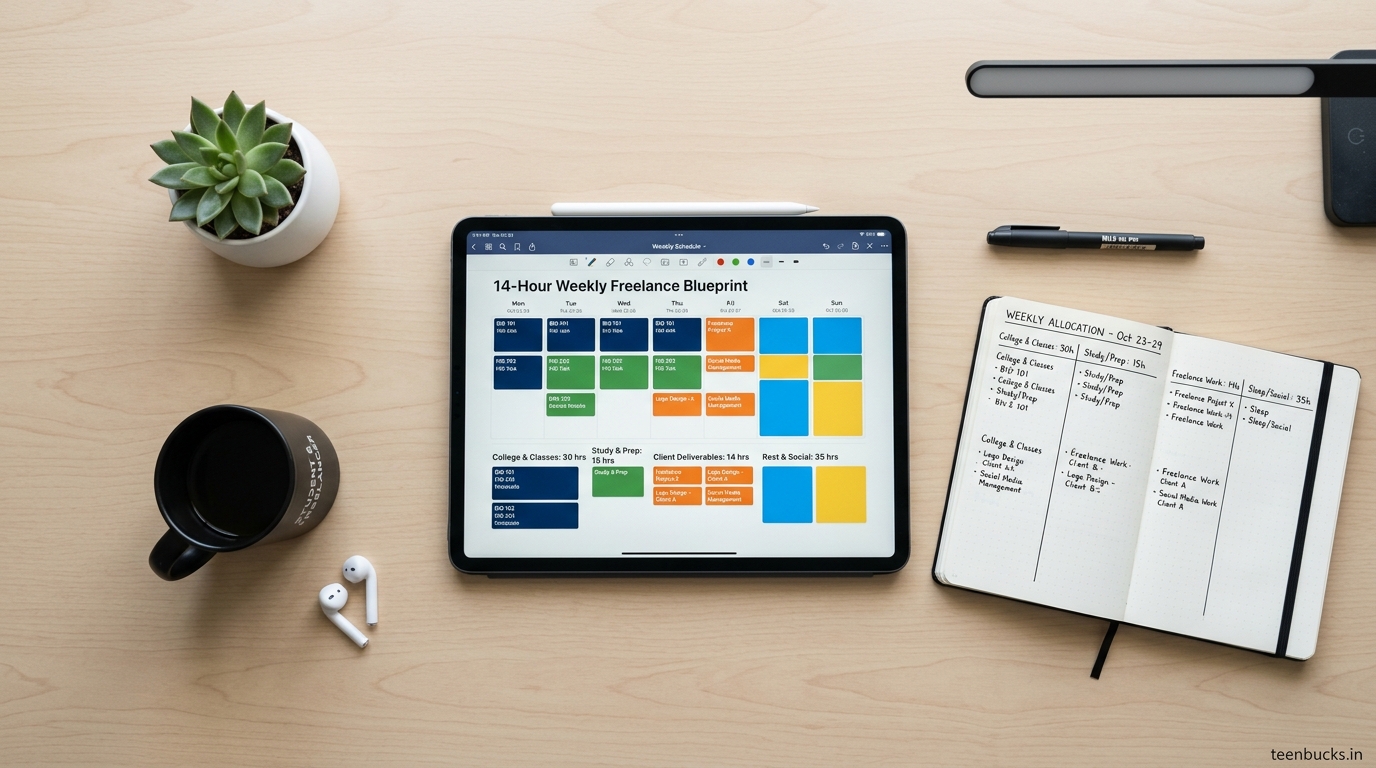
The balanced 14-hour weekly time allocation protecting 75%+ college attendance and semester grades.
The 14-Hour Weekly Student Blueprint (Protecting Attendance & GPA)
Most students who attempt freelancing burn out because they try to juggle client messages during daytime lectures. To maintain a 75%+ attendance record and score an 8.5+ CGPA, your freelance workflow must operate on strict asynchronous time blocks.
🗓 Weekly 14-Hour Execution Schedule
- Monday to Friday (2 hours/night: 8:30 PM to 10:30 PM): 10 hours dedicated to focused deep-work execution (editing video timelines, designing landing page blocks, or writing tutorial drafts). No live client meetings during class hours.
- Saturday (3 hours: 10:00 AM to 1:00 PM): Client deliverable review, staging deployment, and sending weekly progress Loom updates.
- Sunday (1.5 hours: 11:00 AM to 12:30 PM): Invoicing, portfolio updates, and sending 3 targeted value-in-advance audits for pipeline replenishment.
- Total Time Invested: Exactly 14.5 hours per week. Your mornings, college lectures, lab practicals, and social life remain completely uninterrupted.
The 10-Day Exam Batching Rule
What happens during mid-terms and semester finals? Never go silent on clients without notice. Follow the 10-Day Exam Buffer Protocol: exactly 10 days before exams commence, inform your retainer clients of your upcoming academic schedule and batch-deliver two weeks’ worth of content or design assets in advance. Clients respect proactive communication and will gladly pause feedback rounds while you ace your exams.
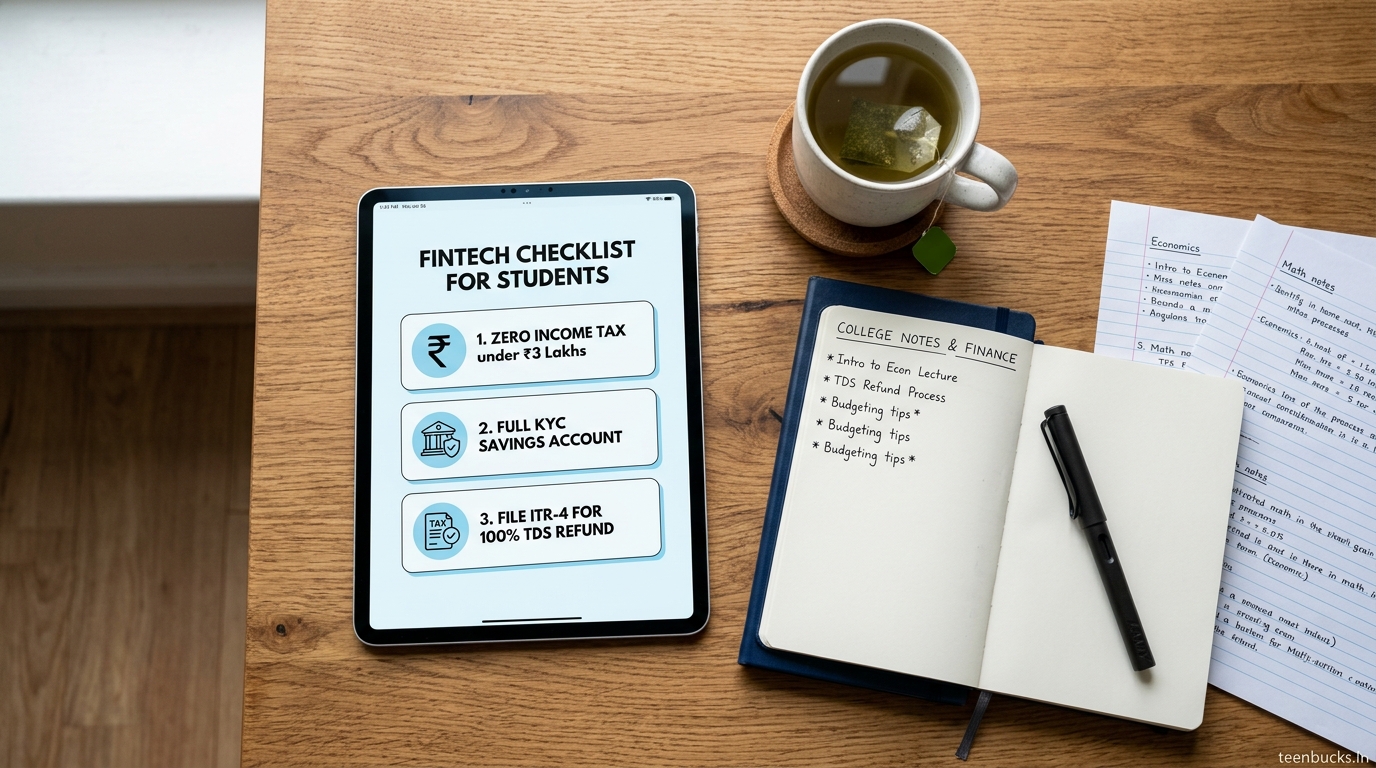
The essential legal, tax, and banking checklist every Indian student earner must follow.
Legal, Tax & Banking Safe Rails for Student Freelancers
When you start making ₹20,000 every month, you transition from a dependent student to an independent earner. Understanding Indian tax laws and banking regulations will save you from frozen bank accounts, TDS deductions, and unexpected notices.
1. Income Tax: You Owe Exactly ₹0 in Taxes
Under India’s New Tax Regime (Section 115BAC of the Income Tax Act), the basic exemption limit covers income up to ₹3,00,000. Furthermore, under Section 87A, any net taxable income up to ₹7,00,000 qualifies for a full tax rebate.
Because an earning rate of ₹20,000/month equals ₹2,40,000 per financial year, your total tax liability is ₹0 (Zero). You do not owe a single rupee of tax to the Government of India.
2. The TDS Refund Hack: How to Get 100% Back via ITR-4
When registered Indian companies pay freelance contractors, they are legally mandated to deduct Tax Deducted at Source (TDS) under either Section 194J (2% for technical services or 10% for professional fees) or Section 194C (1% for work contracts). For instance, on a ₹20,000 payout, a client might withhold ₹2,000 (10%) and deposit it against your PAN.
Always provide your valid PAN card to your clients (otherwise they are required under Section 206AA to deduct a punitive 20% TDS). In July following the financial year, log into the official Income Tax e-filing portal and file ITR-4 (Sugam) under the Section 44ADA Presumptive Taxation Scheme. Because your annual taxable income is below the exemption ceiling, the Centralized Processing Centre (CPC) will process your return and refund 100% of the deducted TDS directly into your pre-validated bank account within 2 to 4 weeks.
CRITICAL WARNING: Never file Form ITR-1 (Sahaj). ITR-1 is strictly reserved for salaried employees. Filing ITR-1 for freelance income triggers a Section 139(9) “Defective Return” notice from the tax department!
3. GST Exemption: 100% Legal Exemption up to ₹20 Lakhs
Many college students panic wondering if they need a GST number to invoice clients. Under CBIC Notification No. 10/2017-Integrated Tax, service providers with an aggregate annual turnover below ₹20 Lakhs are completely exempt from mandatory GST registration—even for inter-state clients and international service exports. At ₹2.4 Lakhs annual earnings, you do not require a GSTIN.
4. Banking Alert: Upgrade from RBI “Small Accounts” Immediately
If you opened your savings account during a college campus drive or through a simplified OTP flow, check your account status immediately. Under RBI Master Directions on KYC, simplified KYC accounts are classified as BSBDA “Small Accounts”, which enforce strict regulatory limits:
- Total credits across the financial year must not exceed ₹1,00,000.
- Total withdrawals and transfers in any given month cannot exceed ₹10,000.
- Maximum balance cannot exceed ₹50,000 at any point.
If you earn ₹20,000 per month, your total credits will breach the ₹1 Lakh cap by Month 5, triggering an automated freeze on incoming transfers. To avoid this, visit your nearest branch or complete an online Video-KYC to convert your account into a Full-KYC Regular Savings Account. For students seeking zero-fee banking with seamless debit cards and high UPI limits, explore our curated list of the top zero-balance bank accounts for Indian students.
5. International Payments: The Wise & Skydo Advantage over PayPal
If you land international clients from the US, UK, or Europe, never use PayPal for large payouts. PayPal charges a base 4.4% transaction fee + $0.30, slaps an undisclosed 3.5%–4% currency conversion spread on top of the mid-market exchange rate, and levies 18% GST on fees—costing you roughly 8.5% to 10% of your total earnings!
- For transfers under $300 (~₹25,000): Use Wise (formerly TransferWise). Wise converts your dollars using the genuine mid-market exchange rate with a transparent ~1.5% fee and delivers an automated electronic Foreign Inward Remittance Advice (e-FIRA) within 72 hours.
- For recurring retainers above $300: Use Skydo. Skydo charges a flat $19 fee with 0% currency conversion markup and generates free, automated e-FIRA certificates compliant with RBI and GST guidelines.
What to Do with Your First ₹20,000: The 50/30/20 Student Rule
Making ₹20,000 per month puts you in the top 5% of financially independent college students in India. How you manage that capital over the next six months determines whether you enter the job market stressed or with an investment portfolio and an emergency fund.
1. Essentials & College (₹10,000 – 50%)
Hostel mess charges, transport, books, mobile recharges, and day-to-day college expenses.
2. Upgrades & Tools (₹6,000 – 30%)
Software subscriptions (Framer Pro, Cursor AI, ChatGPT Plus), networking events, books, and social outings.
3. Wealth & Compounding (₹4,000 – 20%)
₹2,000 into a liquid emergency fund and ₹2,000 into a monthly Nifty 50 Index Fund SIP.
Investing just ₹2,000 per month starting at age 19 creates compounding magic by the time you graduate. Check out our interactive TeenBucks SIP Compounding Calculator to see how starting a ₹2,000 monthly SIP during college grows into a multi-lakh safety net before your 25th birthday.
The 90-Day Step-by-Step Action Plan
Here is your exact, zero-fluff blueprint for the next 90 days:
- Month 1 (Skill Sprint & Spec Projects): Pick one micro-skill from the list above. Spend 30 days mastering the tool. Build 3 fictional yet flawless “spec” client projects (e.g., redesign a popular D2C shoe brand’s landing page in Framer, or edit three retention reels for a tech founder’s podcast). Host them publicly on Contra.
- Month 2 (Value-in-Advance Outreach): Identify 40 targeted founders, creators, or small businesses on LinkedIn and Twitter. Send 2 customized Loom video audits every evening (10 per week). Aim to close your first test client at an introductory rate of ₹5,000–₹7,000.
- Month 3 (Retainer Locking): Overdeliver for your first client. Turn their success into a case study. Leverage that testimonial to pitch 20 new prospects and lock in your target two recurring ₹10,000/month retainers.
Earning ₹20,000 per month in college isn’t about luck or privilege. It is about trading zero-value scroll time for high-value execution. Pick your skill, build your proof of work, and take action tonight.