
Your offer letter says ₹3.82 lakh a year. You divide it by 12 and think, “Okay, roughly ₹31,800 every month.”
Then salary day arrives. Your bank message says ₹28,000 credited.
Where did ₹3,800 go?
Before you send that awkward message to HR, open your payslip. That gap doesn’t automatically mean you were underpaid. Part of it could be your own PF deduction, part could be a state tax, and part might be money your employer contributes for you but never pays into your bank account.
Here’s how to read the whole thing without needing an accounting degree.
Salary slip, CTC, gross and in-hand: the difference in 30 seconds
| Term | What it actually means | What to remember |
|---|---|---|
| CTC (Cost to Company) | Your employer’s estimated total annual cost for your compensation package | Not the amount you receive as cash |
| Basic salary | A component of your pay used for various payroll calculations | Not the same as gross or take-home |
| Gross salary | Basic pay plus applicable cash allowances and other earnings, before employee deductions | Starting point for your payslip calculation |
| Net / in-hand salary | Gross salary minus employee-side deductions | The amount normally credited to your bank |
In-hand salary = Gross earnings − Employee deductions
CTC = Gross cash compensation + Employer-paid components included in your offer
The second formula depends on how your employer defines CTC. Bonuses, gratuity provisions, insurance and other benefits may or may not be included. Read the salary annexure in your offer letter rather than assuming every package uses the same format.
A sample salary slip: ₹30,000 gross, ₹28,000 in-hand
This is a hypothetical full-month payslip for October 2026, not someone’s actual salary record. It assumes a male employee working in Maharashtra, enrolled in EPF, with no leave-without-pay, bonus, loan recovery or additional benefit deductions. The employee has selected the new income-tax regime and has no additional taxable income for this illustration.
| PAYSLIP ITEM | OCTOBER 2026 |
|---|---|
| EARNINGS | |
| Basic salary | ₹15,000 |
| House Rent Allowance (HRA) | ₹6,000 |
| Special allowance | ₹9,000 |
| Total gross earnings | ₹30,000 |
| DEDUCTIONS | |
| Employee EPF: 12% of ₹15,000 | −₹1,800 |
| Maharashtra professional tax (October) | −₹200 |
| Income-tax TDS | ₹0 |
| Total employee deductions | −₹2,000 |
| NET / IN-HAND SALARY | ₹28,000 |
Math check: ₹15,000 + ₹6,000 + ₹9,000 = ₹30,000 gross. Then ₹30,000 − ₹1,800 − ₹200 = ₹28,000 in-hand.
Why only ₹200 professional tax? For a male employee earning above ₹10,000 a month in Maharashtra, the official schedule specifies ₹200 for months other than February and ₹300 for February. If the same assumptions applied in February, this example would produce ₹27,900, not ₹28,000. Tax rules differ across states, so do not copy this deduction into a payslip from another state. Source: Maharashtra GST Department’s professional-tax schedule.
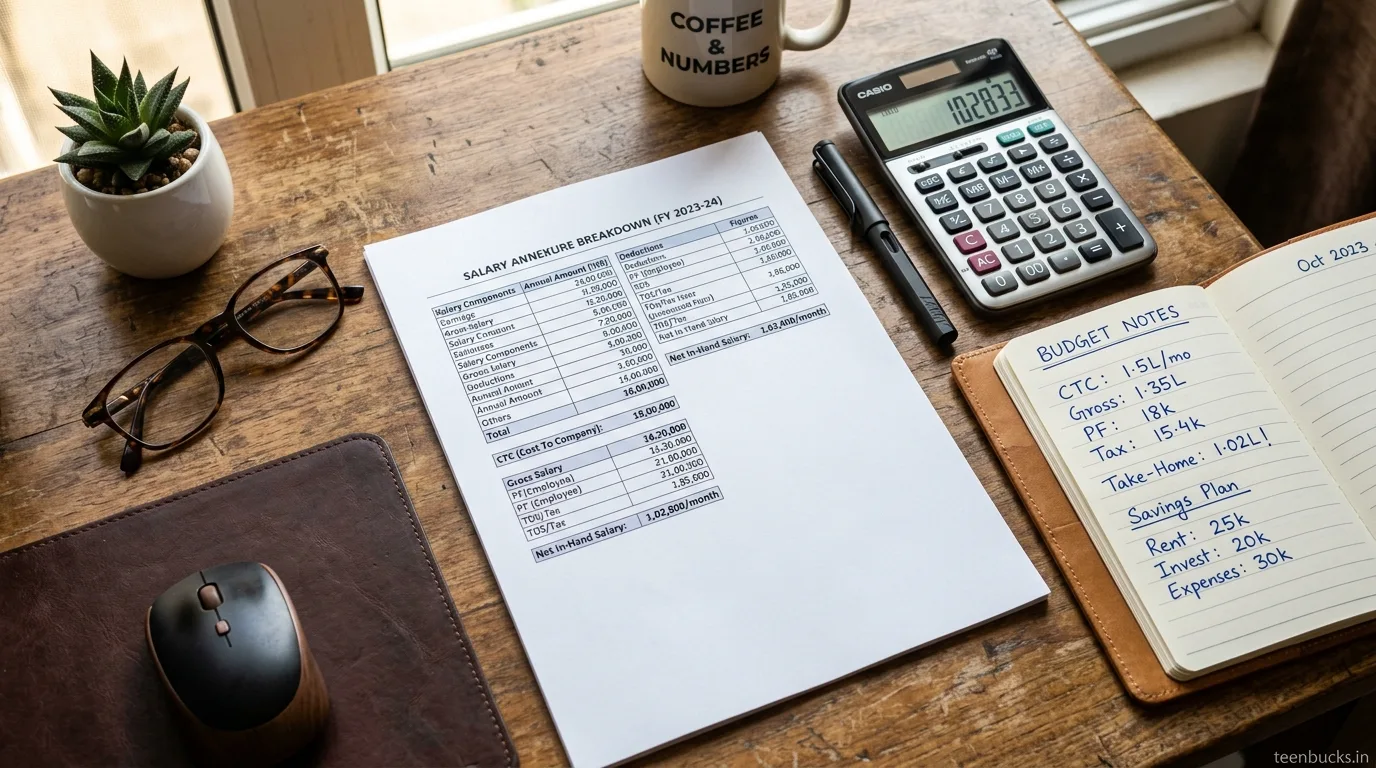
Understanding how your employer offer letter translates into monthly gross pay and bank take-home.
And this is the important part: the example’s monthly CTC is ₹31,800, assuming the company includes only gross pay and its ₹1,800 employer PF contribution, with no other CTC components.
| How the offer is built | Amount |
|---|---|
| Monthly gross salary | ₹30,000 |
| Employer PF contribution (included in this CTC) | +₹1,800 |
| Monthly CTC | ₹31,800 |
| Annual CTC | ₹3,81,600 (~₹3.82 LPA) |
| Actual October bank credit | ₹28,000 |
So the ₹3,800 difference between monthly CTC and bank credit consists of ₹1,800 employer PF + ₹1,800 employee PF + ₹200 professional tax. Your employer’s PF contribution is not an additional deduction from your ₹30,000 gross. Counting it twice would make the calculation wrong.
How to read your payslip, line by line
1. Basic salary: the foundation, not the final amount
In our example, basic pay is ₹15,000. It is one part of the ₹30,000 gross salary, not a separate ₹15,000 deposited in addition to it.
Basic pay (together with other applicable wage components such as dearness allowance) matters for statutory contributions. That is why two people with the same ₹30,000 gross salary can see different PF deductions if their eligible wage components or contribution arrangements are different.
2. HRA: part of your salary, not a free rent refund
House Rent Allowance (HRA) is an allowance from your employer. In the sample, ₹6,000 of the ₹30,000 gross is labelled HRA.
Seeing HRA on your payslip does not mean you automatically save tax on ₹6,000. The old tax regime can provide an HRA exemption if you qualify and meet the conditions. The new tax regime does not offer the regular HRA exemption. Source: Income Tax Department’s old-vs-new-regime FAQs.
If you live in a PG or rented flat in major job hubs like Bengaluru, Pune, Gurugram, or Mumbai, keep your rent records. But don’t assume that simply having “HRA” written on the slip reduces your income tax.
3. Special allowance: usually cash pay, not a mysterious bonus
The ₹9,000 special allowance in this example is simply another earnings component. Companies use different labels: special allowance, flexible allowance, conveyance-related pay or other components.
What matters is whether the amount is actually earned that month, whether it is taxable, and how it affects your company’s wage and benefit calculations. If a component is missing, compare the slip with the offer letter and ask payroll to explain it.
4. Employee PF: money moving to retirement savings
EPF means Employees’ Provident Fund. For covered employees, the usual employee contribution is 12% of applicable EPF wages. Our employee’s EPF wage base is ₹15,000, so employee PF is ₹1,800. The employer also contributes ₹1,800 in this simplified illustration, with its contribution allocated under the applicable EPF/pension rules.
If your employer deducts PF, check whether the amount is consistent with your eligible wage base and verify deposits using the official EPFO member passbook. Your Universal Account Number (UAN) can help you access your EPF records; if it isn’t visible on your slip, ask HR where to find it.
5. Professional tax (PT): a state-level deduction
Professional tax is not central income tax. Where applicable, it is levied under state law and usually collected through payroll. The rate depends on the state and relevant salary bracket.
In this Maharashtra illustration, PT is ₹200 in October; February would be ₹300. Maharashtra’s schedule also has different salary thresholds for men and women. A reader in another state (such as Karnataka, West Bengal, or Tamil Nadu) should check that state’s official schedule, not treat ₹200 as a national rule.
6. TDS: what payroll has withheld for income tax
TDS means Tax Deducted at Source. Payroll estimates your tax liability based on the relevant rules, your declarations and the income information available to the employer.
In our example, the annual gross cash salary is ₹30,000 × 12 = ₹3,60,000. Under the new regime, an eligible salaried employee can claim the ₹75,000 standard deduction. That leaves an illustrative salary income of ₹2,85,000, below the new regime’s ₹4 lakh zero-rate band. So TDS is ₹0 in this example even before considering any tax rebate.
For Tax Year 2026–27, the Income Tax Act, 2025 uses the term Tax Year instead of the older previous-year/assessment-year framing. Under the relevant new-regime rules, an eligible resident individual can receive a rebate that generally eliminates normal slab-rate income tax up to ₹12 lakh total taxable income. For a salaried person eligible for the ₹75,000 standard deduction, that can mean up to ₹12.75 lakh gross salary without normal slab-rate tax, subject to conditions and exclusions such as special-rate income. This is not a promise that everyone earning ₹12.75 lakh will have zero TDS. Sources: Income Tax Department’s new-Act FAQs and tax-rate guide.
Important: A ₹0 TDS line does not automatically mean you never need to file an income-tax return or disclose other taxable income. If TDS looks wrong, check your chosen payroll tax regime and speak to payroll or a qualified tax professional.
Why your in-hand salary can change every month
A payslip is a record of that pay period, not a promise that the next bank credit will be identical.
Your net pay can move because of unpaid leave, overtime, incentives, arrears, reimbursements, a revised PF calculation, a payroll correction, income-tax TDS adjustments, or deductions such as insurance and employee loans. State professional tax can also vary by month, as our February example shows.
One more thing to check is the line marked paid days / loss of pay (LOP). If you joined halfway through a month or took unpaid leave, your first credit might be smaller than a normal full-month salary. Different employers and applicable rules can use different payroll calculations, so don’t assume every employer must divide a month’s salary by exactly 26 or exactly 30.
What if your offer says ₹7.5 LPA? How much reaches your bank?
There is no single correct take-home figure for ₹7.5 LPA. Here’s a second illustrative calculation, not a universal converter. Assume annual CTC includes only gross cash compensation and employer PF; PF contributions are 12% of an eligible wage base of ₹25,000 per month; and the employee is a Maharashtra male employee in a month other than February, using the new tax regime with no additional taxable income.
| ₹7.5 LPA scenario | Monthly amount |
|---|---|
| Stated CTC | ₹62,500 |
| Employer PF included in CTC | −₹3,000 |
| Gross cash salary | ₹59,500 |
| Employee PF | −₹3,000 |
| Maharashtra PT (non-February) | −₹200 |
| Estimated TDS on assumed income | ₹0 |
| Illustrative in-hand | ₹56,300 |
Annual gross cash salary would be ₹7,14,000, and after a ₹75,000 standard deduction the illustrative salary income is ₹6,39,000. For an eligible resident under the new regime, normal slab-rate tax on that amount is covered by the applicable rebate. But change the PF base, benefits, state, taxable income, or tax treatment, and the figure changes too. Never accept a generic CTC-to-in-hand percentage as an exact answer.
Your first-payslip checklist: 7 things to verify
Before spending your first salary, take five minutes to check:
- Your identity and pay period: Name, employee ID, payroll month and joining date.
- Paid days and unpaid leave: Did payroll treat this as a full month or a partial month?
- Earnings against your offer: Basic, HRA, allowances, incentives and agreed fixed pay.
- Employee PF deduction: Does it match the eligible wage base and contribution arrangement?
- UAN and PF deposits: Know your UAN and verify contributions through official EPFO channels.
- State professional tax and TDS: Does the location, applicable slab and declared tax regime make sense?
- Net pay vs your bank account: The amount labelled net pay should reconcile with the salary credit, allowing for separately paid reimbursements or adjustments.

Reconciling your salary credit with payslip deductions before creating your monthly budget.
If something doesn’t match, don’t accuse your employer or guess. Ask payroll for a line-item reconciliation of the offer’s CTC, gross earnings, deductions and credited net pay. A genuine mismatch is much easier to fix when you can point to the exact row.
What to do once ₹28,000 actually lands
Now comes the part that matters for your everyday money: budget from ₹28,000, not ₹31,800. Employer PF isn’t rent money. Employee PF isn’t money sitting in your UPI wallet. Your budget has to work with what reached your account.
If you are living in a PG, paying for transport and occasionally ordering food after a long day, a realistic plan is better than an impressive spreadsheet you abandon next week. Start with rent and essentials, add a small emergency cushion, then give yourself a spending allowance that doesn’t wreck next month’s budget.
If you need an independent bank account with zero maintenance charges to manage your personal savings separately from your corporate salary account, explore our guide to the best zero balance bank accounts in India.
Read TeenBucks’ First Salary in India: 9 Money Moves Before You Spend Re 1 for the next steps, or use our budgeting guide to adapt a simple money split to your actual in-hand pay.
Frequently Asked Questions (FAQ)
How do I read a salary slip for the first time?
Is CTC the same as gross salary?
Is ₹30,000 gross salary equal to ₹30,000 in-hand?
What is the in-hand salary for a 3 LPA package?
What if my gross salary is ₹18,000 a month?
What is the in-hand salary for 7.5 LPA CTC?
Is PF deducted twice from my salary?
Why is HRA written on my slip if I live with my parents?
Is salary calculated for 30 days or 26 days?
Do I need to save my salary slips?
The bottom line
Your offer letter can be exciting. But your bank balance runs on in-hand pay, not the big annual CTC headline.
Once you can tell gross pay, employee deductions and employer costs apart, your salary slip stops looking like a puzzle. And if a number really is wrong, you’ll know exactly which question to ask HR.
Save this guide for your next salary day — and send it to that one friend who still divides CTC by 12 and calls it a monthly salary.
• Ministry of Labour & Employment / PIB: EPF statutory wage ceiling changed to ₹25,000 from 17 September 2026
• EPFO: Official member passbook
• Maharashtra GST Department: profession-tax rate schedule
• Income Tax Department: standard deduction and salaried-person provisions
• Income Tax Department: new-regime tax rates and rebate
• Income Tax Department: Income Tax Act, 2025 and Tax Year 2026–27 explained
• Income Tax Department: HRA under old vs new regime