Taking an education loan is often the biggest financial commitment a student and their family make. Whether you are pursuing a B.Tech degree in India, attending an IIM, or traveling abroad for an MS in the US, tuition and living expenses can easily require borrowing between ₹8 Lakh and ₹40 Lakh.
However, what banks and loan agents frequently gloss over is the shocking total interest cost. On a standard ₹10 Lakh loan at 10% interest repaid over 10 years, you pay nearly ₹5.8 Lakh in interest alone—paying over 58% extra on top of your tuition!
Fortunately, you do not have to accept the bank’s default schedule. By executing a few tactical moves, you can slash your total interest bill by ₹1,50,000 or more.
Strategy 1: Pay Simple Interest During College to Stop “Capitalization Shock”
Most students choose not to pay a single rupee during college because education loans offer a Moratorium Period (Repayment Holiday) covering your course duration plus 6 to 12 months after graduation.
While you are not required to pay full EMIs, simple interest accrues on every tuition disbursement from the exact day the bank transfers funds to your university. If you do not pay this interest, it is capitalized—meaning the accumulated interest is added to your original principal on the day your formal repayment starts.
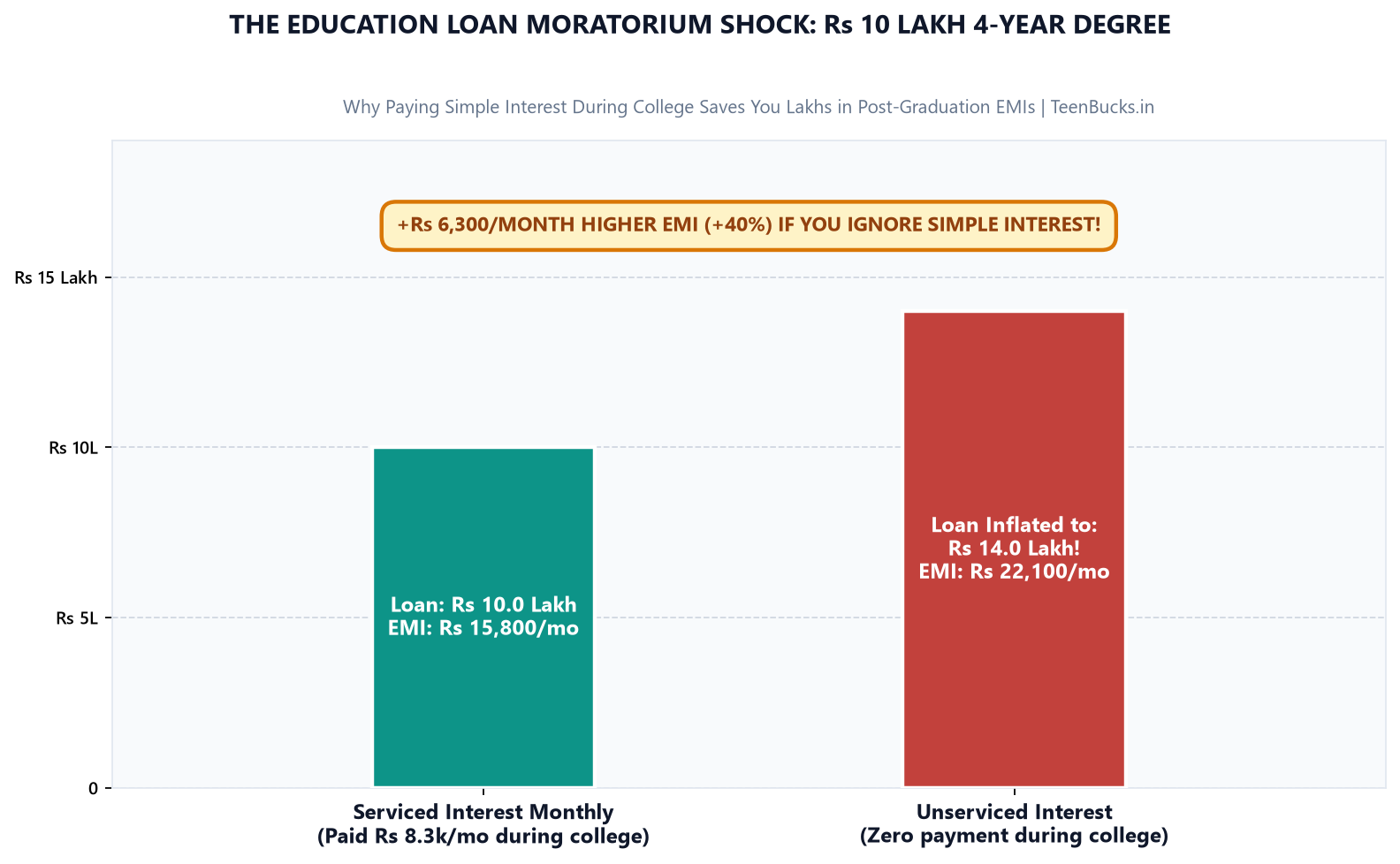
The Double Benefit of Servicing Simple Interest:
- Zero Capitalization: On an ₹8 Lakh loan over 4 years, paying approximately ₹3,500 to ₹5,500 in monthly simple interest saves over ₹1,80,000 in future compounded interest.
- The 1% Interest Rate Concession: Leading public sector lenders (State Bank of India, Canara Bank, Punjab National Bank) offer a 1.00% interest rate rebate across the entire 7- to 10-year repayment tenure if the borrower services simple interest during the study period! On a ₹10 Lakh loan, that 1% concession alone saves over ₹60,000 in cash.
Strategy 2: The ₹1,000/Month Prepayment Accelerator
Once you graduate and secure your first job, your full EMIs commence. The single most powerful tool you hold is voluntary principal prepayment.
Under the reducing balance method used by Indian banks, any payment made above your required EMI is credited 100% against your outstanding principal. When principal drops, every subsequent month’s interest charge shrinks permanently.
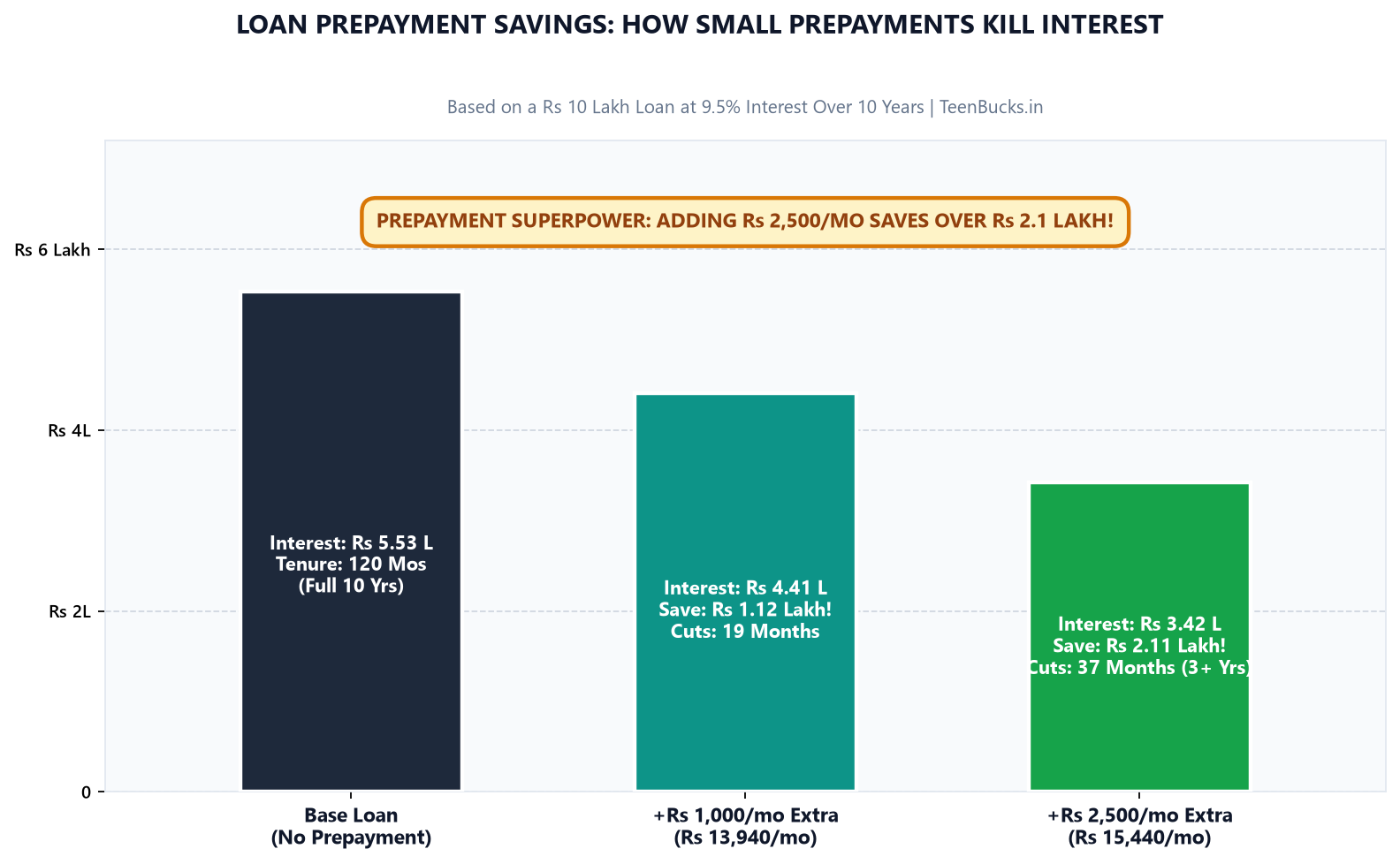
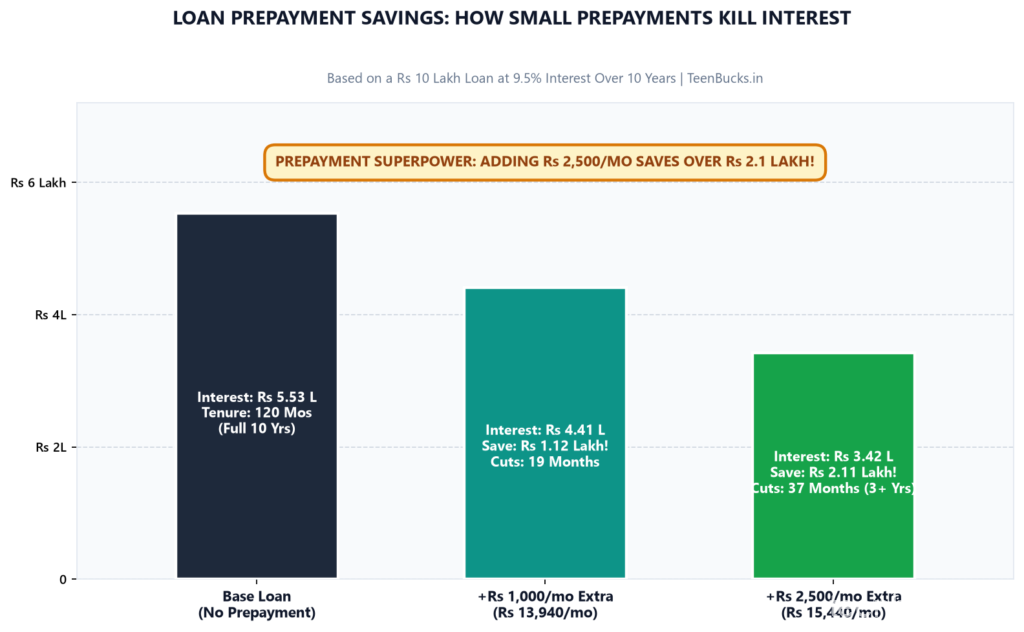
The Numbers: ₹8 Lakh Education Loan at 9.5% for 7 Years
- Standard Monthly EMI: ₹13,090
- Total Interest Without Prepayment: ₹2,99,560
- Action: You pay ₹14,090 per month (just ₹1,000 extra, equal to two skipped restaurant meals).
- New Total Interest: ₹2,67,140
- Direct Cash Savings: ₹32,420!
- Tenure Reduced: Loan closes 7 months earlier.
If you increase your prepayment to ₹2,500/month, your interest savings surge past ₹72,000 and your loan terminates nearly 16 months ahead of schedule! Test your exact loan numbers on our interactive Loan & EMI Calculator with Prepayment Simulator.
Strategy 3: Maximize Section 80E Tax Deduction (Zero Upper Limit)
One of the greatest tax benefits in the entire Indian Income Tax Act is Section 80E, specifically designed to ease education loan debt:
- 100% Interest Deduction: You can deduct the entire amount of interest paid during a financial year from your taxable income.
- No Maximum Limit: Unlike Section 80C (capped at ₹1.5 Lakh) or home loan interest under Section 24b (capped at ₹2 Lakh), Section 80E has NO CEILING. If you pay ₹1.8 Lakh in interest on a higher education loan, the entire ₹1.8 Lakh is fully deductible.
- 8 Consecutive Years: You can claim this deduction starting from the year you begin repaying interest for up to 8 years.
- Real Savings Impact: If you are in the 30% tax bracket and pay ₹1,20,000 in loan interest in Year 1, claiming Section 80E saves you ₹37,440 in direct income tax that year alone!
Strategy 4: Enforce RBI’s Zero Prepayment Penalty Rule
Many young borrowers mistakenly fear that making extra payments or closing a loan early triggers heavy bank penalties. In reality, the Reserve Bank of India (RBI) strictly protects retail borrowers:
RBI Master Direction: Commercial banks, regional rural banks, and NBFCs are legally prohibited from levying any prepayment penalty or foreclosure charges on floating-rate term loans granted to individual borrowers. You have the legal right to prepay ₹5,000, ₹50,000, or your entire balance anytime with zero penalty fees.
Whenever you receive a Diwali bonus, freelance project payment, or tax refund, channel it directly toward your education loan principal. Always verify that your bank marks the payment as “Principal Reduction” and recalibrates your tenure.
Building Wealth While Paying Loans
Once you’ve trimmed your education loan interest and stabilized your cashflow, start putting compounding to work for your future. Even starting a small ₹500 to ₹1,000 monthly investment—or trying our step-up SIP calculator with inflation for beginners—creates a substantial financial safety net. Learn about government student initiatives with our guide on PM-Vidyalaxmi Education Loan 2026 and discover how to build high credit scores early with 7 Smart Steps to Build a 750+ CIBIL Score.
Frequently Asked Questions: Saving Education Loan Interest
Does interest accrue during the education loan moratorium period?
Can parents claim the Section 80E tax deduction instead of the student?
Can banks charge a penalty if I pay extra money towards my education loan?
Before deciding how much to prepay, compare education-loan repayment with starting a SIP against your cash needs.