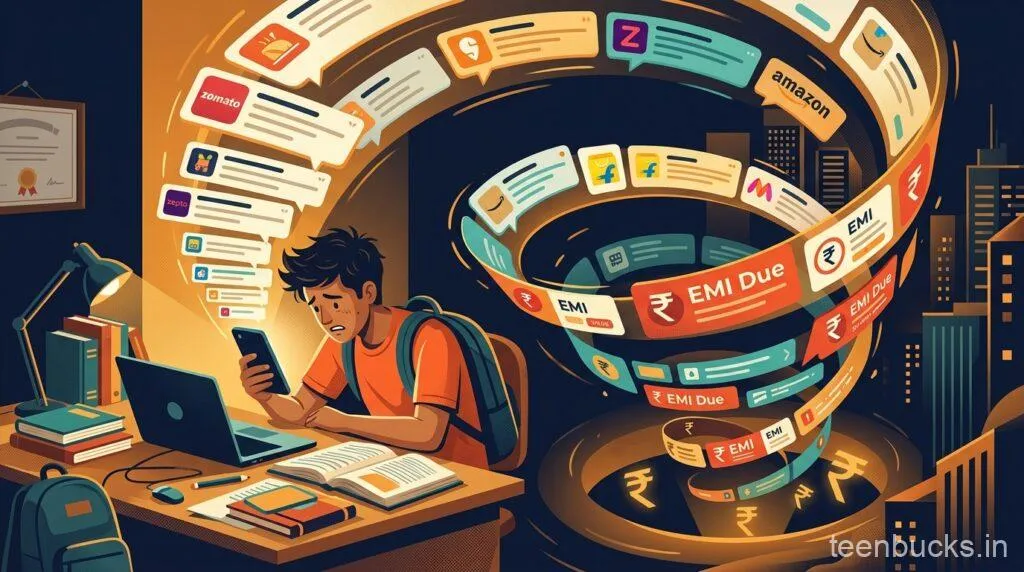
You ordered biryani on Zomato last Friday using “Pay Later.” That Bluetooth earphone on Flipkart? 3-month no-cost EMI. Your Zepto vegetables? Topped up with LazyPay balance. The new hoodie from Myntra — Simpl checkout, pay in 15 days.
Each of these feels small. Each has a green checkmark confirming “interest free.” Each feels like financial intelligence — “I’ll pay later when I have more money.”
But here’s what no app will tell you on that checkout screen: you’ve just taken four separate loans in one week. And every single one is being watched by CIBIL.
What Exactly Is BNPL and Why Is Every App Offering It?
Buy Now Pay Later is not a discount. It is not a student benefit. It is a loan product, structured as a short-term line of credit, offered by apps or merchant platforms in partnership with a bank or RBI-regulated NBFC identified in the Key Fact Statement (KFS). The consumer-facing brand is not necessarily the regulated lender. When you tap “Pay Later” on Zomato, you are not using Zomato’s money. Zomato gets paid immediately by the NBFC. You now owe the NBFC — with a 15-day, 30-day, or 3-month window to repay.
Apps love BNPL because it directly increases their order conversion rates. According to research on checkout psychology, removing the “pain of paying” at the moment of purchase increases basket size by 30–40%. So every app that adds a Pay Later button converts more sales. They get paid. The NBFC gets interest if you’re late. You get a loan you may not have needed.
RBI’s digital-lending rules treat short-term deferred-payment credit as lending when it is provided by a regulated entity. The practical check is not a market-size headline: read the KFS to identify the lender, annual percentage rate, fees, cooling-off period and credit-bureau reporting before accepting the facility.
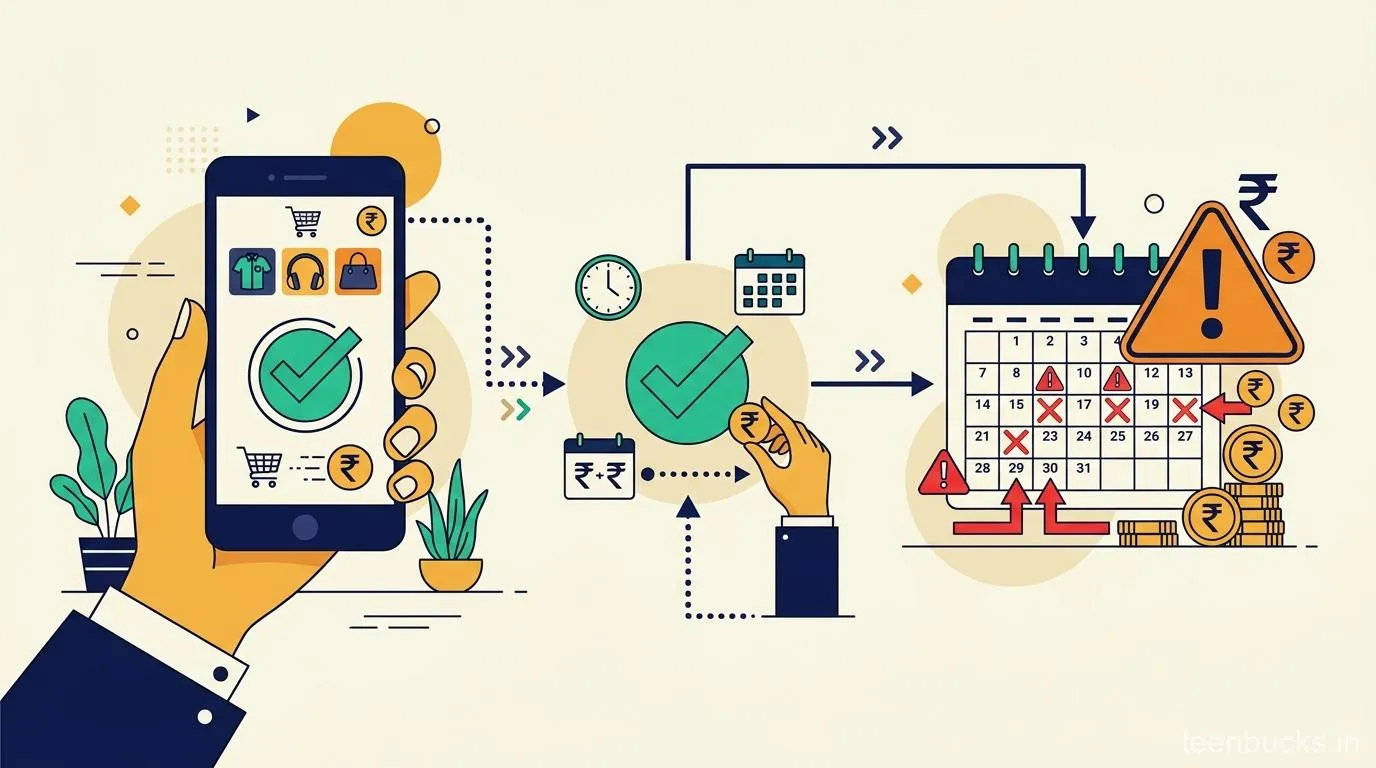
TeenBucks Guide: How BNPL converts a single checkout tap into multiple weeks of debt obligations
The Real Cost of BNPL — A Rupee-by-Rupee Breakdown
Let’s be extremely specific here, because “it’s just a small EMI” is the most dangerous lie in personal finance.
Imagine a typical college student’s BNPL usage in one month:
| Purchase | Amount | Platform | Due Date |
|---|---|---|---|
| Weekend dinner × 3 | ₹1,200 | Zomato Pay Later | 15 days |
| Earphone | ₹1,999 | Flipkart EMI (3m) | Monthly |
| Groceries | ₹800 | Zepto LazyPay | 30 days |
| Hoodie | ₹1,400 | Myntra Simpl | 15 days |
| Movie + snacks | ₹600 | BookMyShow BNPL | 30 days |
| Total Owed | ₹5,999 | Across 5 separate lenders | |
Now, the student’s parents sent ₹8,000 as monthly allowance. After rent split (₹3,000), transport (₹1,000), and college fees (₹500), there’s ₹3,500 left. But ₹5,999 is due in BNPL repayments this month. That’s a ₹2,499 shortfall — before a single meal has been bought with actual money.
The student now has two options: miss a payment (CIBIL hit + late fee) or borrow more to pay this month’s BNPL with next month’s BNPL. This is the debt spiral. It doesn’t look like a spiral when you enter it. It looks like solving a short-term problem.
The Hidden Fees Nobody Puts in the Green Banner
BNPL services prominently advertise “zero interest” or “no cost EMI.” Here’s what they don’t headline:
1. Late Payment Fees: LazyPay charges ₹100–₹500 flat for even one day of delay. Simpl charges up to 3% of outstanding amount per month after the due date. On a ₹1,000 order, that’s ₹30 in month one — which sounds small until you multiply it across 5 apps for 3 months.
2. Processing Fees on EMIs: Many “no cost EMI” offers on Flipkart and Amazon actually charge a processing fee of 1–1.5% that shows up as a separate line item after checkout. On a ₹10,000 purchase, that’s ₹100–₹150 upfront — which the seller quietly builds into the price.
3. Auto-Debit Failure Charges: If your bank account doesn’t have funds when BNPL auto-debits run (usually on the 5th or 10th), your bank charges a mandate bounce fee of ₹250–₹500 per bounce. This is separate from the BNPL late fee. On a bad month, you can be charged twice — once by the bank and once by the BNPL provider — for the same missed payment.
4. CIBIL Reporting from Day 1: Under RBI’s digital lending rules (first issued in September 2022 and now the RBI (Digital Lending) Directions, 2025), Pay Later credit has to come from a regulated lender, and the lender has to report it to credit bureaus. This means a ₹400 merchant-platform purchase funded through a reported digital-credit facility can appear on your credit file. Miss the payment and the lender can report it as overdue (shown as DPD, days past due) in your payment history. How long does that stay? Indian law sets a minimum, not an expiry date: the Credit Information Companies Regulations, 2006 require bureaus and lenders to keep credit information for at least seven years. And CIBIL says on its dispute page that closed accounts stay visible “regardless of how long they have been closed”, and that it can’t change or delete a record without the lender’s confirmation. So pay on time. If an entry is wrong, raise a dispute; there’s no clock that wipes it for you. (Both checked 14 Oct 2026.)
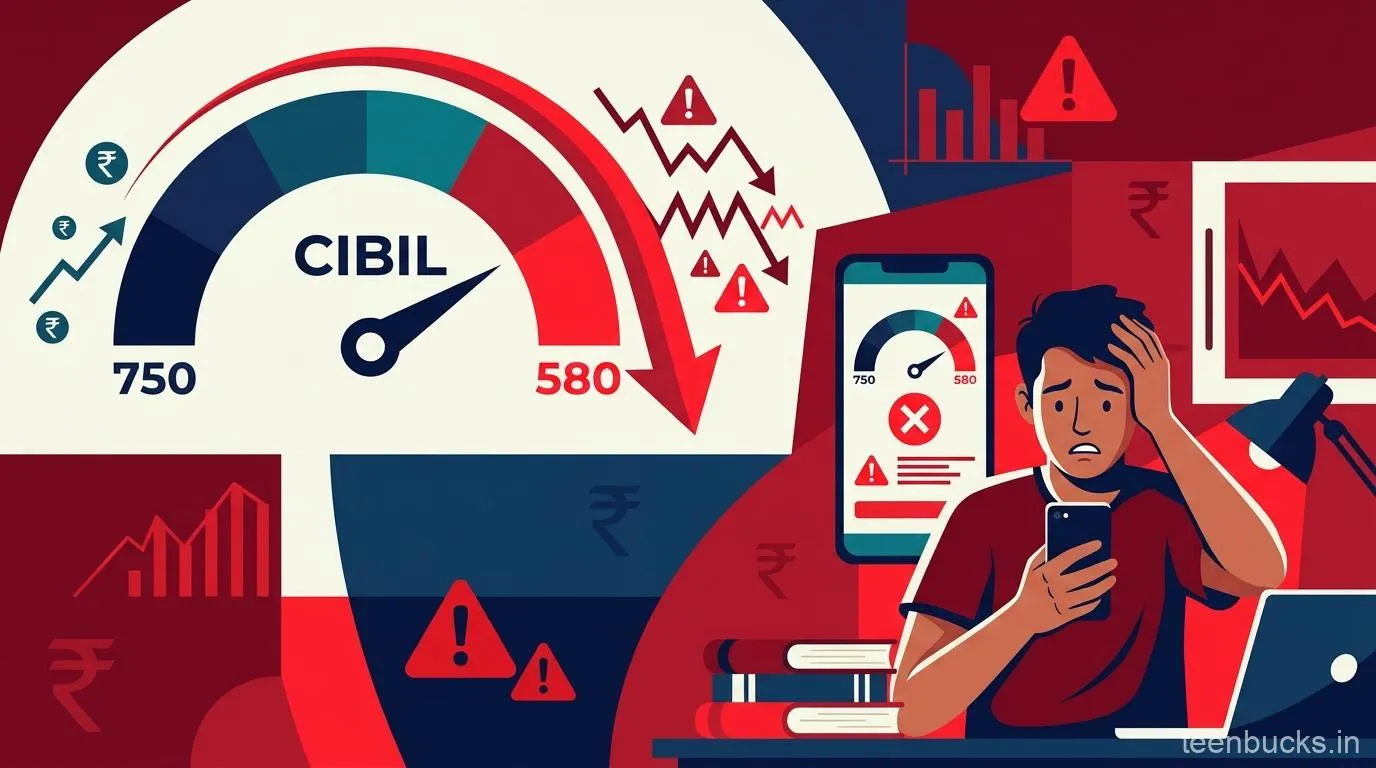
TeenBucks Guide: A missed BNPL payment can harm your credit history; the score impact varies by borrower and bureau model
Why BNPL Is Specifically Designed to Target Students
This is not a conspiracy theory. This is product design. BNPL interfaces are engineered using behavioural economics principles to reduce what psychologists call “loss aversion” at the point of purchase. Paying with cash or a debit card activates the same pain centres in your brain that activate during physical discomfort. BNPL neutralises this entirely — the money doesn’t leave your account today, so there’s no pain signal.
Additionally, BNPL is embedded at the exact point where your resistance is lowest: you’ve already added the item to your cart, you’ve already decided you want it, and you’re one tap away from having it. That’s when the “Pay Later” button appears — not as an option, but often as the default or highlighted choice.
Students are the primary target for another reason: they are not yet income earners. This means they cannot service moderate-sized debt with wages. They rely on allowances, which are irregular. This irregular cash flow is exactly what creates missed payments — not moral failure, just a timing mismatch between when the money arrives and when the EMI is due.
A 2025 study cited by the SEBI Investor Education program found that 68% of Indian students who use BNPL services have no clear plan for repayment at the time of purchase. They assume the money will “figure itself out.” It rarely does.
The “Loan Stacking” Problem Nobody Talks About
Here’s the most dangerous BNPL behaviour that gets almost no coverage: loan stacking.
Because each BNPL account operates in a separate app with a separate dashboard, users have no single view of their total BNPL obligations. Your Simpl app shows ₹1,400 due. Your LazyPay app shows ₹800 due. Your Zomato Pay Later tab shows ₹1,200 due. None of these apps talk to each other or show you the combined number.
This is not a design oversight. It is a design feature — for the lenders. When you see a ₹1,200 limit in Simpl, you don’t think “I owe ₹3,400 elsewhere.” You think “₹1,200 is fine, I can handle that.” And you tap Pay Later again.
The fix is embarrassingly simple: open every BNPL app you have installed and write down what you currently owe on a piece of paper or in Notes. Most students who do this for the first time are shocked. The total is almost always 2–3x what they estimated.
Real Talk: How to Know If You’re Already in the Trap
You might be in the BNPL debt spiral if:
- You have BNPL apps on more than 3 platforms simultaneously
- You’ve ever used one BNPL to float expenses while waiting to pay off another
- You’ve had a payment bounce because your account didn’t have enough balance
- You’ve received a “payment overdue” SMS from a BNPL provider
- Your monthly BNPL obligations exceed 20% of your monthly income/allowance
- You genuinely don’t know your total outstanding BNPL balance without checking
Any two of these is worth taking seriously. All of them together means you need the 5-step plan below — now, not at the end of the semester.
You should also check your CIBIL score immediately. It’s free once a year at CIBIL.com. If your score has dropped below 700, at least one BNPL provider has likely already reported a missed payment. This affects your eligibility for a proper student credit card and eventually your first personal loan, car loan, or home loan — so it matters more than it might seem right now.
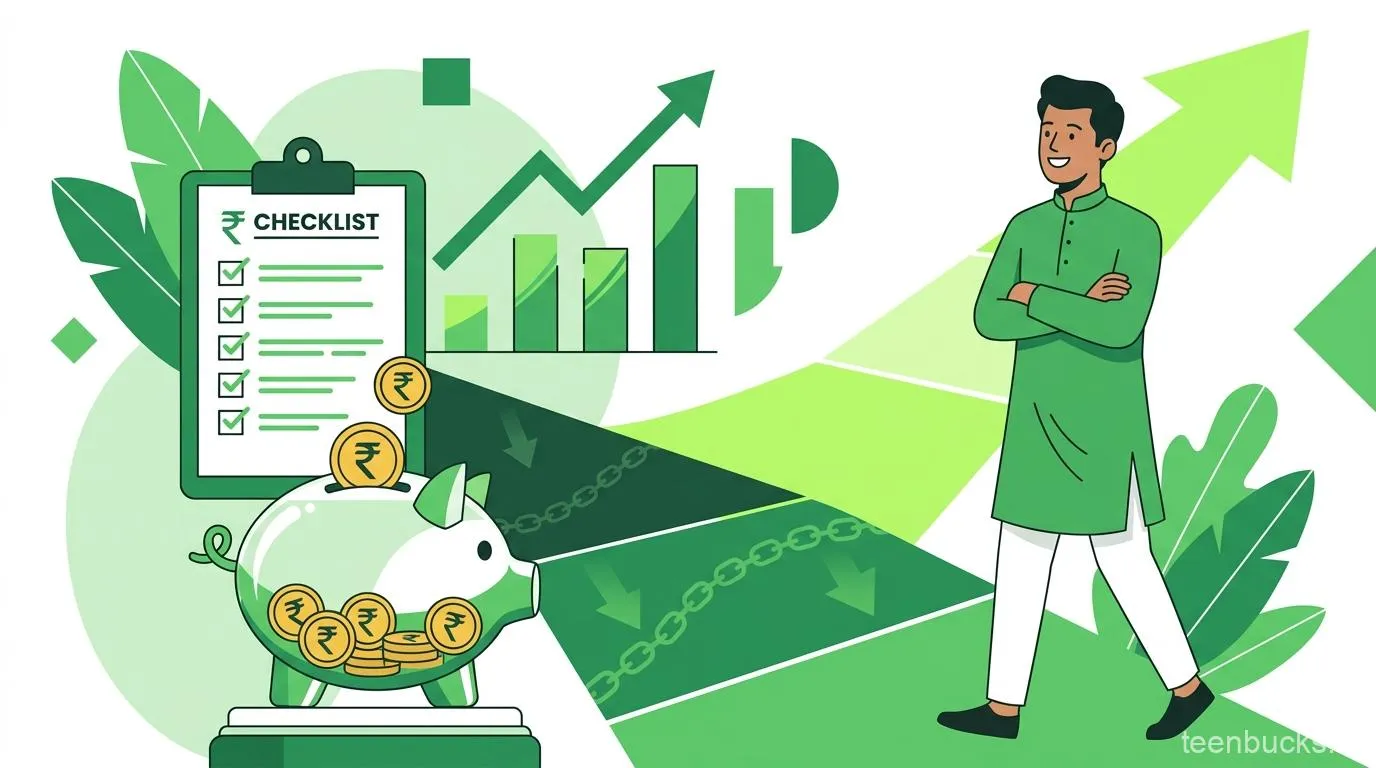
TeenBucks Guide: Getting out of the BNPL trap is a 5-step process — start today, not next month
The 5-Step Plan to Break the BNPL Cycle
Step 1: Do a Full BNPL Audit (Takes 10 Minutes)
Open every app on your phone that has a “Pay Later,” “Buy Now Pay Later,” “Postpaid,” or “EMI” feature. This typically includes: Zomato, Swiggy, Zepto, Flipkart, Amazon, Myntra, BookMyShow, PhonePe (Pay Later), Paytm (Postpaid), and LazyPay/Simpl if installed directly.
For each one, write down three things: current balance owed, next due date, and what happens if you miss it. This list is the first honest view of your actual debt situation. Most students discover they owe between ₹3,000–₹8,000 across platforms without having made a single “big” purchase.
Step 2: Pay Off the Smallest Balance First (The Debt Snowball)
Do not try to pay everything equally. Find the BNPL account with the smallest balance and pay it off completely — even if it means eating at the hostel mess instead of ordering out for 2 weeks. Once one account is zero, close it and disable Pay Later for that platform. The psychological win of eliminating one account gives you momentum to tackle the next.
Step 3: Disable BNPL at the Platform Level
This is the step most guides skip because it’s inconvenient, but it’s the most effective. Go into Zomato settings → Payment → Pay Later → Disable. Do the same in every other app. If you don’t, the option will reappear every checkout and you will use it again during a moment of weakness. Friction is your friend here — add it intentionally.
Step 4: Switch to a Strict Weekly Cash Envelope System
This sounds old-fashioned. It works. Every Monday, calculate your weekly budget (monthly allowance minus fixed expenses like rent, college fees, transport, divided by 4). Transfer only that amount to your primary UPI account. When it’s gone, it’s gone — and you can’t use BNPL if you’ve disabled it at the platform level.
If budgeting feels complicated, start with the 50/30/20 rule adapted for students: 50% on needs (food, transport, rent contribution), 30% on wants (outings, clothes, entertainment), and 20% saved or used to clear existing debt. Our Start Here guide has a simple calculator for this.
Step 5: Build a ₹3,000 Emergency Buffer in a Separate Account
The root cause of most BNPL usage is not greed — it’s a timing gap. Allowance arrives on the 1st, but dinner needs to happen on the 28th. Having even a small emergency buffer (₹2,000–₹3,000) in a separate zero-balance savings account like Fi Money or Jupiter that you don’t use daily means you never need to fall back on Pay Later for legitimate emergencies. This is the structural fix that prevents the cycle from restarting.
Want to understand how to build your CIBIL score after BNPL damage? Read our detailed guide on building a 750+ CIBIL score as a student with no salary — it’s the step-by-step recovery roadmap for exactly this situation.
The RBI’s 2026 BNPL Rules: What Has Actually Changed
It’s worth knowing your rights. As of 2025–26, the RBI requires all BNPL products to:
- Be offered only through a regulated bank or NBFC (not a fintech directly)
- Clearly disclose the Annual Percentage Rate (APR), not just the “interest-free window”
- Provide a Key Fact Statement (KFS) before any loan is sanctioned — a plain-language summary of all charges
- Report to at least one credit bureau (CIBIL, Experian, Equifax, or CRIF)
- Have a clear grievance redressal mechanism with a Nodal Officer
In practice, this means you should always read the Key Fact Statement before enabling Pay Later on any new platform. If you can’t find it or the app doesn’t show it, that is itself a red flag worth reporting to the RBI Ombudsman portal.
When BNPL Is Actually Fine (Yes, Sometimes It Is)
This is not an anti-BNPL manifesto. Used correctly, BNPL is a useful tool. It’s fine when:
- You are buying something you have already budgeted for and the money is sitting in your account
- You’re using a 0-cost EMI to split a large, planned purchase (like a course fee) and paying each instalment on-time, in full
- You have a reliable monthly income (stipend, freelance, part-time) that comfortably covers your total BNPL obligations
- You are using it on exactly one platform and tracking it carefully
The problem is almost never the tool. The problem is using 5 tools simultaneously without a tracking system, which turns “interest-free credit” into an invisible, unmanaged debt portfolio.
A Note on “No Cost EMI” on Electronics
The final thing worth understanding: there is no such thing as a genuinely free loan. “No cost EMI” on a ₹15,000 phone means the seller has marked up the price by 8–12% to cover the financing cost, and then the bank or NBFC processes the “discount” back as a cashback. You are paying for the EMI — it’s just buried in the MRP. Compare the cash price vs the EMI price on any electronics listing and you’ll usually find a ₹500–₹1,500 difference. That difference is the interest, just renamed.
Knowing this doesn’t mean you should never use EMI. It means you should compare the effective total cost across both options before deciding — not just look at the monthly number.
🎓 What to Do Instead: Safe Student Credit Building
Instead of risking your credit score on unregulated BNPL apps, follow safe student alternatives:
- Learn our 7-step blueprint to build a 750+ CIBIL score with zero salary using safe FD-backed cards.
- Compare the best FD-backed student credit cards in India without income proof.
- Use our Student Credit Card Eligibility Finder to check your approval odds.
- Keep your emergency funds in a safe zero-balance student bank account rather than spending credit lines.
Frequently Asked Questions
Does BNPL usage really affect my CIBIL score as a student?
What’s the difference between BNPL and a student credit card?
I already missed a BNPL payment. What should I do right now?
Sources:
1. Reserve Bank of India — Guidelines on Digital Lending and credit-bureau reporting
3. Economic Times — BNPL Market Growth and Default Rate Report 2026
Last updated: August 2026 | Written by TeenBucks | Fact-checked against the RBI (Digital Lending) Directions, 2025 (14 Oct 2026)