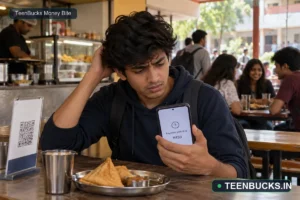

You’re paying ₹3,500 hostel rent. You choose a saved contact, enter your UPI PIN and see Successful.
Two minutes later, your roommate texts: “Bhai, mere paas nahi aaya.”
You look at the name again. Wrong person.
Now your rent money is sitting in someone else’s account, your landlord still wants payment, and the UPI app has no magical Undo button.
Here’s what I’d do — in order — without falling for somebody who promises a “₹99 instant reversal.”
The ₹3,500 hostel example is fictional, used to explain the process.
First: was the payment wrong, failed, or still processing?
| Situation | What it means | What to do |
|---|---|---|
| Failed, but money was debited | A qualifying failed UPI payment may be automatically reversed under RBI’s turnaround rules. | Track reversal and complain if late. |
| Processing/pending | The final status may not be settled or reflected everywhere yet. | Check bank and app records; don’t blindly pay again. |
| Successful — wrong person or UPI ID | Your authorised payment reached an unintended destination, or was reported successful to an incorrect recipient. | Seek a wrong-beneficiary recovery through your bank; no automatic cancel button. |
Our failed UPI refund guide covers the first case. Google Pay says a UPI payment cannot be cancelled once you’ve authorised it with your PIN. Google Pay: incorrect transfers · NPCI: UPI FAQs.
Why your bank can’t simply press Reverse
Once a UPI payment is successfully authorised and credited, the money may already be available to the recipient. That’s different from cancelling an unconfirmed shopping-cart order.
Your bank can investigate and use available banking/dispute channels to request a return. It generally cannot just take money out of another customer’s account because the sender says they made a typo; the receiving bank must follow applicable consent, dispute and legal processes.
There are two points worth keeping separate:
- A successful transfer is not automatically cancellable by the sender.
- Someone who received money by mistake doesn’t simply gain a legal right to keep it. Section 72 of the Indian Contract Act, 1872 says money paid by mistake must be repaid or returned. Enforcing that right, especially against a stranger, may require the bank’s assistance or a legal process. India Code — Indian Contract Act, Section 72.
So “the recipient must return it” and “your bank guarantees a refund by tomorrow” are very different claims. Only the first has a general legal basis; neither proves how quickly money will come back in your particular case.
Save these details before you call the bank
Open the payment entry and record:
- UPI transaction reference (often shown as RRN, UTR or UPI reference ID). Copy the number exactly as provided; don’t guess its format.
- Date, time and ₹ amount.
- Payee’s displayed name and UPI ID (VPA), where available.
- Debited bank account, using only safely masked details when sharing with support.
- UPI app used and a screenshot of the payment details/status.
- Matching debit from your bank statement.
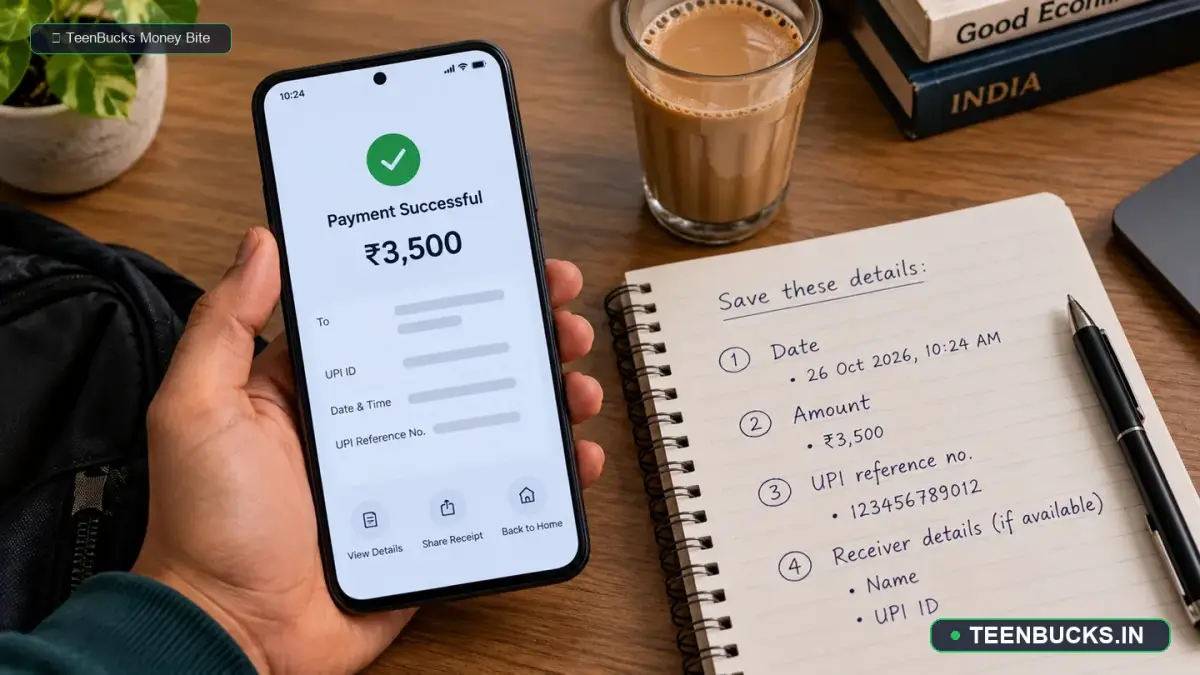
Illustrative visual, not a real bank statement. Keep sensitive data out of public posts and screenshots sent to strangers.
Three things to do immediately
1. Contact the recipient only if it is safe and practical
If the mistaken recipient is a classmate or someone you know, explain the error and request a return after they verify the credit in their own account.
If it’s a stranger, you might not have a reliable way to contact them. Don’t threaten them, publish their identity or send more money to “verify” your refund. You can proceed straight to your bank.
And never give your UPI PIN or OTP to anyone claiming they can reverse the transaction.
2. Raise a wrong-recipient complaint with your own bank
Use the payment app’s help section if it offers the appropriate complaint reason, and contact the bank that debited your account. State plainly:
“I authorised a UPI payment but selected the wrong beneficiary. Please register a wrong-beneficiary recovery request, coordinate with the receiving bank and give me a complaint/reference number.”
Provide the UPI reference, amount, time and payee information. Ask for a written acknowledgement and note what the bank says it can do next.
This distinction matters: NPCI’s published UPI Help guidance says that particular in-app flow does not take complaints on successful person-to-person transactions. So if the app doesn’t offer the right reason, don’t keep filing it as Failed. Use the bank’s grievance channel instead. NPCI UPI Help specification.
3. Follow up through the proper channels
If the bank’s response doesn’t resolve the issue, request its written explanation and use the bank’s grievance/nodal-officer escalation process.
NPCI has a complaint portal and UPI dispute mechanisms, but the available flow depends on the transaction and complaint category. Don’t assume every successful P2P transfer can be submitted through every NPCI app screen. Google Pay’s own wrong-transfer guidance says to approach NPCI within three days if its earlier steps haven’t helped; that is Google’s published instruction, not a guarantee of reversal within three days. Google Pay instructions.
For a bank-service failure, the free RBI Complaint Management System may be available under the Reserve Bank–Integrated Ombudsman Scheme, 2026. You must first complain to the bank. Typically, you can escalate if you’re dissatisfied with its reply, or after 30 days without a reply, or a longer period if applicable RBI/NPCI/card-network rules prescribe one. The scheme also has filing deadlines and admissibility requirements; the Ombudsman does not automatically compel a private recipient to refund a mistaken payment. RBI’s July 2026 FAQs.
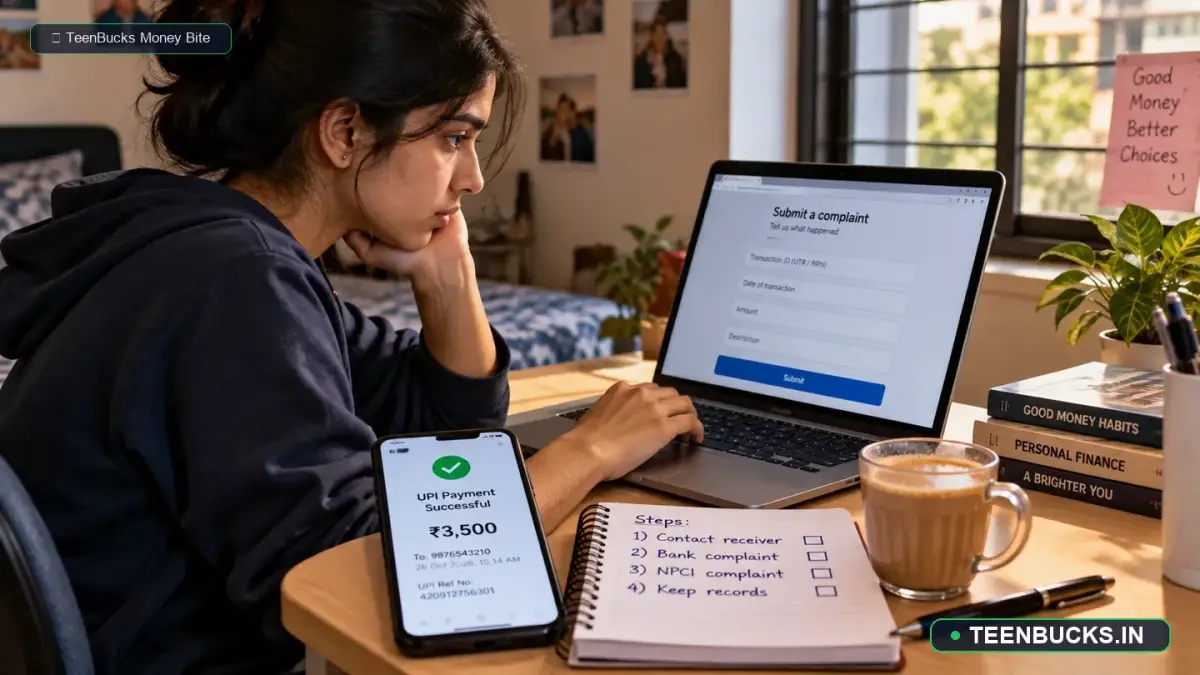
Keep the bank’s acknowledgement, the original UPI reference and all follow-ups together.
A realistic timeline — not a refund promise
| When | Your action |
|---|---|
| Immediately | Preserve proof; contact the known recipient if safe; notify your bank. |
| As soon as you have a complaint ID | Ask the bank which wrong-beneficiary recovery route it has initiated. |
| Next few days | Follow up in writing; use an app/NPCI route only if that complaint type is supported. |
| After an unsatisfactory bank response or the applicable response period | Consider RBI Ombudsman escalation for deficient bank service, subject to the scheme’s rules. |
| If the recipient refuses | Keep records; consider formal legal advice about recovery, especially for a material sum. |
These steps improve your chances of a documented investigation. They do not create a standard 24-hour or 48-hour refund entitlement for an authorised transfer to the wrong person.
What the bank can and cannot do
| Your bank can generally help with | Your bank cannot promise |
|---|---|
| Logging your complaint and checking the payment reference | A unilateral “Undo” of every successful UPI payment |
| Sending a recovery/dispute request through the available interbank process | That another customer will voluntarily return money |
| Coordinating with the beneficiary bank where applicable | A fixed refund date in every wrong-recipient case |
| Providing a written outcome and escalation route | That an Ombudsman complaint by itself will recover the money |
Mistake or scam? Don’t mix them up
Selecting the wrong contact yourself is a mistaken transfer.
If someone impersonated your landlord, sent a fake QR, posed as support or tricked you into authorising the payment, you could instead be dealing with financial cyberfraud. In that case, contact your bank immediately and report suspected fraud to 1930 or cybercrime.gov.in. Don’t wait for ordinary mistaken-payment follow-ups when fraud is suspected.
And remember: you do not need to enter a UPI PIN to receive an ordinary incoming payment. Scammers frequently reverse the story and trick people into authorising outgoing payments. We’ve covered that in the fake UPI credit scam guide.
A ₹3,500 mistake can mean ₹7,000 leaves your account
Let’s say the hostel rent is due and you pay your roommate correctly after the mistaken transfer.
| Transaction | Money out |
|---|---|
| First payment, wrong person | ₹3,500 |
| Second payment, correct roommate | ₹3,500 |
| Total cash outflow | ₹7,000 |
You still intended to pay only ₹3,500 rent. The extra ₹3,500 is a recovery claim, not a fee, not a failed-transaction refund and not money you should assume will be back by Friday.
If rent can’t wait, check your available balance and borrow only through safe, transparent arrangements if absolutely needed — don’t send more money to the stranger or a supposed refund agent.
Five seconds that can save you this headache
- Match the full payee details. Don’t rely only on a profile photo or a familiar-looking display name.
- Confirm a new beneficiary using a trusted contact method, especially for hostel rent or semester fees.
- For a large new payment, consider a small test transfer only if it’s appropriate and both parties can confirm receipt; it’s not a foolproof guarantee and it is still a real transfer.
- Save verified payees carefully rather than trusting similar names in your recent-payments list.
- Read the final confirmation screen before entering your PIN. Scanning a QR and entering a PIN normally authorises paying, not receiving money.
💡 The TeenBucks takeaway
“Successful” doesn’t necessarily mean “sent to the right person.”
You can’t press a cancel button, but you also shouldn’t give up after one rejected app complaint. Save the reference, start with your bank, follow up in writing and avoid anyone selling a guaranteed reversal.
The boring five-second name check before paying is still easier than recovering ₹3,500 while your roommate is waiting for rent.
Official sources: NPCI UPI FAQs · NPCI UPI Help guidance · Google Pay wrong-transfer instructions · Indian Contract Act, Section 72 · RBI Integrated Ombudsman Scheme 2026 FAQs.
Frequently Asked Questions
1. Can I cancel a successful UPI transfer to the wrong person?
Not through an ordinary cancel button. Contact the recipient if appropriate and ask your bank to open a wrong-beneficiary recovery request. A successful P2P transaction may not be supported by the app’s regular UPI Help complaint screen.
2. Will the money come back in 24 or 48 hours? Do I get ₹100/day?
There is no standard guaranteed deadline for recovering an authorised transfer to the wrong beneficiary. RBI’s ₹100/day delayed-reversal compensation relates to qualifying failed transactions under a different framework; don’t apply it automatically to this mistake.
3. What if the recipient refuses to return the ₹3,500?
Get the bank’s written response, preserve all payment evidence and consider the available legal remedies. Section 72 of the Indian Contract Act generally requires repayment of money received by mistake, but enforcing it can take time. The RBI Ombudsman can address qualifying deficiencies in banking service; it is not a court order against the recipient.
Editorial note: All student examples are fictional. This article explains general banking and legal routes; actual recovery depends on facts, available bank processes and any formal proceedings. Never share a UPI PIN or OTP with a caller promising a refund.