When shopping for a new two-wheeler, purchasing an iPhone on EMI, or applying for an instant personal loan, you will often encounter banners screaming: “Special Deal: Just 5.5% Flat Interest!”
To an unsuspecting student or first-time borrower, 5.5% sounds like an unbelievable bargain compared to a bank advertising a 10% interest rate. But this comparison is a financial illusion. Behind that attractive flat number lies one of consumer lending’s most profitable traps.
What Is a Flat Interest Rate?
In a Flat Rate Loan, the lender computes total interest on the full original principal for the entire loan duration right at the start. That lump-sum interest is added to your principal and divided equally by the number of months.
Flat EMI = [ Principal + (Principal × Flat Rate × Years) ] / (Years × 12)
The Catch: Even when you are in Year 3 and have already paid off 80% of your debt, the lender is still charging you interest on the initial 100% loan amount you borrowed on Day 1!
What Is a Reducing Balance Rate?
Under the Reducing Balance Method (mandated by the Reserve Bank of India for all reputable commercial banking), each monthly EMI is split between interest and principal. Interest is charged strictly on the remaining outstanding balance at the end of each month.
As you make payments, your principal balance shrinks. Therefore, the interest component decreases with each passing month, while the principal repayment portion expands.
The Direct Comparison: ₹2 Lakh Bike Loan over 3 Years
To see how flat rates extract hidden money from your pocket, consider a ₹2,00,000 two-wheeler loan over a 3-year tenure (36 months):
| Parameter | Showroom “6% Flat Rate” | Bank “10.5% Reducing Rate” |
|---|---|---|
| Advertised Rate | 6.0% p.a. | 10.5% p.a. |
| Monthly EMI | ₹6,556 / month | ₹6,502 / month |
| Total Interest Paid | ₹36,000 | ₹34,064 |
| Total Repayment | ₹2,36,000 | ₹2,34,064 |
| True Effective APR | 11.2% Reducing | 10.5% True Cost |
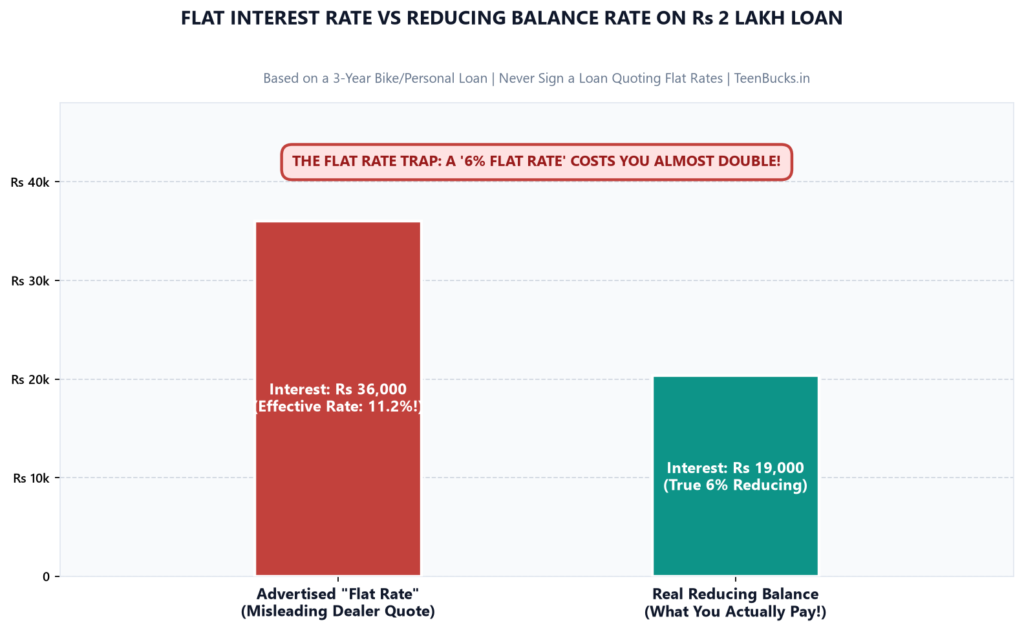
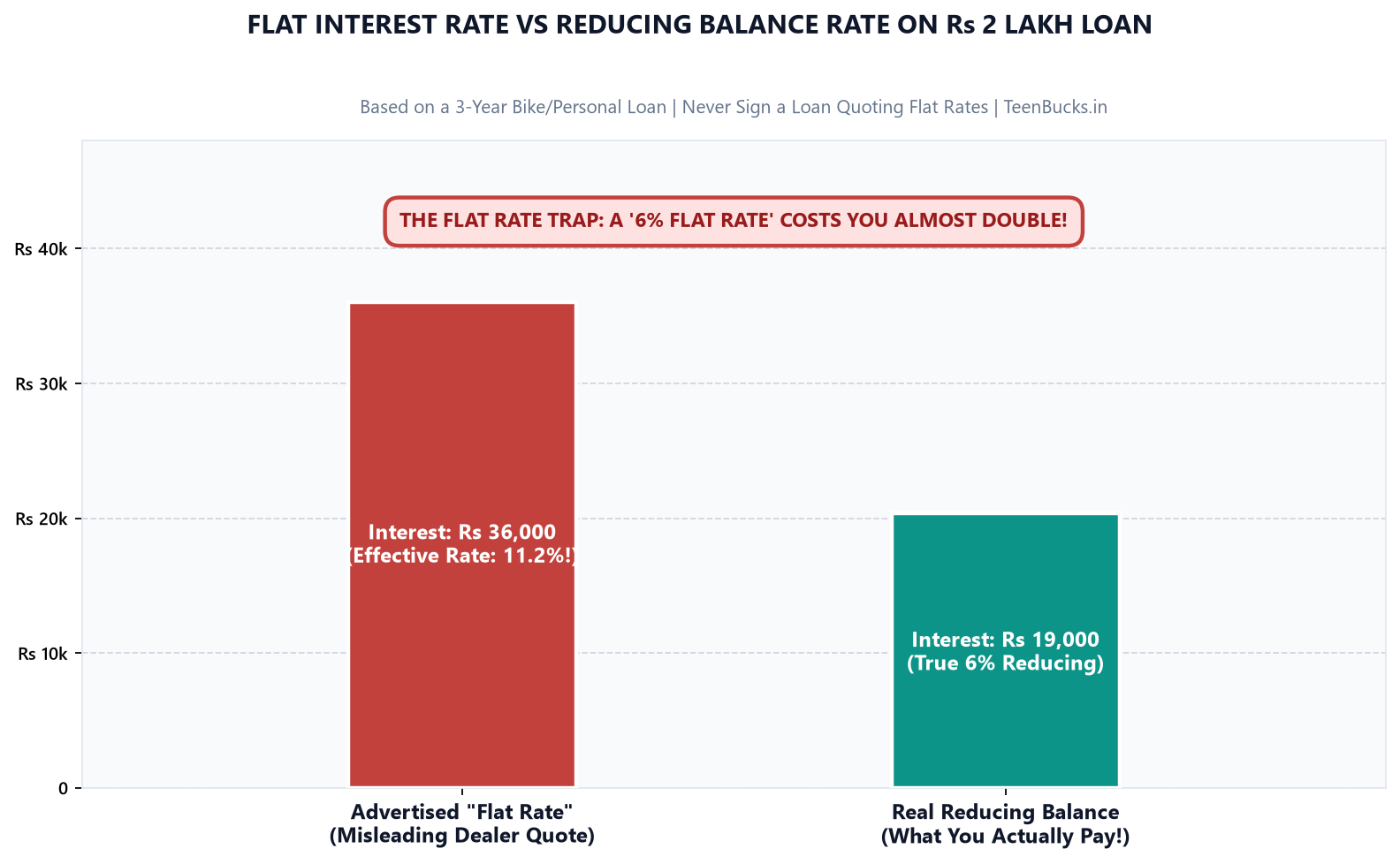
Notice the stunning result: Even though the flat rate looks almost half as cheap (6% vs 10.5%), the borrower paying the 6% flat rate actually pays more total interest and a higher monthly EMI! In reality, a 6% flat rate equates to an effective reducing rate of approximately 11.2%.
You can verify this exact math and test different loan amounts using our free Loan & EMI Calculator.
The Quick Rule of Thumb: How to Convert Flat to Reducing Rate
When talking to automobile dealerships or instant loan apps, you don’t need a financial degree to convert flat rates. Use this rapid mental shortcut:
True Reducing Rate ≈ Flat Rate × 1.85 (to 1.95)
- A 5% Flat Rate is roughly 9.3% to 9.7% Reducing.
- A 6% Flat Rate is roughly 11.2% to 11.8% Reducing.
- An 8% Flat Rate is roughly 15.0% to 15.6% Reducing!
RBI Protection: Demand the “Key Fact Statement” (KFS)
Under Reserve Bank of India (RBI) circulars, every regulated commercial bank, cooperative bank, and Non-Banking Financial Company (NBFC) is legally required to provide borrowers with a standardized, transparent Key Fact Statement (KFS) before loan execution.
The KFS must explicitly state:
- The Annualized Percentage Rate (APR) computed on a reducing balance basis.
- All upfront processing fees, documentation charges, and stamp duty.
- Penal interest charges and late fees.
- Whether any mandatory insurance bundling is required.
If an agent refuses to provide the APR or only quotes a flat rate, walk away. Legitimate institutions will always quote their rates transparently on a reducing balance schedule.
Managing Debt Wisely
Navigating retail loans requires financial awareness. Understand your rights with our guide on Can Bank Balance Go Negative? The RBI Rule Every Student Must Know, explore student loan funding through PM-Vidyalaxmi Education Loan 2026, and start building your financial cushion using our Mutual Fund SIP Calculator.