

You’ve finished your notice period. The office ID card is going back tomorrow. Your new job starts next Monday, and you’re waiting for your full-and-final (F&F) settlement.
Then you remember something in your old offer letter:
You worked there for 24 months. Quick calculator check: ₹1,442 × 24 = ₹34,608. Nice. Maybe that’s a new phone, a few months of rent, or finally that Goa trip your group has postponed three times.
Then the F&F statement arrives.
That hurts. But before you call it a payroll scam, here’s what the offer letter probably didn’t explain: gratuity included in CTC is not the same thing as gratuity you are legally entitled to receive today.
Let’s sort out the 2026 rules, the actual formula and the questions worth asking HR before you resign.

First, what exactly is gratuity?
Gratuity is an employer-paid service benefit. It’s generally paid when eligible employment ends—through resignation, retirement, qualifying contract completion, death, disablement or another covered event.
It isn’t a monthly savings deduction like employee PF. You don’t normally have an individual gratuity balance you can log in to withdraw. And it isn’t a performance bonus that your manager can simply cancel because you didn’t hit a target.
India brought the Code on Social Security, 2020 into effect on 21 November 2025. Section 53 sets out gratuity eligibility and the payment formula. The Ministry of Labour has since clarified how the new wage definition and fixed-term employment rules apply. [Official Ministry FAQ]
The rules typically cover establishments within the gratuity chapter’s scope—for example, qualifying shops and establishments meeting the statutory employee threshold. Individual coverage, continuity, contracts and exceptions can change the outcome.
Gratuity after 1, 3 or 5 years: who actually qualifies?
Here is the distinction most social media posts miss:
| Your service | Regular / permanent employee resigning normally | Eligible employee hired directly on a fixed-term contract |
|---|---|---|
| 1 year | Generally not eligible yet | Can qualify for proportionate gratuity on qualifying contract completion |
| 3 years | Generally not eligible yet | Can qualify, based on qualifying fixed-term service |
| 5 years | Generally eligible, subject to the rules | Generally eligible, subject to the rules |
This table assumes an employer and employee covered by the law. Death, qualifying disablement, certain employment categories and better contractual terms can produce different results. Working journalists also have a specific three-year provision under Section 53. [Code on Social Security, section 53]
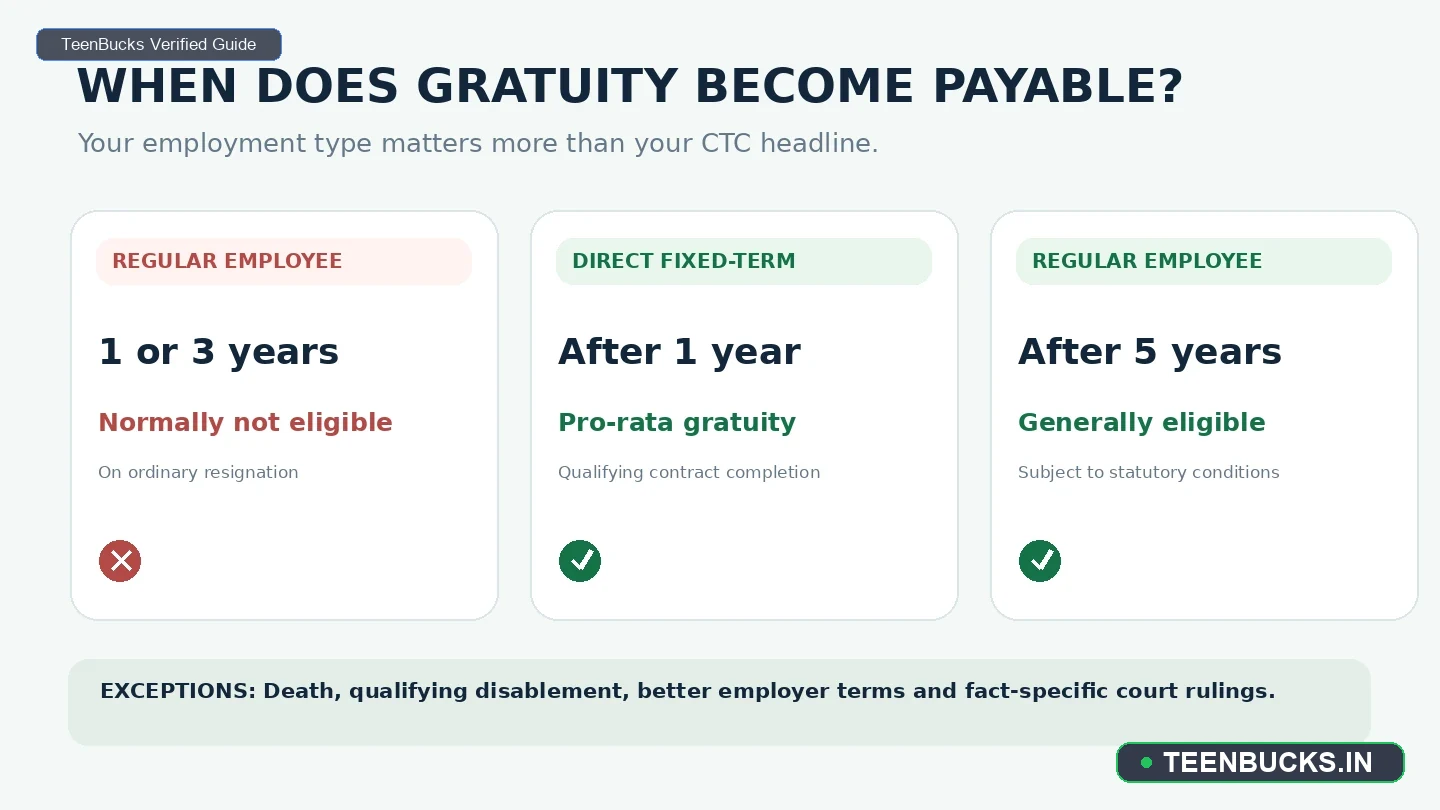
After one year: fixed-term employees have a different rule
Say a company hires you directly for a 12-month project as a fixed-term employee. You complete the contracted year and your term ends. Under the current Labour Ministry clarification, a fixed-term employee who serves one year from the start of the contract can qualify for gratuity, paid proportionately under the relevant provisions. [Labour Ministry clarification, March 2026]
But hold on—“contract employee” is not automatically the same as “fixed-term employee.”
If a staffing agency hires you and sends you to a client office, you may be employed by the contractor rather than directly by the client. The Ministry says contractor-employed workers do not automatically get the special one-year fixed-term treatment; the standard five-year rule generally applies to the contractor’s eligible employees. That’s a big difference when you’re reading an appointment letter.
And no, an 11-month agreement does not magically become eligible under the Ministry’s one-year guidance. Read the contract dates and the actual employer’s name.
After three years: don’t mistake a CTC provision for a payout
If you joined as a regular employee and resign after three years and four months, you ordinarily haven’t met the five-year qualifying service requirement. Your statutory gratuity on that ordinary resignation may be ₹0, even if the employer’s CTC annexure carried a gratuity provision throughout those years.
An employer can offer better gratuity terms through an agreement, award or contract. And special statutory exceptions exist. So if your HR policy promises gratuity after three years, read that wording before assuming the statutory default is your only option.
After five years: generally eligible, but read the service record
For most covered regular employees, five years of continuous service is the standard rule. Continuous service isn’t necessarily broken by every permitted leave or authorised absence; the statutory rules must be applied to the actual employment record.
What about the famous “4 years + 240 days” trick? A February 2026 Madras High Court decision supported a gratuity claim involving four years, ten months and seven days, applying its existing judicial interpretation. But that does not make 4 years + 240 days an automatic, universally settled nationwide entitlement—especially without examining the employment pattern, applicable jurisdiction and law. Don’t resign one day early because an Instagram reel promised you’re covered. [Madras High Court judgment (12 February 2026)]
If you’re close to five years and planning a switch, ask HR for the recorded date of joining, leave history and gratuity eligibility date in writing. That one email is worth more than ten Reddit arguments.
Gratuity calculator 2026: the formula and its limits
For an eligible monthly-rated employee under the standard calculation, the basic formula is:
Estimated Gratuity = (Last-drawn applicable monthly wages × 15 × counted years of service) ÷ 26
What do those numbers mean?
- 15: Fifteen days of wages for each counted year under the general rule.
- 26: The statutory divisor used to calculate 15 days’ wages for monthly-rated employees—not a claim that every payroll month has exactly 26 payable days.
- Counted years: Completed years, with a part of a year in excess of six months generally counted as another year for the standard calculation once eligibility exists. Certain cases, including fixed-term employment, use proportionate payment.
- Applicable wages: The legally relevant wage base at the end of employment, not automatically your full CTC, gross salary or just the basic salary printed on an old offer letter.
For example, 5 years 7 months ordinarily counts as 6 years under that service-rounding rule; 5 years 3 months ordinarily counts as 5. But 4 years 7 months is not automatically five years of eligibility merely because a calculation rounds an incomplete service year. Eligibility and calculation are two different checks. [Ministry of Labour FAQ]
Calculator input tip: Use an applicable wage figure, not the annual package on your placement offer. If you don’t know the wage figure, ask payroll before treating the result as a guaranteed amount.
The 2026 wage rule most old gratuity calculators miss
Older blogs often say “just use basic + DA.” That may understate the statutory wage base under the Labour Codes.
The revised definition generally starts with basic pay, dearness allowance and retaining allowance (where applicable). Specified excluded allowances may be added back to the extent they exceed 50% of relevant remuneration, subject to the statutory rules. The government specifically says the new definition applies to gratuity calculations from 21 November 2025. [Ministry of Labour FAQ on wages]
Here’s a simplified illustration, assuming every ₹40,000 of allowance in this example is a component that counts towards the 50% test and there are no other relevant items:
| Monthly pay component | Amount |
|---|---|
| Basic + DA + retaining allowance | ₹20,000 |
| Relevant allowances | ₹40,000 |
| Total relevant remuneration | ₹60,000 |
| 50% allowance limit for this illustration | ₹30,000 |
| Excess allowance added back | ₹10,000 |
| Illustrative statutory wage base | ₹30,000 |
Under these assumptions, calculating five-year gratuity on ₹20,000 would give ₹57,692. Using the adjusted ₹30,000 wage base gives ₹86,538. That’s a difference of ₹28,846. The actual test can be more complicated depending on other remuneration items, so this is a learning example, not payroll advice for every offer.
Gratuity & Labour Code Calculator (2026)
Real examples: what could actually reach your bank?
All figures below are rounded to the nearest rupee and assume the employee is covered by the relevant gratuity provisions, the quoted wage number is the correct statutory wage base, and there are no special contractual terms changing the result.
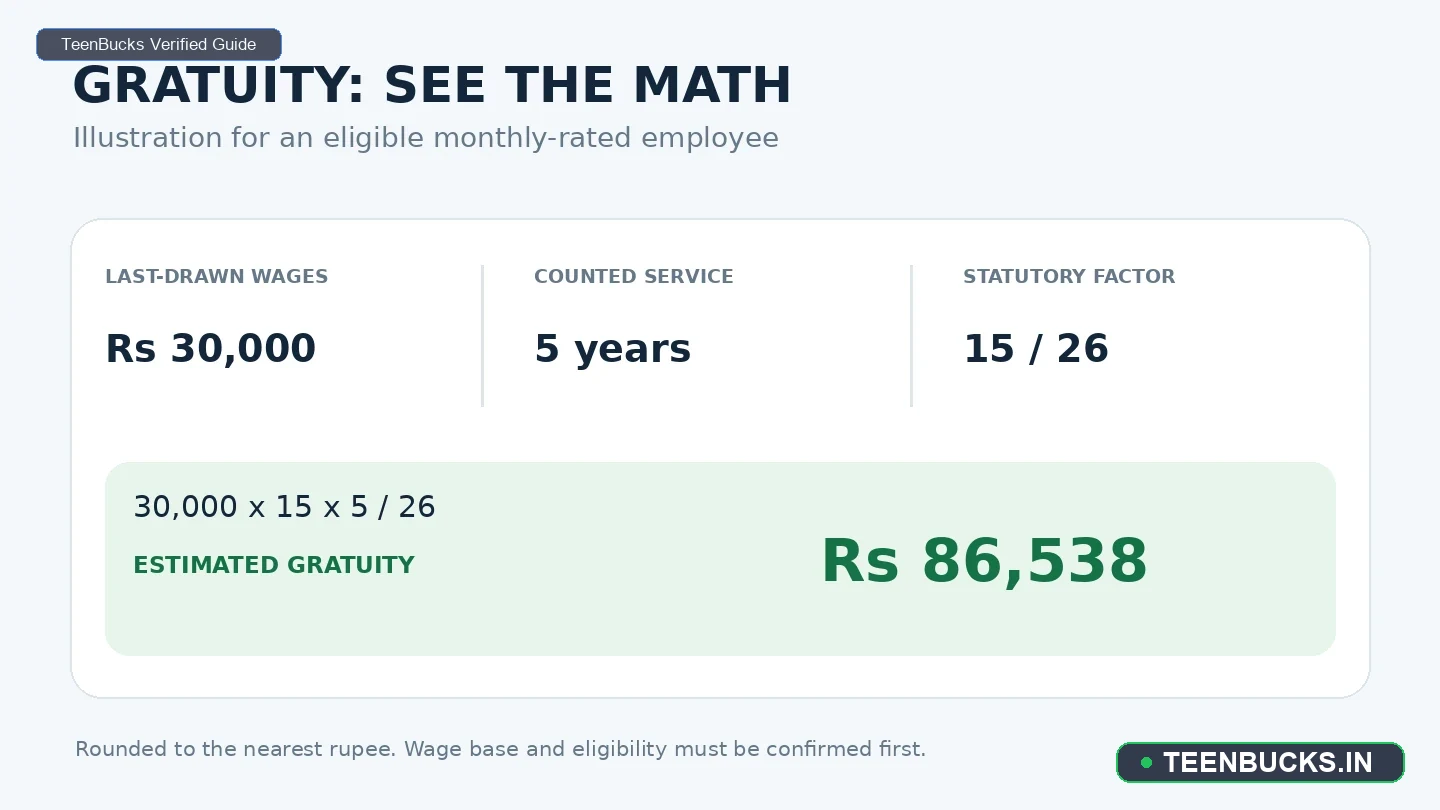
Example 1: One-year directly hired fixed-term employee
- Employment: Eligible directly hired fixed-term employee, contracted year completed
- Applicable last-drawn monthly wages: ₹30,000
- Calculation: ₹30,000 × 15 ÷ 26 × 1
- Illustrative gratuity: ₹17,308
The reason this example qualifies is the fixed-term rule, not because every employee gets gratuity after 12 months.
Example 2: Regular employee resigns after 3 years 4 months
- Employment: Regular employee, ordinary resignation
- Applicable last-drawn monthly wages: ₹45,000
- Statutory service threshold: Not met under the usual five-year rule
- Ordinary statutory gratuity: ₹0
Don’t multiply three years of salary and call it money owed. First check eligibility; only then calculate.
Example 3: Regular employee completes exactly five years
- Employment: Regular employee, eligible resignation
- Applicable last-drawn monthly wages: ₹50,000
- Calculation: ₹50,000 × 15 ÷ 26 × 5
- Illustrative gratuity: ₹1,44,231
Example 4: Employee leaves after 6 years 9 months
- Employment: Regular employee, eligible resignation
- Applicable last-drawn monthly wages: ₹80,000
- Counted service: 7 years, under the standard above-six-month rounding rule
- Calculation: ₹80,000 × 15 ÷ 26 × 7
- Illustrative gratuity: ₹3,23,077
None of these is a promise about the after-tax cash deposit. That depends on the employee’s tax treatment, the amount actually paid and other facts discussed below.
“Gratuity: ₹1,442 per month” — why is it in my CTC?
Let’s return to that F&F surprise.
At monthly applicable wages of ₹30,000, a common employer annualised gratuity-cost estimate based on the standard 15/26 formula is:
₹30,000 × 15 ÷ 26 ÷ 12 = about ₹1,442 per month.
That’s where the frequently quoted 4.81% of monthly wages approximation comes from. But it is not a law saying every company must deduct 4.81% from your monthly take-home or maintain a separate personal gratuity pot for you.
If your CTC includes a gratuity provision, it’s generally an estimated employer cost. It isn’t automatically an employee-side deduction and it doesn’t mean you have an individual, vested balance of ₹1,442 growing every month.
So the original 24-month maths—₹1,442 × 24 = ₹34,608—can be arithmetically correct as an estimate of employer CTC allocation and still not be an amount payable on a regular employee’s two-year resignation.
This doesn’t excuse a confusing offer letter. Ask HR to show CTC, cash gross pay, take-home deductions, employer costs and gratuity provision as separate lines. If you need the basics, read our TeenBucks guide to CTC vs in-hand salary.
Does the ₹20 lakh gratuity limit mean every payout is tax-free?
No. Two different things get confused here:
- The Labour Ministry’s current guidance states a ₹20 lakh statutory gratuity ceiling under the standard framework. Better terms can exist under eligible contracts or arrangements.
- Income-tax treatment is a separate question. For qualifying gratuity, the exemption or salary deduction depends on employee category, the applicable legal limit, actual amount received and other conditions. A private-sector payment is not tax-free merely because it is below ₹20 lakh.
The Income-tax Act, 2025 applies from Tax Year 2026–27. Its Section 19 contains salary deductions concerning qualifying gratuity. Articles citing the old Section 10(10) of the 1961 Act may be describing an earlier tax period or older statutory references. [Income Tax Department: Section 19]
For an ordinary eligible private-sector employee receiving precisely the gratuity payable under the applicable statutory formula and within the limits, the payment will often fall within the available tax deduction. But don’t stamp “tax-free” onto every example without checking the exact case. Government service rules, earlier gratuity receipts, different employment arrangements and extra employer-paid amounts can affect tax treatment.
If your employer quotes a large gratuity settlement, request the taxable/exempt calculation in writing or ask a tax professional to check it.
How to claim gratuity when you resign
If you qualify, you shouldn’t need to beg HR for an amount the law requires. Here’s a practical approach:
1. Keep the evidence. Save your appointment letter, joining date, salary/wage breakup, payslips, service records, resignation acceptance, last working day and final-settlement statement. If you worked through multiple entities, keep those appointment and transfer letters too.
2. Request the calculation in writing. Ask payroll which employment category and wage base they used, what service period they counted, and how they arrived at the amount. Since 8 May 2026, the Social Security (Central) Rules, 2026 ask you to apply in Form IV, ordinarily within 30 days of gratuity becoming payable. A late application must still be accepted if you show sufficient cause. Establishments under a state government follow that state’s rules.
3. Check the payment date. Section 56 of the Code on Social Security says the employer must determine payable gratuity even without an application and arrange payment within 30 days from when it becomes payable. [Section 56]
4. If payment is late or disputed, escalate with documents. Section 56 allows a claim before the competent authority under the applicable process. Where delay attracts statutory interest, the rate is governed by the law and relevant notifications; “10% automatically in every case” is not a safe blanket claim. The law also provides a narrowly defined exception for delay attributable to the employee with permission from the competent authority.
A calm email with the actual figures beats an angry five-paragraph WhatsApp message. If you’re comparing a new job offer against staying a little longer, also see our TeenBucks job-offer comparison guide.
Should you stay four extra months just to get gratuity?
Maybe. But don’t do it using only a gratuity number.
Say your current job could pay ₹1.44 lakh gratuity if you complete the qualifying service. Another employer offers a ₹12,000 monthly increase in take-home. Four months of that increase equals ₹48,000. But the real decision also includes the new role’s growth, joining date, bonus terms, commute, relocation, PF arrangements and whether you’re truly eligible at the old employer.
You don’t need a motivational speech about loyalty here. You need two written offers, your actual last working date, and a realistic cash-flow comparison. Gratuity is one item in the equation, not your whole career plan.
Before you believe a gratuity calculator, check these five things
- Are you eligible yet? Regular, directly hired fixed-term, contractor-employed, working journalist and exceptional cases can follow different rules.
- Is the employer covered? Check the establishment and applicable law, not just the logo on your access card.
- Are you entering the right wages? The 2026 definition and allowance add-back may change the base.
- Are service dates correct? Continuous service, partial years and judicial questions shouldn’t be reduced to a guessed number.
- Are you mixing statutory gratuity, CTC provisioning and tax? They are three separate checks.
If any one of these is unclear, use the calculator for a rough illustration, not as a demand letter.
TeenBucks takeaway: The gratuity line in your CTC is not money to spend on a future Goa trip yet. Verify whether you’re eligible, calculate with the right wage base, and get the HR breakdown in writing. That’s how you protect money you’ve actually earned—not by trusting a number on the offer letter.
Ministry of Labour: Labour Codes FAQ (Dec 2025) ·
Ministry of Labour: Additional FAQ (Mar 2026) ·
India Code: Code on Social Security ·
Income Tax Department: Section 19, 2025 Act ·
Madras High Court case report