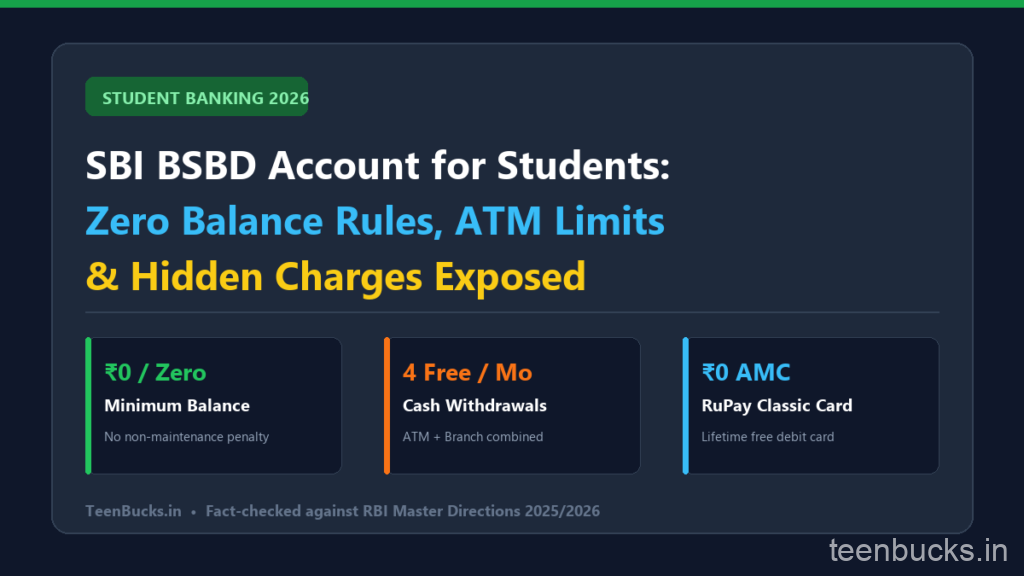
If you have ever walked into an SBI branch as a college fresher carrying your Aadhaar card and ₹500 in your pocket, you probably know this exact feeling: you stand in line at counter three, hand over your account opening form, and the clerk looks at you and says, “Minimum balance ₹3,000 rakhna padega. Zero balance account sirf gaon walon aur government subsidy ke liye hota hai.”
Most students nod, apologize, and either scrape together ₹3,000 from their parents or walk out empty-handed. But here is the reality that branch staff rarely mention: that statement is factually wrong under banking regulations.
SBI’s official BSBD account page says that any individual with valid KYC documents is eligible. The account has a nil minimum balance and is available at SBI branches. A college student is not required to show a salary slip merely because they are a student.
However, an SBI BSBD account is not identical to a regular savings account. It comes with specific rules, distinct card limits, and one very real transaction cap that can quietly eat into your pocket money if you do not understand how it works.
What Exactly Is an SBI BSBD Account?
A Basic Savings Bank Deposit account is a basic savings account designed to provide essential banking services without a minimum-balance requirement.
For a fully KYC-compliant SBI BSBD account, SBI publishes a nil minimum balance requirement. Check the bank’s current terms before relying on any account feature, rate or charge.
Here are the core baseline features of the account:
- Zero Minimum Balance: No Monthly Average Balance (MAB) or Average Monthly Balance (AMB) requirement. You can withdraw your balance down to zero whenever necessary.
- No Penalty for Non-Maintenance: Unlike regular accounts that previously deducted charges when balances fell below thresholds, BSBD accounts are legally exempt from non-maintenance fines.
- Interest: Check SBI’s current savings-account interest-rate page before opening the account; rates can change.
- Receiving credits: SBI lists electronic receipt/credit of money as a free basic facility. Confirm the account details and eligibility requirements required by the scholarship or university portal before submitting them.
SBI BSBD vs Regular Savings Account: The Real Numbers
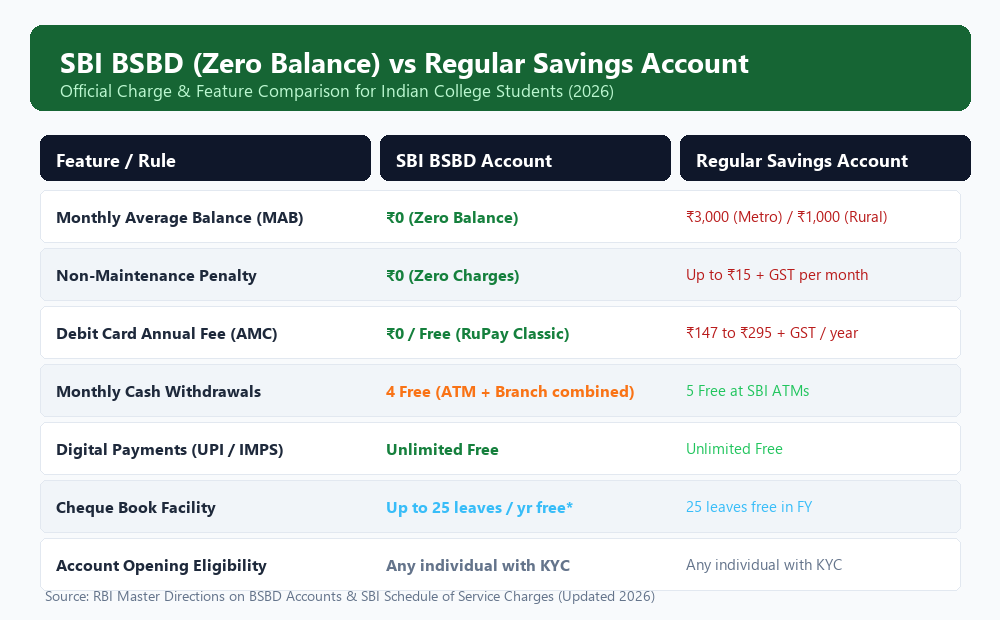
Choose the account based on services you need, not a verbal promise at the branch. SBI’s BSBD page lists a nil minimum balance, a basic RuPay card, and restrictions that differ from a regular savings account.
Here is how the numbers compare for a college student over an academic year:
Debit-card charge: what SBI confirms
SBI states that a basic RuPay ATM-cum-debit card is issued free of cost for BSBD accounts and that no annual maintenance charge applies. Charges and card variants on a regular savings account can vary, so check SBI’s current service-charge schedule before comparing totals.
For students comparing bank options, our companion guide on best zero balance bank accounts for Indian college students breaks down how digital accounts like Kotak 811 compare against traditional public-sector bank setups.
The 4-Withdrawal Rule: The One Trap You Must Understand
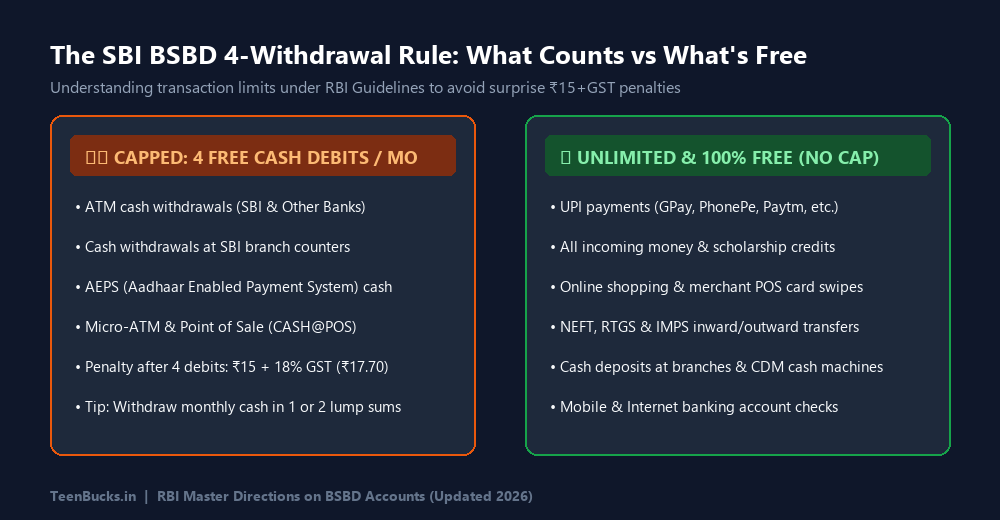
The single most important constraint on an SBI BSBD account is the cash withdrawal cap. SBI’s official BSBD page says account holders receive a maximum of 4 free cash withdrawals per month. It specifically includes own/other-bank ATM withdrawals, branch cash withdrawals and AEPS cash transactions.
If you make a 5th cash withdrawal in that same month, SBI automatically debits ₹15 + 18% GST (total ₹17.70) from your account.
Many students misunderstand what counts toward this limit and assume that paying a chai stall or ordering books via UPI counts against their four transactions. It does not.
What Counts Toward the 4 Free Withdrawals:
- Cash withdrawals at SBI ATMs
- Cash withdrawals at other bank ATMs (HDFC, ICICI, Axis, PNB, etc.)
- Cash withdrawal forms at SBI bank branch counters
- Aadhaar Enabled Payment System (AEPS) cash debits at customer service points (CSPs)
What does not use the four free cash-withdrawal count:
- UPI payments: These are not cash withdrawals. However, normal UPI/app/bank limits can apply, so do not describe them as unlimited.
- Card and online purchases: These are different from cash withdrawals; confirm any account/card transaction limits with SBI.
- Receiving money electronically: SBI lists electronic receipt/credit of money as a free basic facility.
- Cash deposits: SBI lists deposit of cash at a branch as a basic facility. Confirm any channel-specific operating limits before making a large deposit.
The Golden Rule for Students: Do not use your SBI ATM card to pull out ₹200 four times a week. If you need physical cash for hostel canteen coupons or auto rickshaws, withdraw your entire month’s cash requirement (for example, ₹2,000 or ₹3,000) in a single ATM visit at the start of the month. Use UPI for everything else, and you will never pay a single paisa in transaction fees.
The One-Account Restriction: Can You Hold Another SBI Account?
There is one strict legal condition you must know before opening a BSBD account: you cannot hold another savings bank account with State Bank of India.
If you already have a regular SBI savings account and you open a BSBD account, RBI mandates that you must close or convert the regular account within 30 days. You cannot maintain both a regular savings account and a BSBD account within the same bank.
However, this restriction applies only within SBI. You are completely free to hold an SBI BSBD account alongside a digital zero-balance account in another bank (such as Kotak 811, Federal Bank, or Jupiter).
How to Request Conversion from a Regular SBI Account
If you already have a regular SBI savings account, first compare its current services and charges with BSBD before requesting a change.
You do not need to close the account, open a brand new one, or update your bank account details across college scholarship portals and examination forms.
SBI’s Depositors’ Rights Policy says an existing savings account can be converted to BSBD. The published material reviewed for this article does not state a 7-business-day legal deadline, so do not promise one. Ask the branch for its process and timeframe in writing.
How to Submit the Conversion Request:
- Write a simple 1-page application addressed to your SBI Branch Manager: “Application for Conversion of Regular Savings Account No. [Your Account Number] to Basic Savings Bank Deposit (BSBD) Account as per RBI Directions.”
- State that you wish to opt for an SBI Basic Savings Bank Deposit account and ask the branch to explain the current services, debit-card variant and any restrictions.
- Carry the KYC documents the branch asks for. Do not submit account numbers or identity documents through unverified links or to unofficial agents.
- Submit it to the customer service desk at your home branch and ask for an acknowledgement stamp on your copy.
Keep the stamped acknowledgement and ask the branch to confirm in writing what will change, including debit-card services, cheque-book availability, account number/IFSC treatment and the expected completion date. If the issue is not resolved, use SBI’s official grievance route rather than relying on an oral assurance.
How to Open a Fresh SBI BSBD Account (Step-by-Step)
If you are opening an account for the first time, here is the clean process to follow:
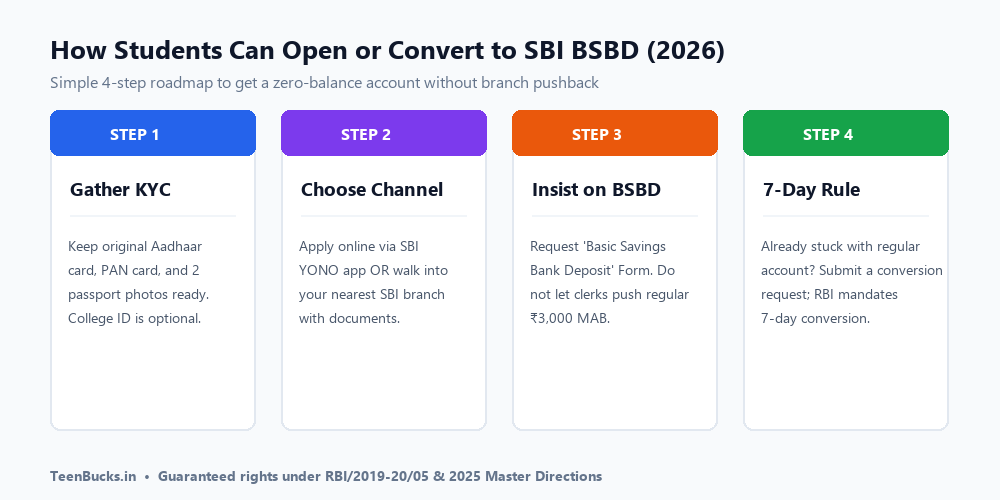
Option 1: In-Branch Application (Most Reliable for BSBD)
- Collect documents: Carry the officially valid KYC documents and photographs, if requested by the branch. A student ID can help explain your purpose but is not a substitute for KYC.
- Visit Your Nearest SBI Branch: Head to the new accounts desk. Clearly ask for the Basic Savings Bank Deposit Account opening form.
- If you are unsure: Show the branch SBI’s official BSBD account page and ask for the current written terms. Escalate through SBI’s official customer-support/grievance process if necessary.
- Confirm the card: SBI says a basic RuPay ATM-cum-debit card is issued for BSBD. Ask the branch to confirm the card variant and the current fee schedule before signing.
- Get written confirmation: Ask the branch how you will receive account details, card and passbook, and confirm the account variant before you leave.
Option 2: Digital Video KYC via SBI YONO App
SBI’s YONO video-KYC page promotes the Insta Plus Savings Account, which has regular-savings service charges. This article cannot verify that a YONO flow opens BSBD. If BSBD is important to you, confirm the available route with SBI before submitting a digital application.
How an SBI BSBD Account Fits Into Your Student Money Stack
An SBI BSBD account may be useful for students who want a basic account with no minimum balance. Before giving any account details to a scholarship, university or exam portal, check that portal’s current eligibility and account requirements.
Here is how to structure your student money setup for maximum safety and zero fees:
- The Primary Institutional Vault (SBI BSBD): Use this account to receive family allowances, semester fee transfers, and college scholarships. Keep the balance clean, and never risk this account on sketchy third-party platforms. Keep account credentials, OTPs and debit-card details private; use only official SBI channels for account support.
- Automated Long-Term Wealth: Once you have a functioning savings account with net banking or UPI, you can link it to automated micro-investments. Our step-by-step walkthrough on how to set up an auto-debit ₹500 SIP on Groww or Zerodha explains how to put your pocket money to work quietly in an index fund.
- Avoid Instant Credit Traps: When you manage your own bank account, avoid relying on quick food delivery credit lines. Our report on the BNPL debt trap on Zepto and Zomato highlights how small unpaid grocery orders can harm your starting credit score before you even graduate.
nn