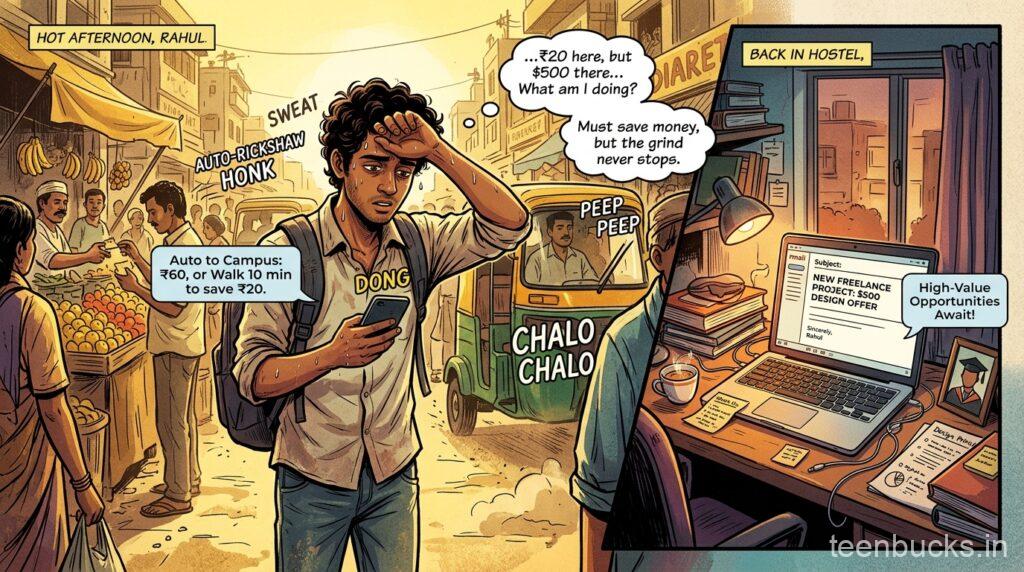
Saving ₹20 can matter when your weekly budget is tight. The problem starts when you feel unsafe spending even on food, transport or a necessary book despite having money set aside. This guide helps you make those decisions without dismissing your family’s sacrifices.
Imagine a student choosing between a bus fare and a long walk, or between a free tutorial and a paid course. These are ordinary trade-offs. They become exhausting when every choice feels like a test of whether you are a good child or a responsible person.
For example, you might spend two hours searching for a cheaper textbook while postponing a useful purchase you can afford. Another student might need those savings for meals. The same behaviour can reflect anxiety or a sensible response to limited money; the context matters. This is an illustrative situation, not a reported case or an income forecast.
Their chest tightens. A wave of visceral guilt washes over them. A quiet, inherited voice whispers: “Paise ped pe nahi ugte. Chadar dekh kar pair phailao.”
A useful money mindset makes room for both caution and opportunity. Treat “scarcity mindset” as a everyday description of persistent money fears, not a clinical diagnosis or a claim that people stay poor because they think incorrectly.
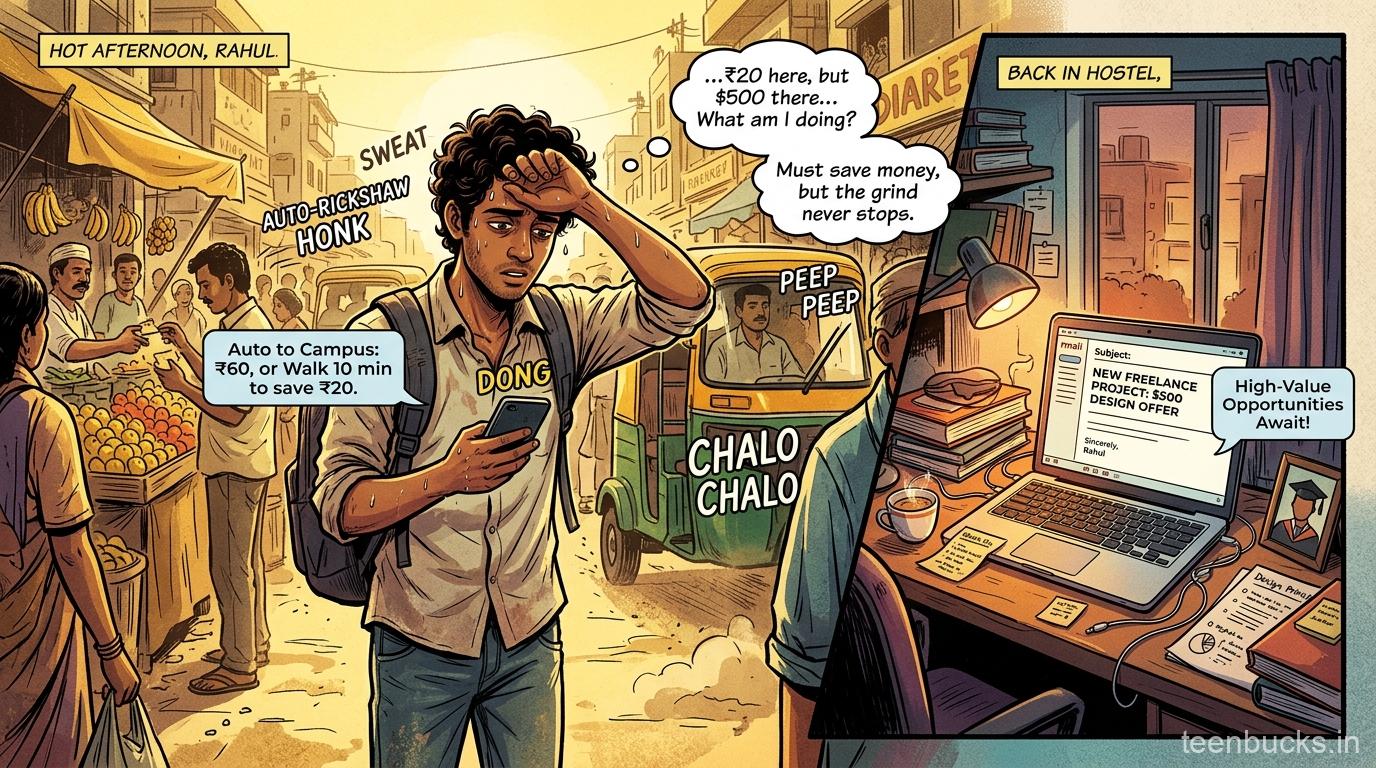
What is a scarcity mindset? In everyday financial language, it means focusing on the possibility of running out of money, sometimes even when current needs are covered. For students, it may show up as guilt about necessary spending, avoiding bank balances or feeling pressure to accept poorly paid work. Real financial hardship needs practical support, not positive thinking alone.
1. Why do students feel guilty about spending money?
Money habits can reflect your family’s experiences of uncertain income, debt or education costs. Their caution may be reasonable. You can respect it while checking whether a particular rule still helps you today.
Ask which of these beliefs influences your spending, and what a more flexible version would look like:
Belief #1: “Chadar Dekh Kar Pair Phailao” (The Fixed-Pie Illusion)
Living within your means is useful. It does not prevent you from learning a skill, applying for an internship or improving your earning prospects. Keep present commitments affordable while exploring those options.
Choose one small skill-building experiment: complete a free course, make a portfolio sample or contact a potential client. You can test interest before paying for a tool. There is no guaranteed income from buying software or a course.
Belief #2: “Saving Money Is Virtuous; Investing Is Satta (Gambling)”
Cash savings and investments serve different purposes. Accessible savings can protect fees, rent and emergencies; equity investments can fall in value and are unsuitable for money you need soon. Inflation may reduce purchasing power, but its effect depends on the actual inflation rate, interest and taxes. A cautious family is not automatically making a mistake.
Belief #3: The Parental Sacrifice Guilt Spiral
You may feel you owe your family a perfect result because they pay for college. Acknowledge their effort without treating every meal, break or learning expense as a moral failure. If guilt leads you to avoid necessities, talk with someone you trust.
Money fears and more balanced alternatives
To see where your daily habits fall, review this comparative breakdown:
| Decision Dimension | Persistent money fear | Balanced money decision |
|---|---|---|
| Primary Financial Focus | Feeling guilty about every small expense | Balance affordable spending with gradual skill development |
| Spending on Tools & Courses | Viewed as wasteful expense and trigger for parental guilt | Compare free options and test the value before paying |
| View of the Stock Market | Either feared as gambling (FD bias) or gambled on F&O options | Protect near-term needs; consider investing only when suitable |
| Pricing Freelance Services | Feeling unable to negotiate the scope or price of your work | Price agreed scope, time, revisions and evidence of value |
| Digital Rails (UPI & BNPL) | Small purchases can add up; review your own statement | Plan essentials, optional spending and future needs separately |
2. What does research say about money worries?
Financial choices involve feelings as well as arithmetic. The research below offers context; it does not diagnose an individual student.
Richard Thaler’s Mental Accounting: The Illusion of “Different” Rupees
Mental accounting describes how people group money into categories. You might treat a gift differently from an allowance. For this guide, keep categories flexible: a learning budget can help you plan, but food and necessary transport still come first.
Sendhil Mullainathan’s Scarcity Bandwidth Tax
A 2013 study by Anandi Mani, Sendhil Mullainathan, Eldar Shafir and Jiaying Zhao examined financial concerns and cognitive performance, including Indian sugarcane farmers before and after harvest. It found evidence that financial strain can affect attention. It did not show that saving a bus fare lowers a student’s IQ. See the original study, Poverty Impedes Cognitive Function.
Kahneman & Tversky’s Loss Aversion
Loss aversion describes situations in which potential losses weigh more heavily than equivalent gains. Its size varies with context; there is no universal multiplier for every student. You can acknowledge that fear while checking the actual cost, alternatives and consequences of a decision.
3. How can you review spending without blaming yourself?
Review your last seven days of payments. Group them into essentials, useful learning, optional spending and debt payments. This gives you information without labelling every small purchase a failure.
Convenient payments can make repeated purchases easy to overlook, but UPI itself does not cause overspending. Use your own statement to find patterns. Try a weekly optional-spending limit and turn off shopping notifications if they encourage purchases you regret.
Pay-later borrowing adds a repayment obligation. Before using it, check the lender, charges, due date and credit-reporting terms. Missed payments can affect credit history; a specific credit score cannot be predicted from a ₹140 balance. Read our student BNPL guide for questions to ask.
4. The Gambler vs. The Builder: Escaping the F&O and Telegram Mirage
When young Indians finally decide to escape the scarcity trap, they frequently swing to the opposite extreme: reckless impatience.
Pressure to catch up financially can make trading promises tempting. Be cautious of anyone selling certainty, screenshots or urgent tips. Borrowing to trade adds further risk.
A better response to money pressure is to protect essential costs, review debt and learn gradually. Our guide to social-media trading tips explains why an online tip should not replace independent checks.
Building financial stability takes time. There is no purchase, investment or mindset exercise that guarantees wealth. Start with manageable actions you can repeat.

5. The Earning Shift: Curing “Student Discount Syndrome” & Freelancer Imposter Pricing
If you freelance, being a student does not mean your time has no value. Start with a clear scope, a realistic estimate of hours and the number of revisions included.
Clients may consider experience, reliability, budget and fit. Show a relevant sample and explain what you can deliver rather than promising business revenue you cannot control.
A project price is negotiated. Revenue a client earns is not automatically the value of your work, and low prices do not automatically attract bad clients. Agree on deliverables, payment dates and boundaries before starting.
The Minimum Acceptable Rate (MAR) Formula for Student Freelancers
The following is a planning example, not an industry standard or guaranteed market rate:
The 20% buffer and 60% billable-time assumption are adjustable examples. For instance, ₹6,000 of monthly costs including a buffer, divided by 24 billable hours, gives a planning rate of ₹250/hour. Whether clients will pay that rate depends on the work and market. Explore our student side-hustle guide to compare ways to start.
6. The 3-Account “Guilt Firewall”: Practical Financial Architecture for Indian Youth
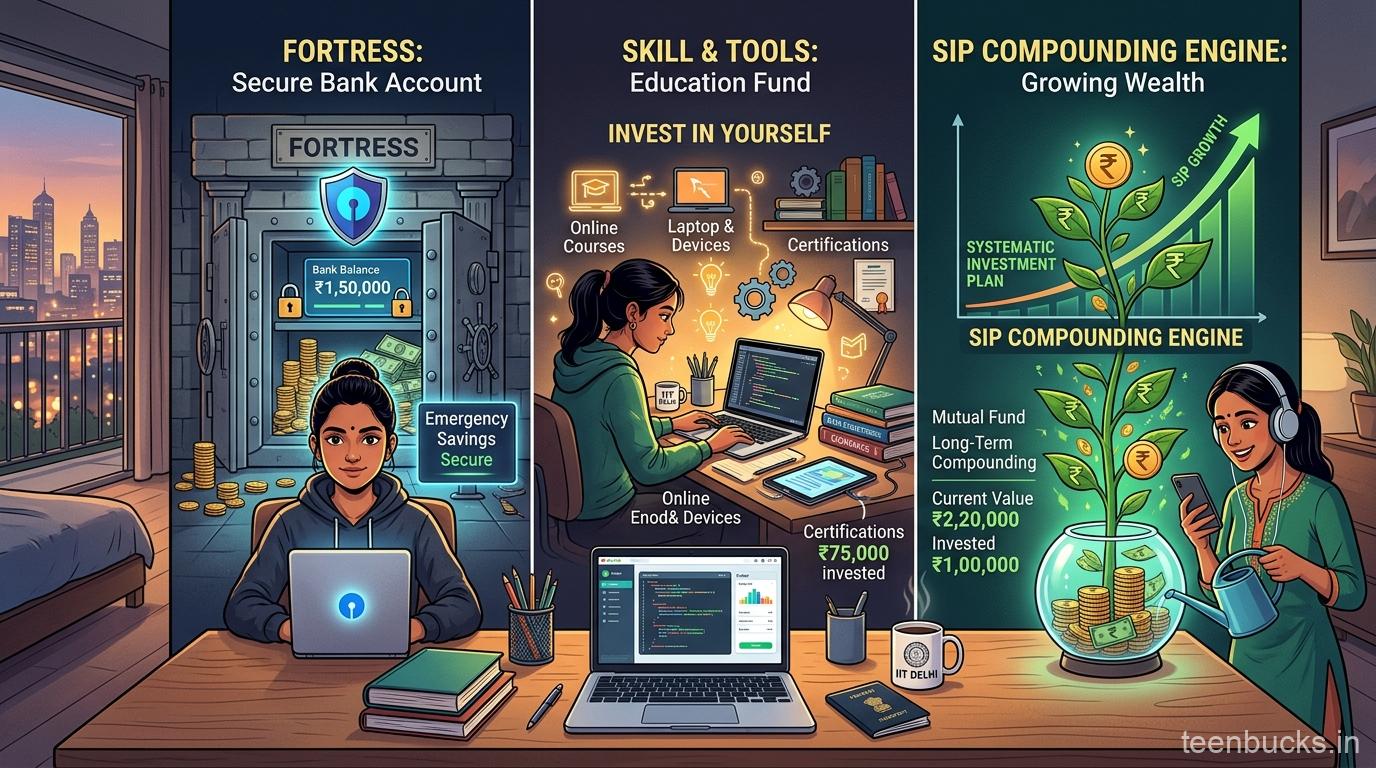
Use three budget buckets inside one account, a spreadsheet or a notebook. Three bank accounts are optional and may create unnecessary fees or administration. The 50/30/20 rule is a starting point you can adapt; no fixed split suits every student.
Bucket 1: Essentials and a buffer
Bucket 1 covers food, transport, phone costs, fees and a small accessible buffer. List what must be paid before the next allowance or income arrives. If you need an account, compare eligibility and fees in our student banking guide.
Bucket 2: Learning and everyday enjoyment
Bucket 2 is a flexible learning and recharge budget. It can be ₹0 while money is tight. Use free resources first, set a cap for any paid experiment and check whether it helped. You are never required to spend this money every month.
Bucket 3: Future needs
Bucket 3 is for future needs. Build accessible savings for near-term costs before considering market investments. If you later invest, check the time horizon, risk, charges and product requirements. SIPs do not guarantee returns and should not use fees, borrowed money or emergency funds. Our beginner SIP guide explains the next questions to ask.
7. How to Talk to Risk-Averse Indian Parents: The Script
When asking family for a learning purchase, explain the purpose, cost, free alternatives and a way to review the result. Be honest about uncertainty; a course cannot insure a placement.
The Reframe Script:
“I want to practise this skill for my portfolio. I have tried the free option, and this tool costs ₹500 for one month. Can we check whether that fits our budget? I will cancel the renewal and show you what I made before we decide whether to continue.” This is an illustrative script; adapt the amount and language to your situation.
8. Summary Checklist: Your 7-Day Money Mindset Reset
- Day 1: Write down your available money and essential costs.
- Day 2: Review seven days of spending without judging yourself.
- Day 3: Name one fear: running out, disappointing family or being behind friends.
- Day 4: Set an affordable optional-spending limit, even if it is zero.
- Day 5: Try a free learning activity before buying a tool.
- Day 6: Discuss one money decision with someone you trust.
- Day 7: Review what helped. Keep the useful habit and adjust the rest.
Frequently Asked Questions (FAQ)
How do I stop feeling guilty when spending money on myself in college?
Can the 50/30/20 rule work for a student budget?
How should an Indian student freelancer quote rates without feeling like an imposter?
Example: a ₹5,000 monthly student budget
This example assumes rent and tuition are already covered. Set aside ₹3,500 for listed essentials, ₹1,000 for upcoming costs and a buffer, and up to ₹500 for learning or enjoyment. These are illustrative amounts, not a recommended universal split. If your essentials cost ₹4,800, the optional amount must shrink; you do not need to force an investment or buy a course.
When should you ask for help with money anxiety?
If worry regularly disrupts sleep, meals, study or relationships, speak with your college counsellor or a qualified mental-health professional. If income does not cover essentials, ask the student welfare office about available assistance. The NHS money-worries guidance connects budgeting with seeking support; its listed services are UK-specific.
Sources and review notes
- Mani and colleagues, Poverty Impedes Cognitive Function (2013): research context, not a student IQ prediction.
- NHS Every Mind Matters: money worries and mental health: budgeting, self-compassion and support.
Reviewed 1 October 2026. Budget amounts, freelance calculations and conversation scripts are TeenBucks examples. This guide provides general education and does not diagnose anxiety.