
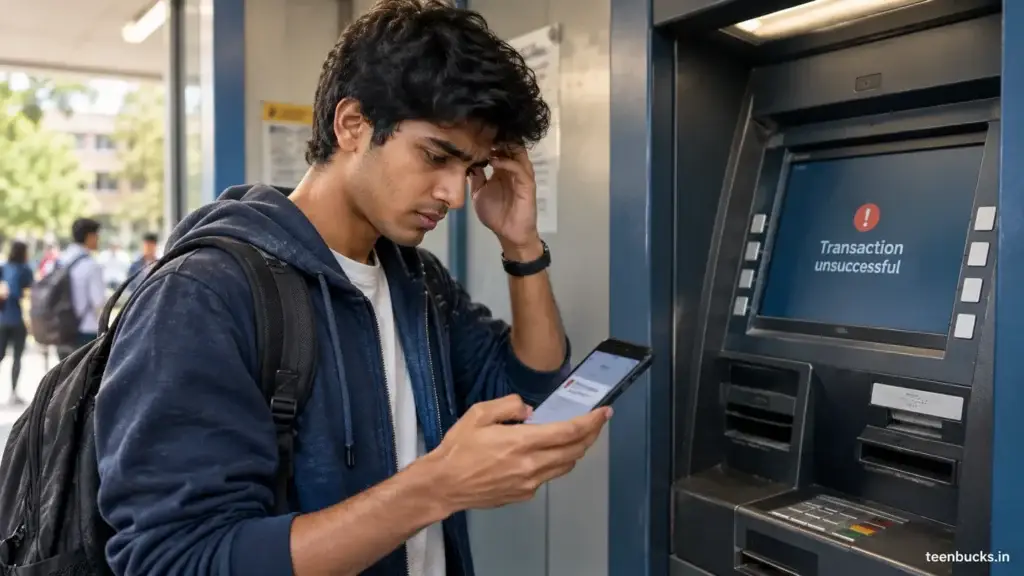
You’re outside an ATM near your hostel. It’s evening, the mess fee is due, and you need ₹1,000 in cash.
The machine makes that familiar whirring noise. Then: Transaction unsuccessful. No notes come out.
Your phone, meanwhile: ₹1,000 debited.
Bhai, that’s a horrible moment when ₹1,000 is the money you were counting on for the week. But don’t assume it’s gone forever, and don’t let someone outside the ATM talk you into paying a “refund fee.”
This is an illustrative student situation, not a reported incident. Here’s what actually matters.
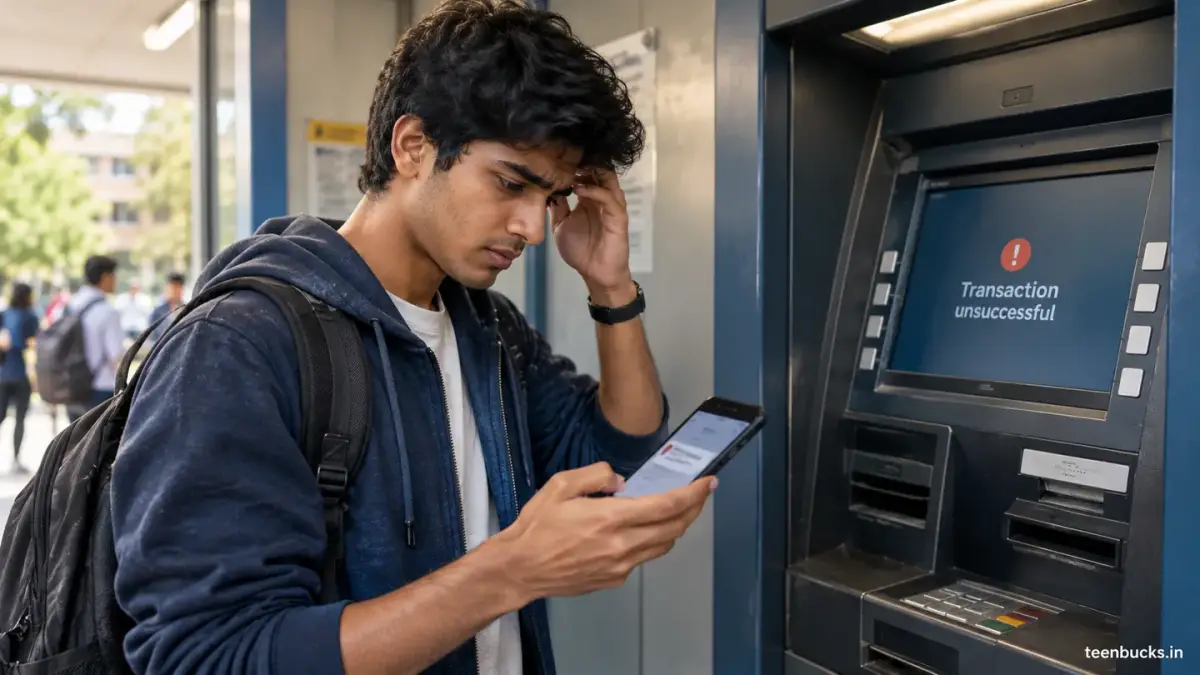
First 10 minutes: do these four things
1. Check what really happened. Did the ATM give you zero cash? Check the transaction in your bank app or statement. A debit alert and a posted debit aren’t always the same thing; look for a reversal too.
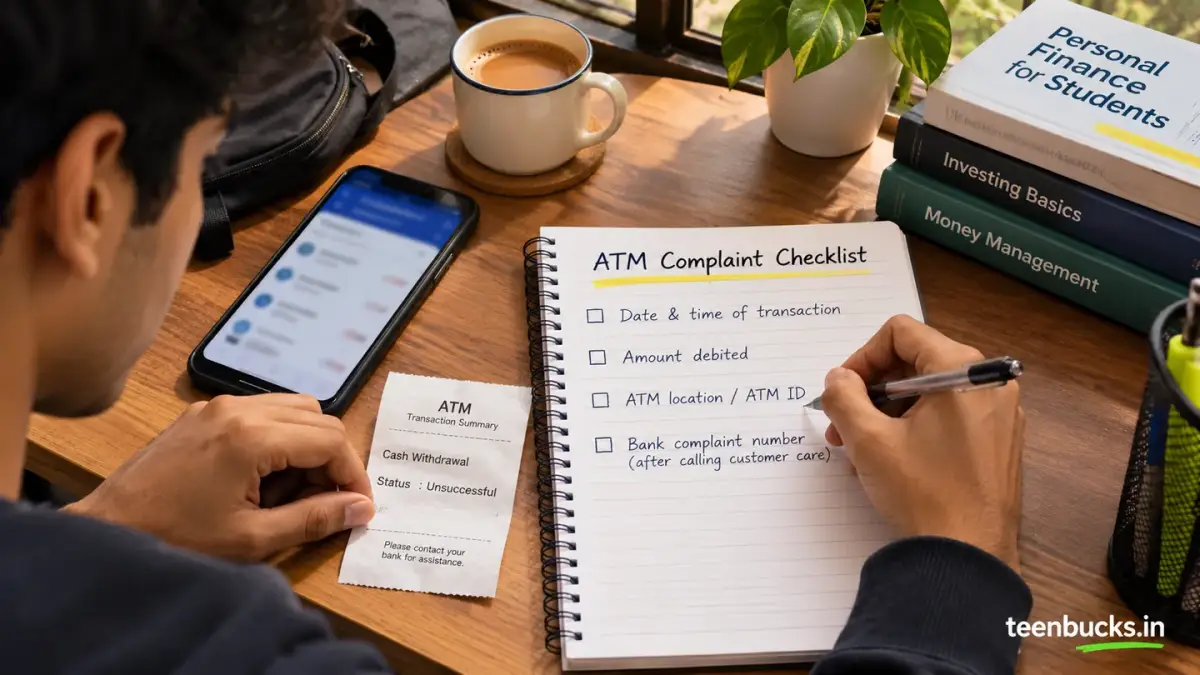
2. Save the details. Note the date and time, amount, ATM location, machine/terminal ID if displayed, and transaction reference if available. Save the SMS and any printed receipt. No receipt? Still complain. You can provide the other details.
3. Contact your bank. Even if the ATM belongs to another bank, start with the bank that issued your debit card. Use its official app, helpline, website or branch. Say: “ATM cash not dispensed, account debited.” Ask for a complaint or service-request number.
4. Don’t withdraw again on autopilot. If cash is urgently needed, check your available balance and decide how to pay safely. Trying repeatedly at the same broken ATM can make an already stressful situation worse.
And please: never share your ATM PIN, OTP, card CVV or full card details with a stranger promising to “release” your refund.
The RBI rule: T+5 means calendar days, not working days
This is not a special 2026 bank offer. It comes from the RBI’s 20 September 2019 Harmonisation of Turn Around Time (TAT) circular, which covers qualifying domestic ATM and micro-ATM failures. Read the official RBI TAT rule.
| If this happened | RBI requirement |
|---|---|
| Your account was debited, but the ATM dispensed no cash | Automatic reversal within T+5 calendar days |
| Reversal arrives after T+5 | ₹100 for each day of eligible delay |
| You haven’t separately requested compensation | The prescribed compensation should still be credited automatically |
T is the calendar date of the failed withdrawal. Weekends don’t magically stop this clock. The deadline is an outer limit, so the money can return earlier.
What does ₹100 per day actually look like?
Let’s use actual calendar dates, but a fictional transaction:
- Thursday, 5 November 2026: You try to withdraw ₹1,000, but receive no cash. That’s T.
- Tuesday, 10 November: The T+5 reversal deadline.
- Thursday, 12 November: Suppose the ₹1,000 finally gets credited.
The reversal is two calendar days late: 2 × ₹100 = ₹200 compensation.
That means ₹1,000 returned + ₹200 compensation = ₹1,200 credited in total, assuming the transaction qualifies and the entire amount was originally debited. The ₹200 is not a fee you pay to someone.
If your bank reverses the transaction by 10 November, the late-reversal compensation in this example would be ₹0.
What if five days pass and your money still hasn’t come back?
Open your bank complaint and ask about both the missing cash-withdrawal reversal and the automatic delay compensation. Keep the complaint acknowledgement and bank’s reply together.
If the bank’s response is unsatisfactory, or it doesn’t respond within the applicable complaint period, escalation may be available through the RBI Complaint Management System under the Reserve Bank–Integrated Ombudsman Scheme, 2026. This process is free. You must complain to the bank first; the usual no-response threshold is 30 days, or a longer period required by applicable RBI/NPCI/card-network rules. A dissatisfied customer need not always wait for that full period after receiving the bank’s response. Read RBI’s official 2026 Ombudsman FAQs.
Important: The five-day reversal deadline and the Ombudsman complaint-admissibility timeline are different rules. Don’t interpret T+5 as permission to skip your bank and file a new RBI complaint immediately.
If some cash came out but less than you requested, raise a dispute for the exact shortfall and describe the amount received. Don’t automatically assume every partial-dispensing dispute follows the same no-cash compensation treatment without the bank checking the case.
The TeenBucks takeaway
Your bank alert is evidence of the problem—not proof that your ₹1,000 has disappeared for good.
Save the ATM details, complain to your own bank, and know the calendar-day deadline. If the qualifying refund is late, check that the ₹100-per-day compensation arrives too.
Already dealt with a different kind of failed payment? Our UPI payment failed but money debited guide explains why UPI person-to-person transfers have a different T+1 deadline. If you’re choosing an account for college in the first place, our student zero-balance bank-account guide explains the card and account fees worth checking.
Official sources: RBI failed-transaction TAT circular (20 September 2019) · RBI Integrated Ombudsman Scheme FAQs (1 July 2026).
Frequently Asked Questions
Is the ATM refund deadline five working days or five calendar days?
Five calendar days for the eligible failed ATM situation described here. RBI defines T as the transaction’s calendar date and specifies reversal within T+5 days.
Do I have to file a complaint to get ₹100 per day?
RBI says applicable late-reversal compensation should be credited automatically, without waiting for a separate claim. Still report the failed withdrawal promptly and keep the bank complaint number if the reversal or compensation doesn’t arrive.
What if I used another bank’s ATM?
Start with your card-issuing bank, even if the ATM operator is different. Share the location, terminal ID if available, date, amount and transaction reference so your bank can investigate with the ATM operator.
Editorial note: Examples are hypothetical. This guidance covers eligible domestic failed ATM withdrawals where the account was debited and no cash was dispensed; it is not a promise of compensation for every ATM dispute.