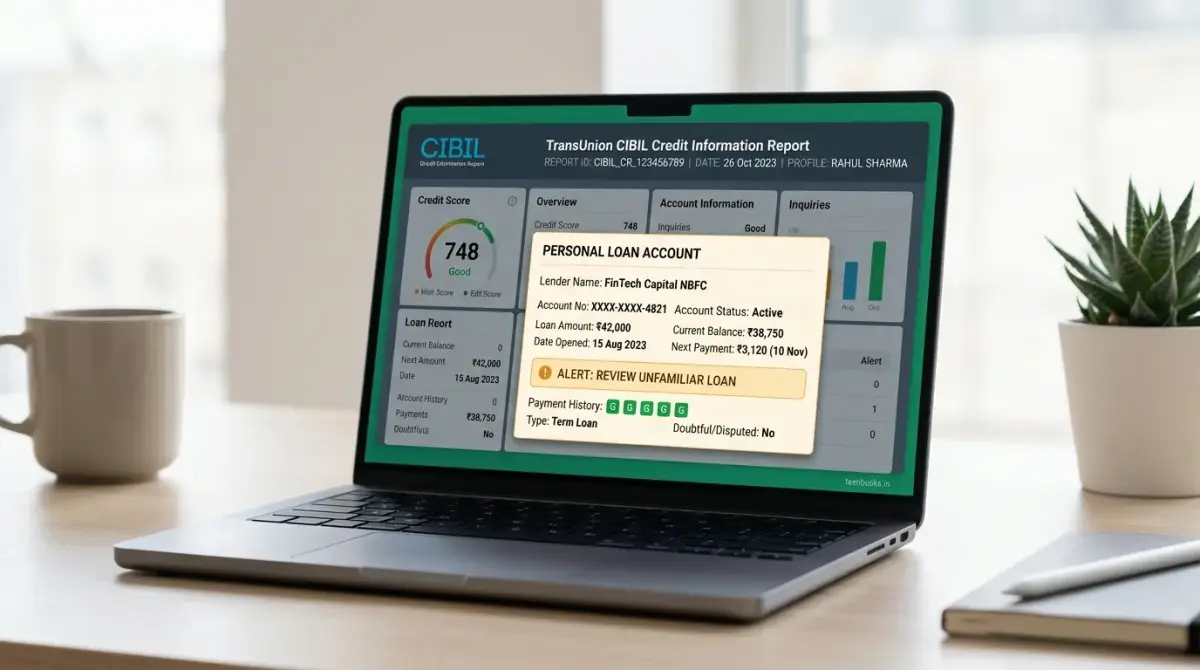
💡 Quick Answer: If an unknown loan in CIBIL report records appears out of nowhere, take a deep breath: don’t panic and don’t immediately accuse anyone of cyberfraud. First, download your complete, official Credit Information Report (CIR) from TransUnion CIBIL and inspect the exact lender name, account number, opening date, and reported status. In many cases, it is actually an innocent “Pay Later” or BNPL checkout facility you used on apps like Zomato, Zepto, or Amazon where a backend NBFC partner provided the line of credit. However, if the account genuinely does not belong to you or someone misused your PAN card, raise a free online ownership dispute on the TransUnion CIBIL portal AND immediately submit a formal written complaint to the reporting lender’s Grievance Redressal Officer. Under the Reserve Bank of India’s (RBI) mandatory compensation framework, qualifying credit-information complaints that remain unresolved beyond 30 calendar days may entitle you to statutory compensation of ₹100 per calendar day of delay.
Imagine this situation. You’ve just landed your first campus placement or you’re wrapping up your final year of college, and you decide it’s finally time to apply for an entry-level credit card. Maybe you want to start building credit early, or perhaps you want to purchase a laptop on a no-cost EMI.
Two days later, your phone buzzes with a blunt, one-line SMS: “We regret to inform you that your application has been rejected due to bureau policy.”
Your stomach drops. You’ve never borrowed money from a bank in your life. You log into your credit profile to check what went wrong, and right there in black and white sits an active tradeline:
Sanctioned Amount: ₹42,000
Status: Active (Overdue: ₹4,200)
Small problem: you never borrowed a single rupee of that ₹42,000 loan.
You frantically call your college roommate. You search through two years of old SMS alerts. You check your bank passbook to see if some mystery deposit ever hit your account. Nothing. Absolute radio silence.
Your first instinct is almost certainly to panic and think, “Bhai, who stole my PAN card and took a loan in my name?”
Listen to me: don’t ignore the entry, but also don’t assume you are the victim of a high-tech identity syndicate just yet. Discovering an unknown loan in CIBIL report files is deeply unsettling, but in the Indian financial ecosystem, there are several distinct reasons why an unfamiliar tradeline can land on your credit history—and the exact solution you need depends entirely on which scenario you’re actually dealing with.

First, check whether that unknown loan in CIBIL report records is actually yours
Here is something that catches even experienced working professionals off guard: the lender name printed on your CIBIL report will almost never match the consumer-facing app you actually used on your phone.
Let’s say you bought sneakers on a shopping portal, split a ₹1,200 food delivery bill, or activated a one-click checkout feature on an e-commerce platform. You recognise the brand name on your home screen. But under RBI digital lending guidelines, apps cannot lend their own money unless they hold a valid banking or NBFC licence. Instead, they partner with regulated Non-Banking Financial Companies (NBFCs) or private banks who quietly underwrite and disburse the credit facility behind the scenes.
When that loan gets reported to credit bureaus like TransUnion CIBIL, Experian, CRIF High Mark, or Equifax, it is reported under the legal corporate name of the lending partner—not the app. TransUnion CIBIL explicitly warns consumers that digital loans, consumer durable credits, and checkout finance facilities frequently show up under unfamiliar registered NBFC entities.
That doesn’t mean every mystery loan is legitimate. It means before assuming worst-case identity theft, you must systematically check whether an unknown loan in CIBIL report files matches your past digital checkout behavior.
| What You See on CIBIL | What It Actually Means | Your Immediate First Step |
|---|---|---|
| Unfamiliar NBFC or Bank name | Underlying financing partner behind a Buy Now Pay Later (BNPL) app, digital card, or checkout EMI you used months ago. | Search your Gmail and SMS history for loan agreements, Sanction Letters, and Key Fact Statements (KFS). |
| Loan account definitely not yours | Clerical data entry mistake by the lender, a clerical PAN mix-up, or identity theft/PAN misuse. | Dispute Account Ownership on CIBIL and submit a written dispute to the reporting lender. |
| Old repaid loan marked “Active” | You cleared all dues, but the lender failed to transmit the closure status update to the credit bureau. | Dispute Account Status on CIBIL and attach your official No Dues Certificate (NDC). |
| Same loan appears twice | Duplicate bureau reporting by the institution or portfolio migration during a corporate merger/takeover. | Compare the account numbers and dates; dispute the duplicate tradeline on CIBIL with proof. |
| Unknown credit enquiry | A lending institution pulled your bureau file—either triggered by an aggregator you browsed or an unauthorized loan application. | Check your recent credit comparison searches and file an Unauthorised Enquiry dispute. |
A critical detail worth keeping in mind: A fully repaid and closed loan is supposed to remain visible in your credit report under the status marked “Closed”. That is completely normal and healthy—it proves to future lenders that you borrowed money and paid it back on time. You should never attempt to delete a legitimate closed account; you only need to take action when an account is misreported as open, overdue, or entirely alien to you.
If you’re still building your credit profile from scratch or starting with a blank file, read our comprehensive student CIBIL score guide, where we break down why having zero credit history is very different from having bad credit, and how to build a 750+ score safely.
Step 1: Download your actual CIBIL report—not just the three-digit score
A single three-digit number like 680 or 740 cannot tell you why your credit card application was rejected or which specific loan is causing the damage. Third-party fintech apps show you a high-level summary score, but to fix an error, you need the official, unredacted Credit Information Report (CIR).
Under Reserve Bank of India mandates, TransUnion CIBIL is legally required to provide one full, free CIBIL Score and Report every calendar year to every Indian citizen. You can access this directly through CIBIL’s official free-report portal. Sign in or create an account, verify your identity using your PAN and Aadhaar OTP, and download your comprehensive CIR in PDF format. Checking your own credit report is classified as a “soft inquiry” and has zero negative impact on your score.
Once you open the document, navigate immediately to the Accounts / Credit Facilities section and extract the following exact details for the mystery entry:
- Credit Institution (Lender Name): Note down the exact legal entity name (e.g., “ABC Capital Services Pvt Ltd” or “XYZ Small Finance Bank”).
- Account Number: Note the masked or full loan account number provided in the report.
- Account Type & Ownership: Check whether it is classified as a Personal Loan, Consumer Loan, Credit Card, or Overdraft, and whether ownership is listed as Single, Joint, or Guarantor.
- Sanction Date & Disbursed Amount: The exact date the facility was activated and the total sanctioned credit limit.
- Current Balance & Amount Overdue: Exactly how much money is currently claimed to be outstanding or past due.
- Date Reported & Payment History: The date the lender last sent data to CIBIL and the month-by-month DPD (Days Past Due) grid.
- Enquiries Section: Scroll to the bottom of the report and review the Enquiries table to see which institutions pulled your file around the date that loan was opened.
Save that complete CIBIL PDF in a secure folder on your computer before taking any further action. This document serves as your baseline legal evidence (“the before-picture”) in case the data shifts or disappears during the investigation. And please: never share an unredacted CIBIL report on Reddit, public forums, or WhatsApp. It contains your full name, PAN, date of birth, home address, and financial footprint—handing that to anonymous strangers exposes you to severe phishing risks.
Step 2: Check these three things before clicking “Dispute”
Before you jump onto the bureau portal and file a claim, do a quick five-minute reality check. Filing the wrong dispute category or claiming fraud on a legitimate micro-loan will only delay resolution.
1. Did you use a Buy Now Pay Later (BNPL) or micro-credit app?
Open your email inbox and search specifically for the lender’s name, as well as terms like “Sanction Letter”, “Key Fact Statement”, “Credit Line Agreement”, or “Welcome to Pay Later”. That ₹1,500 gadget purchase or festival grocery order you split into installments on apps like LazyPay, Simpl, Amazon Pay, or Flipkart might have registered an active revolving credit line with partners like Axio, PayU Finance, or IDFC FIRST Bank. If you’re unsure how these micro-credits operate, check out our in-depth investigation on the BNPL debt trap for Indian students to see how checkout finance apps secretly report credit lines to bureaus.
2. Did you pay off or close the loan recently?
Look at the Date Reported in your report. While RBI rules now require more frequent data submissions, routine database synchronization can take a few weeks. If you recently closed a consumer durable loan or repaid an education EMI, check whether you received an official No Dues Certificate (NDC) or loan closure letter. If the loan is yours but still listed as open, your issue is an incorrect account status, not an ownership dispute.
3. Do your personal identification details actually match?
Examine the personal information block tied to that tradeline. Is the PAN identical to yours, or is there a single character discrepancy? Is the registered address in a state where you’ve never lived? A typo in a PAN card entered at a branch can accidentally cross-link two different individuals with similar names. Identifying whether it is a data-matching glitch versus deliberate identity theft helps you choose the right legal category.
Step 3: Raise a free dispute for the unknown loan in CIBIL report records
Once you are certain the entry is erroneous, fraudulent, or outdated, go directly to CIBIL’s official consumer dispute resolution portal. Log into your myCIBIL account, navigate through Credit Reports → Dispute Centre → Dispute an Item, and locate the specific disputed account.
Keep in mind that CIBIL’s online system allows you to initiate disputes on reports generated within the past 60 days. If your saved report is older than that, simply generate a fresh report on the portal before submitting the ticket.
Select the precise dispute category:
- Account Ownership / Account Does Not Belong to Me: Choose this if you never applied for, authorized, or received funds from this credit facility.
- Account Information / Status: Choose this if the loan is genuinely yours, but the outstanding balance is wrong, payments are falsely marked overdue, or a closed account is still shown as active.
- Enquiry Information: Choose this if an unauthorized hard inquiry appears from an institution you never approached.
Once submitted, the system will generate a unique Dispute ID. Note down this Dispute ID, the exact date of submission, and the registered email address used. TransUnion CIBIL will mark the tradeline as “Under Dispute” in its backend and forward the query to the reporting bank or NBFC for verification.
Remember: filing a CIBIL dispute is 100% free. You do not need a paid bureau subscription, an agent, or a third-party “credit doctor” to exercise your legal right to correct false data.
Step 4: File a formal written complaint with the reporting lender
Raising a dispute on CIBIL is only half the battle. If an unknown loan in CIBIL report files shows an unauthorized amount of ₹42,000 sitting in your name—especially with reported overdue balances—you must immediately contact the reporting lender directly. The lender is the institution that submitted the bad data, and they are the only entity that can authorize CIBIL to purge it.
Never rely on a random customer service helpline number you found in an online comment section. Go straight to the bank or NBFC’s official website, locate their Grievance Redressal Policy, and find the email address of their Principal Nodal Officer (PNO) or Grievance Redressal Officer (GRO).
Send a crisp, factual, formal email detailing the error. Demand that they investigate their KYC records, produce the loan agreement with your verified signature/biometrics, and withdraw the fraudulent data from all four credit bureaus.
Copy-Paste Email Template for Disputing Unknown Loans
Subject: URGENT: Formal Dispute of Inaccurate / Fraudulent Credit Facility Reported to CIBIL — [Your Full Name] — PAN: [Your Masked PAN, e.g., ABCDE****F]
To,
The Principal Nodal Officer / Grievance Redressal Officer,
[Name of Bank / NBFC]
Dear Sir/Madam,
I am writing to register an urgent formal grievance regarding an inaccurate and unauthorized loan facility being reported by your institution in my TransUnion CIBIL credit information report.
Account Details as Shown on CIBIL Report:
• Reporting Institution: [Lender Name as seen on report]
• Loan Account Number: [Masked Account Number, e.g., XXXX4821]
• Sanction Date: [Date]
• Reported Amount: ₹[Amount]
• CIBIL Dispute Reference ID: [Insert CIBIL Dispute ID, if already raised]
Statement of Dispute:
[Choose the scenario that applies to you:]
Option A (Identity Misuse / Never Taken): I hereby declare under penalty of law that I have never applied for, authorized, received, or serviced the above-mentioned loan facility. I have had no commercial relationship with your institution. This appears to be an unauthorized facility opened through identity theft or a gross clerical data-mapping error.
Option B (Status Not Updated): The above-mentioned loan was fully paid off and settled by me on [Date]. I hold the official No Dues Certificate. However, your institution continues to misreport this facility as ‘Active’ with overdue balances.
Option C (Incorrect Balance): The reported overdue amount of ₹[Amount] is factually incorrect as documented in the attached transaction receipts.
Requested Redressal Actions:
1. Immediately freeze/block the disputed account to prevent further accrual of late fees or overdue reporting.
2. Provide copies of the loan application form, KYC documents, IP logs/e-sign audit trails, and bank disbursement records used to open this facility.
3. Issue an immediate electronic update to TransUnion CIBIL, Experian, CRIF High Mark, and Equifax to completely withdraw/correct this tradeline.
4. Provide a formal grievance acknowledgment number and written resolution within the statutory 30-day timeline prescribed under RBI Circular RBI/2023-24/72.
I have attached a redacted copy of my CIBIL report and my self-attested identity proof for verification purposes.
Yours sincerely,
[Your Full Legal Name]
Contact Number: [Your Phone Number]
Email Address: [Your Email]
Postal Address: [Your Address]
Always keep a timestamped copy of this sent email, along with the automated delivery receipt. If the lender responds by claiming the account is yours, do not back down—demand a copy of the Key Fact Statement (KFS), the bank account details where the loan funds were disbursed, and the KYC selfie/Aadhaar OTP logs. If the money was disbursed into a bank account you don’t own, you have undeniable proof of third-party fraud.

The RBI ₹100-per-day rule: what does it actually pay for?
You may have seen viral reels or social media posts claiming: “If CIBIL has a mistake, RBI will pay you ₹3,000 every month!”
That is an oversimplified myth. Let’s look at what the law actually mandates so you can enforce your rights without falling for false promises.
Under the official RBI framework for compensation for delayed updating of credit information (Circular RBI/2023-24/72), regulated lenders and credit bureaus are subject to a strict 30-calendar-day deadline to resolve qualifying credit-information complaints from the date you lodge your initial grievance.
The framework divides that 30-day window between the two entities:
- Credit Institution (The Bank / NBFC): Has a maximum of 21 calendar days to investigate the complaint and send the corrected credit data to all credit bureaus.
- Credit Information Company (CIBIL / Experian, etc.): Has the remaining 9 calendar days to update its records and notify the consumer via SMS or email.
If an eligible, qualifying complaint regarding an unknown loan in CIBIL report records is delayed beyond this total 30-calendar-day window, the defaulting institution (the lender, the bureau, or both proportionately) must pay compensation of ₹100 per calendar day of delay directly into the complainant’s bank account.
An exact example of RBI delay compensation
Let’s run through a real-world scenario to see how this calculation works in practice:
| Milestone / Parameter | Timeline & Value |
|---|---|
| Statutory resolution window allowed by RBI | 30 calendar days |
| Actual elapsed time before rectified report sent | 37 calendar days |
| Days of delay beyond statutory deadline | 37 − 30 = 7 calendar days |
| Mandatory compensation payable to complainant | 7 × ₹100 = ₹700 |
That ₹700 is not a payment for emotional distress or a lower credit score. It is a strict statutory regulatory penalty for an unexcused 7-day administrative delay. Furthermore, keep these operational rules in mind:
- Mandatory Credit Timeline: The RBI directive states that applicable compensation must be credited directly to the complainant’s bank account within 5 working days of the date of resolution.
- Date of Resolution: The resolution date is formally defined as the date the rectified Credit Information Report is delivered to you by the bureau or bank.
- Written Justification Required: If the institution rejects your complaint after investigation, it cannot simply close the ticket silently—it must provide a detailed written explanation stating why the data is deemed correct.
- Explicit Exclusions: Disputes challenging the internal mathematical scoring model itself, or cases that are already pending before consumer courts, debt recovery tribunals, or High Courts, do not qualify for the automatic ₹100-per-day framework.
A 2026 update: lenders now report credit data four times a month
Historically, Indian banks and NBFCs only updated credit bureaus once a month, usually during the first week. If an erroneous loan appeared, you had to wait an entire monthly billing cycle just to see if a fix went through.
Effective 1 July 2026, the Reserve Bank of India enacted landmark amendments to the Credit Information Reporting Directions. Credit institutions are now mandated to transmit credit data to all four credit bureaus on four fixed reference dates every single month: the 9th, 16th, 23rd, and the final day of the month.
This means your credit history updates on a near-weekly basis. If a bank rectifies a mistake on the 10th, they no longer have an excuse to wait until next month to send that batch to CIBIL—it goes out in the next scheduled cycle on the 16th or 23rd. However, do not treat these dates as instant score guarantees; they are reporting snapshots that accelerate the transmission of verified corrections.
What if the lender rejects the complaint or ignores you?
If 30 calendar days pass and the lender fails to respond, or if they send a boilerplate rejection insisting that a fraudulent loan is yours, it’s time to escalate through regulatory channels.
1. Escalate to the RBI Integrated Ombudsman (CMS Portal)
The Reserve Bank of India operates the RBI Complaint Management System (CMS) under the Reserve Bank – Integrated Ombudsman Scheme, 2026 (effective 1 July 2026). The Ombudsman serves as a free, senior quasi-judicial authority for deficiency in banking and NBFC services.
To file a valid complaint with the RBI Ombudsman:
- You must have first submitted a formal written grievance to the lender’s Grievance Redressal Officer.
- Either 30 calendar days have elapsed without a response from the lender, or the lender rejected your grievance unfairly.
- Per the updated 2026 Ombudsman guidelines, you must approach the Ombudsman within a 90-day window from the date of the lender’s rejection or the expiry of the 30-day waiting period.
- Upload all documentary evidence: the CIBIL CIR showing the disputed loan, your complaint email with date-stamps, any bank statements proving non-receipt of funds, and the lender’s rejection letter.
The Ombudsman has statutory powers to direct the lending institution to purge inaccurate records, issue a clearance letter, and credit the mandatory delay compensation under RBI guidelines.
2. In Cases of Suspected Identity Theft or Criminal Cybercrime
If the lender produces application documents that show someone clearly forged your signature, used your photo on a forged Aadhaar, or hijacked your OTP to siphon funds, you are dealing with a criminal offense.
Immediately report the incident on the Government of India’s official National Cyber Crime Reporting Portal or call the national cyber helpline at 1930. An official cybercrime acknowledgement or FIR provides legal immunity and serves as airtight evidence when demanding that the lender close the fraudulent account without demanding payment from you. While you’re securing your financial identity, also review our guide on the RBI negative balance rule for savings accounts to ensure your bank doesn’t penalize you for non-maintenance while an account is under review.
What this mistake can cost you—and what you must NEVER do
An unknown, unpaid loan on your CIBIL report is not a cosmetic blemish—it can cause severe financial bottlenecks when you least expect it:
- Instant Credit Rejections: Automated underwriting algorithms will instantly flag any active loan with overdue payments or high credit utilization, triggering automated rejections on entry-level credit cards, education loans, and laptop EMIs. If you’re looking for clean credit alternatives that don’t rely on salary slips, read our breakdown of the best credit cards for students without income proof and our comparative review of Slice vs OneCard vs IDFC WOW.
- Higher Interest Rates: If you eventually take a two-wheeler loan or student loan, a compromised score could push your interest rate up by 2% to 4%, costing you tens of thousands of rupees in extra interest. Use our interactive Loan & EMI Calculator to calculate the real long-term cost of even a 1% higher interest rate.
- Campus Employment Checks: Leading fintechs, consulting firms, and MNC banks now conduct routine background credit checks on fresh campus recruits to assess financial integrity. An unexplained default on a personal loan can complicate background verification.
Two critical mistakes you must avoid at all costs:
1. Do NOT “spray and pray” credit applications.
If one bank rejects you because of the mystery loan, do not immediately apply to four other banks hoping one of them won’t notice. Every credit card or loan application generates a hard inquiry on your report. Stacking five hard inquiries in two weeks will cause your score to drop even further, making you look credit-hungry.
2. NEVER pay a “CIBIL Repair Agent” on Telegram or Instagram.
Social media is flooded with fraudsters claiming: “Pay ₹2,999 and we will permanently remove all negative loans and boost your score to 800+ in 48 hours using insider bank logins.” This is an absolute scam. No third party has backdoor access to TransUnion CIBIL’s core servers. Legitimately disputed tradelines can only be corrected through the official, free regulatory dispute process outlined above. Paying a scammer will only result in losing your money and having your personal PAN documents leaked.
💡 The TeenBucks Takeaway
An unknown loan in your credit report is a legal dispute, not a reason to panic. Keep your head clear, document every step, and execute the playbook: Identify the underlying NBFC, download the full CIR, raise a free CIBIL dispute, send a formal grievance email to the lender, and enforce the RBI 30-day / ₹100-per-day rule. When you act with documentation and legal awareness, the law is entirely on your side.
Official regulatory sources verified 2 November 2026:
• RBI Framework for Customer Compensation for Delayed Updation of Credit Information (Circular RBI/2023-24/72)
• TransUnion CIBIL Consumer Dispute Resolution Portal
• TransUnion CIBIL Annual Free CIR Guidelines
• Reserve Bank – Integrated Ombudsman Scheme (2026 Official FAQs)
• RBI Complaint Management System (CMS) Official Portal
• National Cyber Crime Reporting Portal (Helpline 1930)
*Editorial Disclaimer: The ₹42,000 personal loan scenario and ₹700 compensation calculation are illustrative examples designed to explain regulatory mechanisms. Statutory compensation eligibility depends strictly on the factual findings, lender documentation, and applicable RBI frameworks. This article provides general financial education and does not constitute individual legal advice.*
Frequently Asked Questions
1. Can TransUnion CIBIL remove a loan that I never took?
TransUnion CIBIL can update or completely delete an inaccurate loan entry from your report, but only after the reporting credit institution (the bank or NBFC) verifies and confirms the correction. Under the Credit Information Companies (Regulation) Act, CIBIL cannot independently erase an account simply based on a consumer’s verbal or written request. You must raise a free Ownership Dispute on the CIBIL portal and simultaneously file a written dispute with the lender’s Grievance Redressal Officer.
2. How long does a CIBIL dispute take to resolve in 2026?
Under the Reserve Bank of India’s statutory compensation framework, credit institutions and bureaus have an overall deadline of 30 calendar days from the date of the initial complaint to investigate, resolve, and deliver a rectified Credit Information Report. Under the updated 2026 reporting directions, lenders now transmit credit data four times a month (the 9th, 16th, 23rd, and last day), ensuring that once a lender approves a correction, the updated file reflects across bureaus much faster than in previous years.
3. Can I claim ₹100 per day if my CIBIL score is lower than expected?
No. The RBI’s ₹100-per-calendar-day compensation rule applies strictly to delays beyond 30 calendar days in updating or rectifying factual credit information (such as an unauthorized loan, wrong overdue balance, or misreported account status). It does not apply to grievances regarding the internal mathematical credit scoring model itself, or to disputes already under adjudication in consumer forums or civil courts.